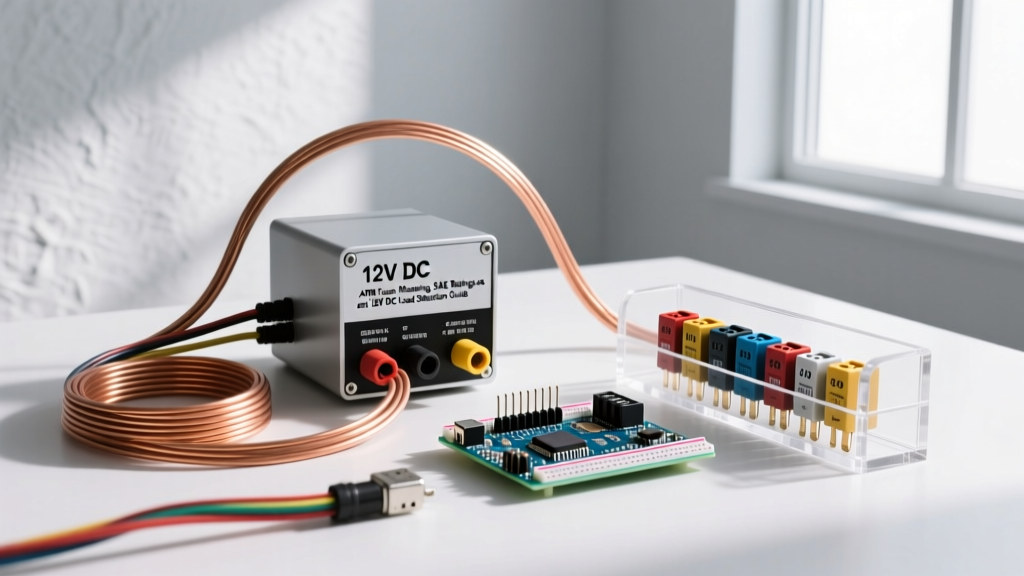

The term ATM in electrical components stands for Automotive Miniature. Often referred to colloquially as a 'Mini blade fuse,' the ATM fuse is a specific SAE J554 and ISO 8820-3 standardized overcurrent protection device designed for compact 12V and 24V DC circuits. While standard ATO/ATC fuses measure 19.1mm wide, the ATM (Mini) footprint shrinks this to just 10.9mm wide, allowing modern automotive fuse panels to double their circuit density without sacrificing safety.
If you are sizing a fuse for a DC accessory build, repairing a vehicle harness, or designing a 12V solar distribution block, you need to look past the plastic color-coding and understand the interrupting ratings, time-current curves, and physical wiring constraints of the ATM format. Below is the bench-level guide to selecting, wiring, and testing these components.
Decoding the ATM Fuse Meaning and Ratings
Beginners often confuse the terminology of electromechanical relays with fuses. While relays use 'coil' and 'contact' ratings, fuses rely on a fusible element and blade terminals. To bridge this terminology gap for those cross-referencing component datasheets, here is the ATM rating table mapped to standard electromechanical equivalents.
| Coil (Fusible Element) Voltage | Contact (Blade Terminal) Rating | Breaking Capacity | Governing Application Rule |
|---|---|---|---|
| 32V DC Maximum | 2A to 30A Continuous | 1000A @ 14V DC | Governs steady-state resistive loads and wire ampacity limits. |
| 32V DC Maximum | 2A to 30A Continuous | 500A @ 32V DC | Governs 24V nominal systems (which peak near 28.8V charging). |
| N/A (Thermal Limit) | I²t (Melting Integral) | Time-Current Curve | Governs inductive/motor loads where inrush current dictates survival. |
Which rating column governs your load? For simple resistive loads (LED lighting, heating elements), the Contact (Blade Terminal) Rating governs; you simply match the fuse to 125% of the continuous draw. However, for inductive or motor loads, the Breaking Capacity and the I²t (Melting Integral) govern. A 20A ATM fuse must survive a 100A inrush for 0.1 seconds without blowing, which is dictated by its specific time-current curve, not its static 20A stamp.
Coil (Element) vs. Contact (Terminal) Side Wiring
Technically, an ATM fuse is non-polarized; current can flow through the zinc-alloy element in either direction. However, in practical harness design, we define the 'coil side' (the internal fusible element connected to the line/battery) and the 'contact side' (the output terminal connected to the load).
Line/Load Orientation: Always wire the battery/power source to the designated 'Line' busbar side of the fuse holder, and the protected load to the 'Load' side. This ensures that when you pull the fuse, the exposed metal slots in the panel are de-energized on the load side, preventing accidental shorts to ground while servicing downstream components.
Selection Decision Path by Load Type
Selecting the right ATM fuse requires matching the load's inrush profile to the fuse's melting curve. Standard ATM fuses are 'fast-acting' but still possess a slight thermal delay. If your application requires surviving massive inrush currents (like a winch motor), you may need to step up to an ATC (standard) or MAXI fuse with a dedicated 'Slow Blow' (time-delay) profile, as ATM fuses are rarely manufactured in true slow-blow variants above 20A.
| Load Type | Inrush Multiplier | Governing Rating Column | ATM Fuse Selection Strategy |
|---|---|---|---|
| Resistive (LEDs, Heaters) | 1.0x to 1.2x | Continuous Current Rating | Size at 125% of continuous load. (e.g., 10A load = 15A ATM fuse). |
| Inductive (Relays, Solenoids) | 5x to 10x (milliseconds) | I²t (Melting Integral) | Size at 150% of continuous load to survive the initial magnetic inrush without nuisance tripping. |
| Motor (Pumps, Fans, Winches) | 6x to 8x (Locked Rotor) | Time-Current Curve | ATM fuses are generally unsuited for high-amperage motors. Use a MAXI slow-blow fuse or a DC-rated breaker for loads >20A with high locked-rotor amps. |
Fuses vs. DC Circuit Breakers: The Curve Discussion
A common mistake in 12V DC builds is treating fuses and breakers as interchangeable. They are not. An ATM fuse clears a 1000A short circuit in milliseconds by physically vaporizing its element. A standard thermal-magnetic DC breaker relies on a magnetic trip curve that may take 20-50 milliseconds to open under the same fault. In a 12V system with thick, low-resistance battery cables, a 50ms delay can melt wire insulation before the breaker trips. Use ATM fuses for branch circuit protection where fast short-circuit clearing is mandatory; use DC breakers only for main disconnects or where manual reset capability outweighs the need for ultra-fast fault clearing.
Testing and Replacement: Dead, Live, and Field Rules
Diagnosing a blown ATM fuse requires a multimeter and an understanding of the fuse's physical test points. Modern ATM fuses feature two exposed metal pads on the top of the plastic housing, specifically designed for live-circuit troubleshooting without pulling the fuse.
How to Test It Dead (Continuity)
- Remove the ATM fuse from the panel.
- Set your digital multimeter to Continuity mode (or Ohms, lowest range).
- Place probes on the two metal blade terminals.
- Result: A reading of < 1.0 ohm (or an audible beep) indicates a good fuse. An 'OL' (Open Loop) reading means the internal element has melted.
How to Test It Live (Voltage Drop)
- Leave the fuse seated in the energized panel.
- Set your multimeter to DC Volts (20V or Auto range).
- Connect the black probe to a known good chassis ground.
- Touch the red probe to the exposed test points on the top of the ATM fuse.
- Result: If you read system voltage (12V-14.4V) on both test points, the fuse is intact and passing current. If you read system voltage on the line-side point but 0V on the load-side point, the fuse is blown. If you read 0V on both points, the fuse is fine, but you have an upstream power loss (e.g., a blown main fuse or open relay).
When to Repair vs. Replace
Frequently Asked Questions
What is the exact ATM fuse meaning compared to ATO and ATC?
ATM stands for Automotive Miniature. It is the SAE designation for the 'Mini' blade fuse (10.9mm wide). ATO and ATC both refer to the 'Standard' blade fuse (19.1mm wide). 'ATO' is the original open-element design, while 'ATC' (Automotive Compact) features a sealed plastic housing that protects the internal element from moisture and corrosion. In modern practice, ATC and ATO are used interchangeably for standard fuses, but ATM strictly refers to the Mini footprint.
Can I use a standard ATO fuse in an ATM mini slot?
No. The physical blade spacing and width are entirely different. An ATM (Mini) fuse has a blade pitch of 8.1mm, while a standard ATO/ATC fuse has a pitch of 15.9mm. Forcing a standard fuse into a mini slot will destroy the terminal contacts. If you need to adapt a circuit, you must use a dedicated ATM-to-ATC inline fuse holder adapter harness, not raw force.
Why did my 15A ATM fuse blow when my load only draws 12A?
Continuous current is only one part of the equation. If your 12A load is a DC motor or a compressor, its locked-rotor inrush current might spike to 60A for half a second upon startup. A standard 15A fast-acting ATM fuse will interpret this 60A spike as a fault and blow to protect the circuit. To fix this, you must either calculate the I²t melting integral to find a fuse that survives the inrush, or upgrade to a larger wire gauge and install a 20A or 25A ATM fuse, provided the wiring ampacity supports the increase.
Are ATM fuses and circuit breakers interchangeable in 12V DC systems?
They are not directly interchangeable without analyzing the fault-clearing curve. An ATM fuse has an interrupting rating (breaking capacity) of 1000A at 14V DC, meaning it can safely vaporize and extinguish a massive dead-short arc. Many cheap, automotive-style DC thermal breakers only have a breaking capacity of 50A to 100A. If a 500A short occurs, a low-grade breaker may weld its internal contacts shut and catch fire. Use ATM fuses for branch wiring protection, and reserve breakers for main battery disconnects where manual resetting is required.


