
For 90% of continuous-duty workshop, conveyor, and pump applications, the 3-phase TEFC (Totally Enclosed Fan Cooled) squirrel cage asynchronous motor is the undisputed default pick. It offers the highest reliability, the flattest torque curve, and the simplest integration with variable frequency drives (VFDs). However, when you are limited to single-phase residential power or dealing with extreme breakaway torque requirements, you must look at other asynchronous motor types. This guide cuts through the theory and gives you the exact decision matrix, wiring rules, and failure diagnostics you need to spec the right motor and drive for your load.
The Asynchronous Motor Decision Matrix
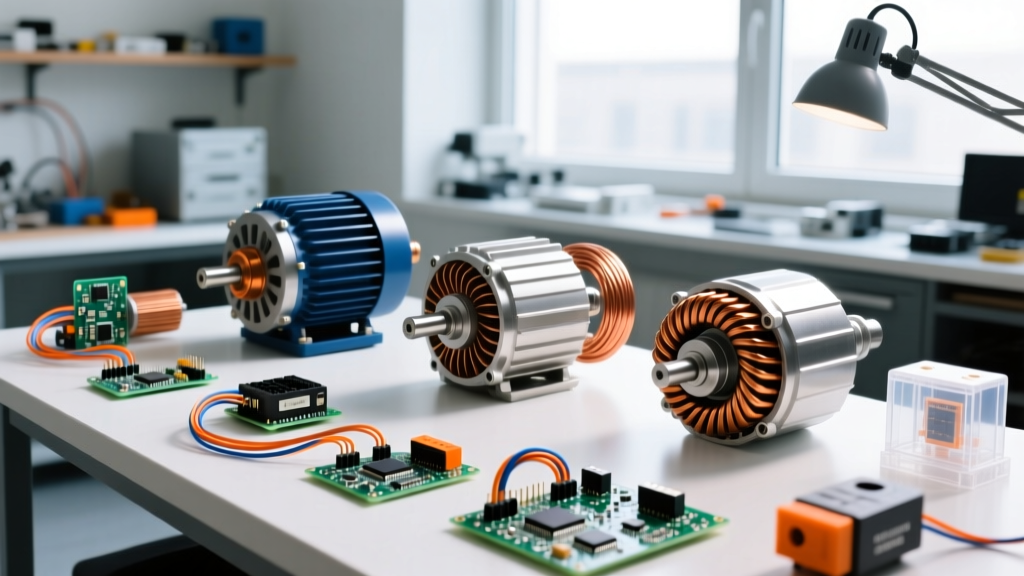
Asynchronous motors (induction motors) rely on slip—the difference between the rotating magnetic field speed and the rotor speed—to induce current in the rotor. The way they generate their starting torque and handle continuous loads varies wildly by construction. Here is how the primary types stack up against each other.
| Asynchronous Motor Type | Starting Torque Profile | Control / Drive Needs | Typical Cost (1.5 HP eq.) | Best Load Profile |
|---|---|---|---|---|
| Shaded Pole | Very Low (< 10% FLT) | Direct On Line (DOL) only; no speed control | $30 - $50 | Small cooling fans, blowers, low-inertia loads |
| Split-Phase / Capacitor-Start (CSIR) | High (200% - 300% FLT) | DOL, mechanical reversing switch; hard to VFD | $150 - $250 | Reciprocating compressors, deep well pumps (single-phase power) |
| 3-Phase Squirrel Cage (TEFC) | Medium-High (150% - 200% FLT) | DOL, Soft Starter, or VFD for full speed control | $250 - $400 | Conveyors, machine tools, continuous-duty industrial loads |
| Wound Rotor (Slip Ring) | Maximum with low inrush current | Rotor resistance bank; complex contactor sequencing | $800+ | Heavy cranes, ball mills, high-inertia soft-start applications |
Sizing Rule of Thumb and Worked Load Example
The most common mistake makers and DIYers make is sizing a motor purely on continuous horsepower (HP) or kilowatt (kW) ratings without accounting for breakaway torque. A motor might easily run a load once spinning, but stall completely when trying to start it.
Worked Example: 1.5 HP Reciprocating Air Compressor
Let’s say you are building a 1.5 HP (1.1 kW) air compressor. The continuous running torque is relatively low, but if the motor attempts to start while the tank already holds 90 PSI of head pressure, the breakaway torque spikes to roughly 180% of the motor's full-load torque (FLT).
- A standard NEMA Design B 1.5 HP motor provides about 150% starting torque. It will trip its breaker or stall if it tries to start against head pressure.
- To solve this, you either spec a NEMA Design C motor (which provides 200%+ starting torque specifically for high-breakaway loads) or you oversize the frame to a 2.0 HP NEMA Design B motor to clear the breakaway hump.
For deeper context on motor design letters and torque curves, the All About Circuits AC Motors chapter provides excellent baseline theory on how rotor bar shape dictates these NEMA design classes.
Wiring and Terminal Identification by Motor Type
Miswiring an asynchronous motor will instantly fry the start winding or cause a dead short. Terminal naming conventions differ based on whether you are working with single-phase or three-phase power, and whether the motor follows NEMA (US) or IEC (International) standards.
Single-Phase Capacitor-Start (NEMA Standard)
Standard 1-phase motors usually have leads labeled 1 through 8. The golden rule for 115V/230V dual-voltage 1-phase motors:
- For 230V Operation: Connect Line 1 to Lead 1. Connect Line 2 to Leads 4, 5, and 8. Connect Leads 2 and 3 together and tape them off.
- For 115V Operation: Connect Line 1 to Leads 1, 3, and 8. Connect Line 2 to Leads 2, 4, and 5.
- Never apply line voltage directly to the start winding leads (usually 5 and 8) without the start capacitor and centrifugal switch in the circuit.
Three-Phase Squirrel Cage (IEC Standard)
IEC 3-phase motors use a 6-terminal block labeled U1, V1, W1 (start of windings) and U2, V2, W2 (end of windings).
- Delta (Low Voltage, e.g., 230V): Link U1-W2, V1-U2, and W1-V2 horizontally with copper jumpers. Apply 3-phase power to the top row.
- Star / Wye (High Voltage, e.g., 460V): Link U2, V2, and W2 together vertically. Apply 3-phase power to U1, V1, W1.
Drive and Controller Demands (DOL vs. VFD)
The controller you pair with your asynchronous motor dictates its inrush current, speed flexibility, and lifespan. The US DOE AMO Sourcebook heavily emphasizes matching the drive to the load profile to avoid massive efficiency penalties.
| Controller Type | How It Works | When to Use It | Motor Requirement |
|---|---|---|---|
| DOL (Direct On Line) | Applies full line voltage instantly via a contactor. | Fixed speed, low-inertia loads where 600% inrush current won't cause voltage sag. | Standard NEMA/IEC induction motor. |
| Soft Starter | Thyristors ramp up voltage over 2-10 seconds to limit mechanical shock. | High-inertia loads (large fans, long conveyors) where speed control isn't needed. | Standard 3-phase motor. |
| VFD (Variable Frequency Drive) | Rectifies AC to DC, then PWM-switches it back to AC at variable frequency/voltage. | Applications requiring precise speed control, energy savings on pump/fan loads. | Inverter-Duty Motor (NEMA MG 1 Part 31) with upgraded winding insulation to survive dv/dt voltage spikes. |
Failure Signatures: Hum, Overheat, and Stall
Asynchronous motors rarely fail without warning. By reading the physical and electrical signatures, you can diagnose the root cause before the windings melt.
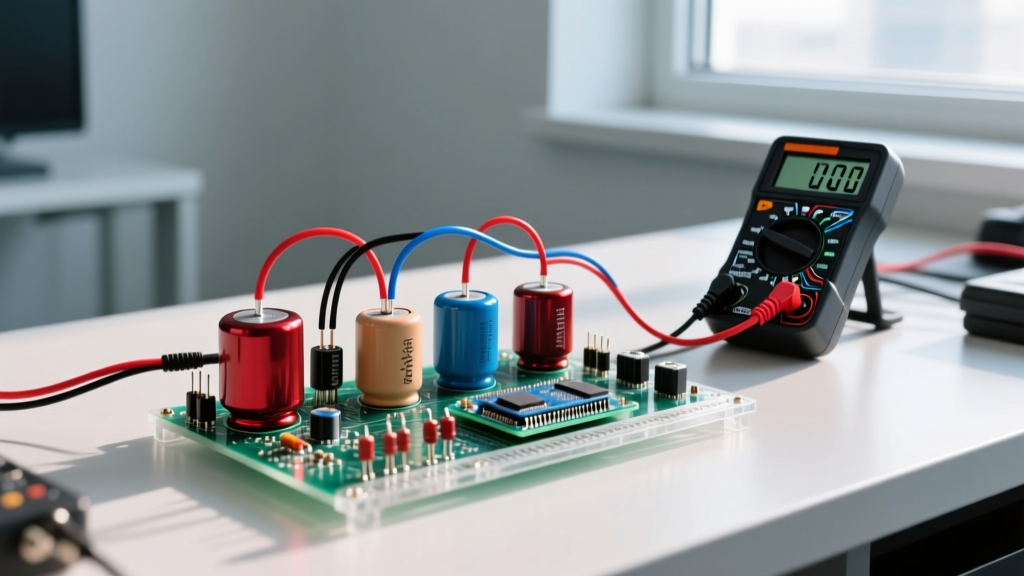
- The "Hum and Click" (Single-Phasing or Bad Cap): If a 3-phase motor hums loudly, doesn't spin, and trips the breaker, you have single-phasing (one leg of the 3-phase supply is dead). Put a True-RMS multimeter across L1-L2, L2-L3, and L1-L3 at the contactor output. If one pair reads 0V, check your fuses. On a 1-phase motor, this exact symptom means the start capacitor has failed open, or the centrifugal switch is stuck.
- Overheat at 80% Load: If the motor's thermal overload trips while the ammeter shows current below the FLA nameplate rating, check the cooling. TEFC motors rely on an external shaft-mounted fan. If you are running a standard TEFC motor at 50% speed via a VFD, the fan is also spinning at 50%, moving insufficient air. You must either add an externally powered blower or upgrade to a vector-duty motor with independent cooling.
- Stall Under Load: If the motor runs fine unloaded but bogs down and stalls when the mechanical load is applied, measure the voltage at the motor terminals while it is running. If your 230V supply drops to 205V under load, your feeder wire is undersized, causing severe voltage drop. Asynchronous motor torque drops with the square of the voltage; a 10% voltage drop results in a 19% loss of available torque.
The Final Decision Path
Stop guessing and use this decision tree to lock in your exact hardware spec.
| IF your load profile is... | AND your available power is... | THEN choose this Motor & Drive combo: |
|---|---|---|
| < 1/4 HP, constant speed, very low starting torque (e.g., small exhaust fan) | 120V Single-Phase | Shaded Pole Motor wired DOL via a simple toggle switch. |
| 1/4 HP to 3 HP, high breakaway torque (e.g., air compressor, well pump) | 240V Single-Phase | Capacitor-Start (CSIR) Motor (e.g., Leeson C145T frame) wired DOL with a magnetic contactor. |
| > 1 HP, continuous duty, variable speed required (e.g., milling machine, conveyor) | 208-230V Three-Phase | 3-Phase TEFC Inverter-Duty Squirrel Cage driven by a VFD. |
| Extreme high-inertia start, restricted grid capacity (e.g., large rock crusher) | 460V Three-Phase | Wound Rotor Motor with a liquid rheostat or stepped resistor bank. |
The Default Concrete Pick for 90% of Makers
If you have 3-phase power (or a rotary phase converter) and need a reliable, variable-speed workhorse for a lathe, conveyor, or heavy pump, do not overcomplicate it. Spec the Baldor-Reliance CEM3615T (1.5 HP, 3-Phase, 1750 RPM, TEFC, Inverter-Duty). It features a 200:1 constant torque turndown ratio and Class F insulation. Pair it with a Hitachi WJ200-015SF VFD. This combination gives you smooth speed control from 10 RPM to 1800 RPM, built-in dynamic braking, and a motor that will easily outlast the machine it is bolted to.