
Yes, standard residential wired doorbells are low voltage, typically operating between 16 and 24 volts AC, which is stepped down from your home's 120V mains by a dedicated transformer. This classification fundamentally changes how the circuit is installed: it allows the use of thin, inexpensive 18 to 20 AWG unshielded bell wire routed through walls without metal conduit, and it eliminates the lethal shock hazard at the button and chime. However, DIYers commonly confuse the safe, low-voltage secondary side of the circuit with the dangerous 120V primary side hidden inside the transformer's junction box, or mistakenly assume the system runs on DC because most modern electronics do.
The Anatomy of a Class 2 Low-Voltage Circuit
Under the National Electrical Code (NEC Article 725), doorbell circuits are classified as Class 2 circuits. This designation means the power source is inherently limited in both voltage and current, ensuring that even if the low-voltage wires short out inside your wall, they will not generate enough heat to start a fire. According to EC&M's breakdown of NEC circuit classes, this inherent power limitation is what allows bell wire to be run without the strict derating and conduit rules applied to standard branch circuits.
A complete wired doorbell circuit consists of three main components:
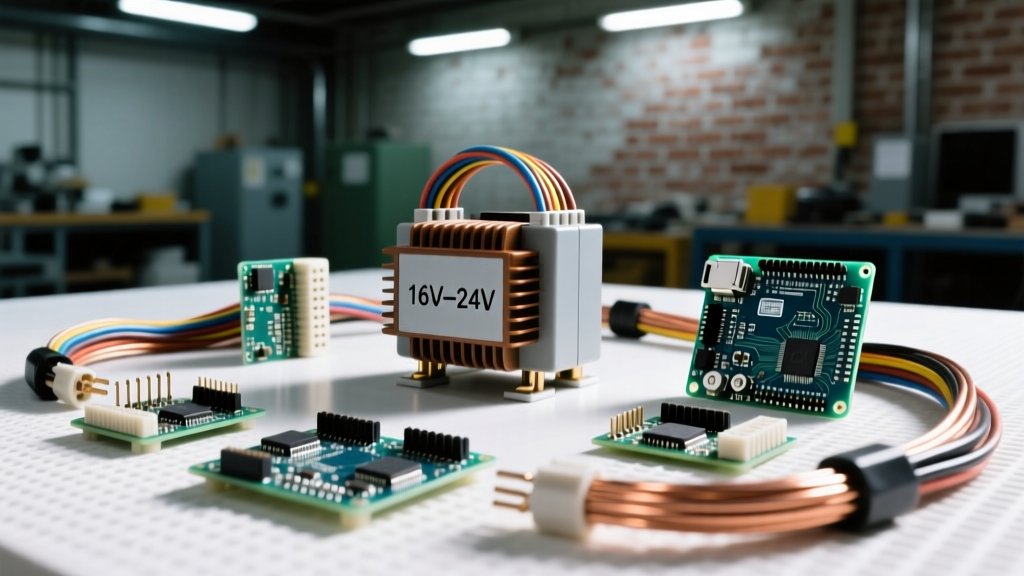
- The Transformer: Mounted to a 120V junction box (often in the attic, basement, or near the main panel), it steps down line voltage to 16V–24V AC and limits the maximum current output.
- The Button (Switch): A normally-open, momentary switch located at the exterior door.
- The Chime (Load): Located inside the home, this is either a mechanical electromagnet that strikes a physical tone bar or a digital speaker board.
Worked Example: Sizing a Transformer for a Smart Doorbell Upgrade
The most common reason homeowners investigate doorbell voltage today is to upgrade from a legacy mechanical chime to a smart video doorbell (like a Ring Pro or Nest Wired). Smart doorbells require significantly more continuous power than a mechanical chime, which only draws current for the two seconds you hold the button down.
The Scenario: You have an existing 16V, 10VA transformer powering a mechanical chime. You want to install a Ring Video Doorbell Pro, which requires 16-24V AC and a minimum of 30VA to operate its Wi-Fi radio and video processing without rebooting.
The Math:
VA (Volt-Amps) is the apparent power the transformer can safely deliver. The formula is VA = Volts × Amps.
If your smart doorbell draws a continuous 1.2 Amps at 16 Volts to power its night vision and Wi-Fi, the power demand is:
16V × 1.2A = 19.2 VA.
If you leave the old 10VA transformer in place, the doorbell will attempt to pull 19.2VA from a source rated for only 10VA. According to Ring's official transformer specifications, this overload causes the transformer's internal thermal fuse to trip, or the voltage to sag below 16V under load, resulting in a doorbell that constantly drops off Wi-Fi or fails to ring the internal chime.
The Fix: You must upgrade the transformer at the junction box to a 16V, 30VA unit. This provides 30VA of headroom, ensuring the voltage remains stable at 16V even during peak current draws (like when the IR night vision LEDs turn on).
Where You Meet Low Voltage in Practice
Understanding that doorbells are low voltage dictates your material choices and troubleshooting steps on the jobsite or at the workbench.
| Component / Metric | Standard Specification | Practical Application & Edge Cases |
|---|---|---|
| Wire Gauge | 18 AWG to 20 AWG solid copper | 18 AWG is preferred for runs over 50 feet to minimize voltage drop. Never use stranded speaker wire for in-wall runs; it lacks the proper CL2 fire-rating jacket. |
| Transformer Output | 16V AC or 24V AC | Multimeters will often read 18V-20V on a 16V transformer when the circuit is open (unloaded). This is normal transformer regulation behavior. |
| Chime Compatibility | Electromechanical vs. Digital | Mechanical chimes require AC to function. Digital chimes often have internal rectifiers and can tolerate DC, but should still be fed AC from the transformer. |
| Pro-Tech Module | 25 Ohm / 10 Watt resistor | Required when installing a smart doorbell with a mechanical chime to prevent the chime from humming and to complete the circuit for the camera's trickle charge. |
When troubleshooting a dead doorbell, set your multimeter to AC Voltage (V~). Place the probes on the two screw terminals of the transformer. If you read 0V, the transformer is dead or the primary breaker is tripped. If you read ~16V-24V at the transformer but 0V at the button, you have a broken 18 AWG wire inside the wall or a corroded button contact.
Common Confusions: AC vs. DC and Primary vs. Secondary
Confusion 1: 'Low voltage means DC.'
Because batteries and USB adapters output DC, many assume doorbells run on Direct Current. Traditional doorbells are strictly AC (Alternating Current). The mechanical chime relies on the 60Hz alternating cycle of the AC waveform to rapidly energize and de-energize an electromagnet, causing the striker to vibrate against the tone bar. If you feed a mechanical chime DC, the electromagnet will lock the striker in the 'pulled' position, resulting in a single dull 'clack' followed by a continuous hum that will eventually burn out the coil.
Confusion 2: 'The whole circuit is safe to work on.'
People confuse the secondary side (the 18 AWG wires going to the door) with the primary side (the 120V wires entering the transformer). The transformer is a dual-voltage boundary device. The primary side requires standard NEC line-voltage wiring practices: 14 AWG or 12 AWG NM-B (Romex) cable, proper wire nuts, and a grounded metal or plastic junction box. As detailed in All About Circuits' transformer theory guide, the magnetic induction crossing the transformer's core provides galvanic isolation, but the physical terminals on the primary side remain lethal.
Frequently Asked Questions
Can I touch low voltage doorbell wires without getting shocked?
Yes, under normal conditions, touching the bare 18 AWG wires at the doorbell button or the chime will not shock you. The 16-24V AC output is well below the ~50V threshold required to push current through human skin resistance. However, if the transformer has failed internally and lost its galvanic isolation, 120V mains could theoretically leak to the secondary side. Always verify the circuit is dead with a multimeter before handling exposed wires if you suspect a fault.
Why do smart video doorbells require a higher VA transformer?
A mechanical chime only draws power for the 1-2 seconds the button is pressed. A smart video doorbell (like a Ring, Nest, or Wyze) requires a continuous trickle of current 24/7 to power its Wi-Fi radio, logic board, and standby video processing. A legacy 10VA transformer cannot sustain this continuous load without overheating or experiencing severe voltage sag, which causes the smart doorbell to drop offline or fail to record motion events.
Is doorbell wire AC or DC?
The power delivered through standard doorbell wire from the transformer is AC (Alternating Current), typically at 60Hz in North America. While the smart video doorbell itself contains internal bridge rectifiers and voltage regulators to convert this AC into the low-voltage DC required by its microchips and camera sensors, the wiring in your walls carries AC. You must set your multimeter to AC Voltage (V~) to accurately measure the circuit.
What happens if I connect a 24V transformer to a 16V mechanical chime?
If you upgrade to a 24V transformer to support a smart doorbell but leave your legacy 16V mechanical chime in the circuit, the chime will receive 50% more voltage than it was designed for. This will cause the electromagnet to strike the tone bar with excessive force (often resulting in a loud, distorted buzzing rather than a clean chime) and will rapidly overheat the chime's internal coil, eventually melting the insulation and destroying the unit. You must either replace the mechanical chime with a 24V-compatible digital chime or install a smart doorbell 'pro power kit' that regulates the voltage reaching the chime.


