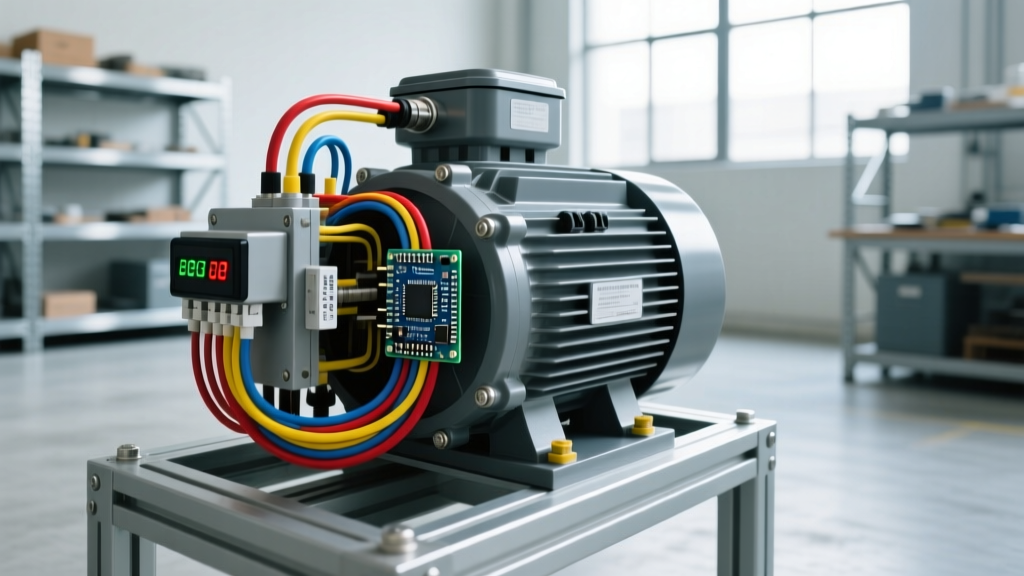

The Core Application of 3 Phase Induction Motor Systems
The primary application of a 3 phase induction motor (specifically the squirrel-cage variant) is continuous, high-inertia rotational work where precise position feedback is unnecessary. If your load requires moving air, water, or bulk materials on a conveyor at a steady state, the induction motor is the undisputed baseline. Unlike brushed DC motors, it has no commutator to arc and wear; unlike synchronous motors, it requires no complex rotor excitation.
The fundamental principle relies on slip. The stator's rotating magnetic field spins at synchronous speed (e.g., 1800 RPM for a 4-pole motor on 60Hz). The rotor chases this field but never quite catches it, typically lagging by 1% to 3% at full load. This slip is what induces the current in the rotor bars, creating the torque. When you evaluate the application of a 3 phase induction motor for a new build or retrofit, your default pick for anything above 5 HP should be a NEMA Premium Efficiency (IE3) cast-iron frame, such as the WEG W22 series, paired with a Variable Frequency Drive (VFD) to manage inrush current and optimize part-load efficiency.
Motor Type Comparison Matrix
Before committing to an induction platform, verify that your load profile actually demands it. Misapplying a motor type is the most common cause of premature drive failure. Note that stepper and servo motors serve entirely different kinematic purposes and are not interchangeable in high-inertia continuous applications.
| Motor Type | Torque Curve Profile | Control Complexity | Cost per HP | Ideal Load Profile |
|---|---|---|---|---|
| 3-Phase Induction (Squirrel Cage) | High starting torque, drops to breakdown torque, linear operating region near sync speed. | Low (Direct-on-line) to Medium (V/Hz VFD). | $80 - $150 | Pumps, fans, compressors, conveyors, crushers. |
| PMSM (Synchronous) | Constant torque up to base speed, zero slip at steady state. | High (Requires FOC/Vector drive and encoder/resolver). | $250 - $400 | High-efficiency HVAC, traction drives, precision extruders. |
| AC Servo | Peak torque up to 300% for short bursts, extremely high dynamic response. | Very High (Closed-loop position/velocity/torque control). | $500 - $1000+ | CNC spindles, robotic arms, pick-and-place indexing. |
| Stepper | High holding torque, drops off rapidly at speed, prone to resonance. | Medium (Open-loop pulse/direction, microstepping). | $100 - $250 | Low-speed 3D printer axes, small valve actuators. |
Sizing Rules and Worked Centrifugal Pump Example
The golden rule for sizing an induction motor is to never size exactly to the continuous running load. You must account for the NEMA Service Factor (SF), ambient temperature derating, and the starting torque required to overcome static friction. According to the Department of Energy's Premium Efficiency Motor Selection Guide, continuous operation at 100% nameplate load drastically reduces insulation life due to thermal saturation.
Always size your motor so that the continuous running load falls between 75% and 85% of the motor's nameplate Full Load Amps (FLA). This keeps the motor in its peak efficiency band and leaves thermal headroom.
Worked Example: Sizing for a Cooling Tower Pump
The Load: A centrifugal cooling water pump requires 8.5 kW of mechanical shaft power at its maximum operating point (1750 RPM). The pump operates 24/7 in a 40°C ambient environment.
- Convert with Context: 8.5 kW × 1.341 hp/kW = 11.4 HP. (We do not just blindly convert; we recognize this is the steady-state hydraulic load, ignoring starting inertia).
- Apply Ambient Derating: Standard NEMA motors are rated for 40°C ambient. Since our environment is exactly 40°C, no additional derating is required, but we cannot rely on the 1.0 SF margin.
- Select Standard Frame: The next standard NEMA size up is 15 HP.
- Verify Service Factor: A standard 15 HP TEFC (Totally Enclosed Fan Cooled) motor carries a 1.15 SF. This means it can safely deliver 15 × 1.15 = 17.25 HP continuously without degrading the Class F insulation.
- Check Operating Point: Our 11.4 HP load represents 76% of the 15 HP nameplate rating. This is perfectly centered in the peak efficiency zone of the motor's torque curve.
The Pick: 15 HP, 4-Pole, 1800 RPM (nominal), NEMA 254T Frame. Example part: Baldor-Reliance EM4406T or WEG W22 IE3 15HP.
Terminal Wiring Identification and VFD Pairing
When wiring the application of a 3 phase induction motor, you will encounter either NEMA (T1, T2, T3) or IEC (U1, V1, W1) terminal designations. For standard across-the-line starting, you connect your three phase lines directly to T1/T2/T3. However, for motors 10 HP and above, direct-on-line (DOL) starting causes massive voltage dips and mechanical shock. This demands a VFD.
Wye vs. Delta Configurations
Many 9-lead dual-voltage motors (e.g., 230V/460V) require internal jumpering in the peckerhead.
- High Voltage (460V): Wired in Wye (Star). The phase voltage is reduced by the square root of 3, lowering the starting current.
- Low Voltage (230V): Wired in Delta. Full phase voltage is applied to each winding for higher starting torque.
VFD Controller Pairing
For general industrial applications, pair your NEMA Premium motor with a drive like the ABB ACS580 or Yaskawa GA800. These drives handle the V/Hz scalar control natively. Critical Hardware Addition: When running an induction motor on a VFD, the high-frequency PWM switching creates common-mode voltage that capacitively couples to the rotor. This voltage discharges through the motor bearings, causing electrical fluting (micro-pitting). You must install an Aegis Shaft Grounding Ring on the drive end of the motor to bleed this voltage safely to ground. Expect to add $80-$120 to your BOM for this ring; it will save you a $600 bearing replacement in year two.
Failure Signatures: Diagnosing Hum, Overheat, and Stall
Induction motors rarely fail without warning. Recognizing the acoustic and thermal signatures of impending failure allows you to intervene before a catastrophic burnout. The NEMA MG-1 standard outlines thermal limits, but real-world diagnostics rely on sensory feedback.
| Symptom | Root Cause | Diagnostic Measurement | Corrective Action |
|---|---|---|---|
| Loud 120Hz Hum + Rapid Overheat | Single-Phasing. One phase of the supply is lost (blown fuse, loose contactor pole). | Measure line-to-line voltage at the peckerhead. One leg will read 0V or severely depressed. | Replace blown fuse, torque contactor lugs to spec, check VFD output transistors. |
| High-Frequency Squeal + Vibration | Bearing Fluting. VFD common-mode voltage is arcing through the bearing grease. | Use an accelerometer or stethoscope on the bearing housing. Look for distinct high-freq spikes. | Install Aegis shaft grounding ring; replace damaged bearings with insulated (hybrid ceramic) variants. |
| Motor Stalls Under Load + High Slip | Broken Rotor Bars. The squirrel cage is cracked, reducing rotor torque production. | Perform Motor Current Signature Analysis (MCSA). Look for sideband frequencies at exactly 2x slip frequency around the line fundamental. | Motor must be rewound or replaced. Rotor bar repair is rarely economical for frames under 449T. |
| Case Temp > 90°C (No Overload) | Harmonic Heating or Blocked Cooling. VFD output distortion or clogged TEFC fan cowling. | Check THD (Total Harmonic Distortion) with a power analyzer. Inspect fan shroud for debris. | Add a 3% or 5% dV/dt line reactor on the VFD output; clean the cooling fins. |
The Decision Tree: Picking Your Exact Motor and Drive
Stop debating edge cases. Use this decision matrix to lock in your hardware for the application of a 3 phase induction motor system. Follow the logic path down to your final BOM.
Hardware Selection Decision Path
- IF the load requires continuous rotation, high starting torque, and operates >4 hours/day AND precise positional indexing is NOT required:
→ PICK: 3-Phase Squirrel Cage Induction Motor (NEMA Premium IE3). - IF the motor is >5 HP and connected to a variable load (pump/fan) or requires soft starting to prevent mechanical shock:
→ PICK: V/Hz Scalar VFD (ABB ACS580 or Yaskawa GA800). - IF the motor is <5 HP and runs at a fixed speed across-the-line:
→ PICK: NEMA-rated magnetic contactor with bimetallic overload relay (e.g., Eaton XTCE series). - IF the application demands high-speed indexing, exact angular positioning, or rapid acceleration/deceleration:
→ ABORT INDUCTION. Switch to an AC Servo system (e.g., Yaskawa Sigma-7).
The Default Recommendation
For 90% of general industrial and heavy commercial applications, the hardware stack is standardized for a reason: it is robust, easily replaceable, and cost-effective. If your load profile points to an induction motor, specify the WEG W22 IE3 Cast Iron series for the motor, paired with an ABB ACS580-01 VFD sized to the motor's FLA. Add an Aegis SGR grounding ring to the drive-end shaft, use 3M 2228 mastic tape on your VFD cable terminations to prevent corona discharge, and you will have a drive system that runs for a decade without a second thought.


