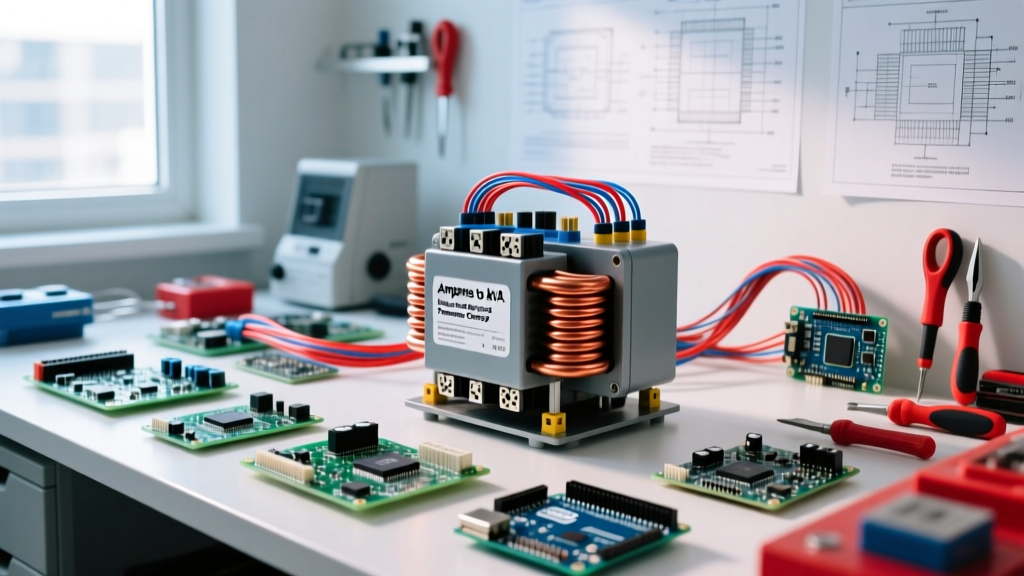

Amperes measure the physical flow of electrical current through a conductor, while kVA (kilovolt-amperes) measures the apparent power capacity of an AC system by multiplying voltage and current without factoring in the power factor. When you are sizing branch circuit breakers and wire gauges, you look strictly at amperes to prevent thermal melting and satisfy NEC ampacity tables. But when you size upstream equipment like transformers, generators, or UPS inverters, you must calculate kVA. This is because magnetic cores and semiconductor switches are limited by total volt-amperes, regardless of whether that power is doing useful work or just sloshing back and forth as reactive energy.
The Core Difference: What Changes in a Real Installation?
The most common mistake DIYers and junior technicians make is adding up the nameplate amperes of every device in a shop and using that total to buy a transformer or generator. This fails because amperes only tell you the current at a specific voltage, while kVA normalizes the capacity of the source equipment.
What people commonly confuse is kW (real power) with kVA (apparent power). A 10 kW heater and a 10 HP motor might both draw roughly the same amperes on a 240V line, but the motor requires a much larger kVA-rated transformer due to its inductive reactance and poor power factor. If you size your upstream supply based purely on real power (kW) or running amperes, your equipment will brown out or trip under load.
The Math: Converting Amperes to kVA (With Real Numbers)
To convert amperes to kVA, you need to know the system voltage and whether it is single-phase or three-phase. The formulas ignore power factor because kVA is a measure of apparent power, not real power.
Single-Phase Formula
kVA = (Voltage × Amperes) / 1000
Three-Phase Formula
kVA = (Voltage × Amperes × √3) / 1000
You are installing a 480V, 3-phase AC motor that draws a measured 45A under full load.
Calculation: (480V × 45A × 1.732) / 1000 = 37.41 kVA.
Even if the motor's power factor is 0.85 (meaning it only does about 31.8 kW of real mechanical work), the upstream transformer must still be sized to supply the full 37.41 kVA to handle the magnetic fields and heat generated by the total current flow.
For a deeper look at how power factor bridges the gap between these units, reference the Fluke guide on power factor and harmonics, or the All About Circuits breakdown of apparent power.
Where You Meet This in Practice
You will encounter the amperes-to-kVA translation requirement in three primary areas of electrical work:
- Dry-Type Transformers: Transformer nameplates are strictly rated in kVA (e.g., 15 kVA, 45 kVA, 112.5 kVA). A 15 kVA transformer with a 240V secondary can safely supply a maximum of 62.5 continuous amperes (15,000 / 240). If you exceed this, the copper windings overheat and the insulation degrades.
- UPS Systems and Inverters: IT server racks and medical imaging gear often specify loads in watts (kW), but the UPS internal IGBTs and batteries are limited by total amperes and voltage (kVA). A 10 kVA UPS might only deliver 8 kW if the connected servers have a power factor of 0.8.
- Welders and Induction Heaters: These are highly reactive loads. A MIG welder might draw 50A at 240V (12 kVA), but because the power factor can drop to 0.5 during the arc, it only consumes 6 kW of real power. Your generator must be sized for the 12 kVA, not the 6 kW.
Numbered Steps: Sizing an Upstream Transformer from Amperes
- Audit the Loads: List every device on the secondary side. Note the voltage, running amperes, and phase (1P or 3P) for each.
- Convert to kVA: Apply the single-phase or three-phase formula to each individual load.
- Sum the Apparent Power: Add the kVA values together. Do not add amperes directly if the voltages or phases differ.
- Apply the 125% Rule: Multiply the total continuous kVA by 1.25 to satisfy NEC transformer derating requirements.
- Select the Standard Size: Round up to the next standard ANSI transformer size (e.g., 15, 30, 45, 75, 112.5 kVA).
Real-World Scenario: The Workshop Transformer Saturation
To understand why confusing amperes and kVA leads to catastrophic failures, let us look at a real-world bench and jobsite scenario.
The Setup: A small fabrication shop installs a new 15 kVA, 240V single-phase isolation transformer to feed a 5 HP air compressor and a CNC plasma router. The shop owner looks at the nameplates: the compressor draws 28A running, and the CNC draws 20A running. Total running current is 48A. Since the 15 kVA transformer can supply 62.5A (15,000 VA / 240V), the owner assumes the setup is perfectly safe.
The Numbers: Running kVA for the compressor is 6.72 kVA (240 × 28). Running kVA for the CNC is 4.8 kVA (240 × 20). Total running load is 11.52 kVA, well under the 15 kVA limit.
The Outcome: The system runs fine while the compressor is idle. But the moment the CNC is cutting metal and the compressor's pressure switch clicks on, the CNC's VFD faults on 'DC Bus Undervoltage', the compressor breaker violently trips, and the transformer emits a loud, angry hum.
What Went Wrong: The owner sized the transformer for running amperes, completely ignoring starting kVA. The 5 HP compressor motor has a Locked Rotor Amperage (LRA) of 140A. When the motor starts, it momentarily draws 140A. The instantaneous kVA demand spikes to 33.6 kVA (240V × 140A). The 15 kVA transformer's magnetic core instantly saturates because it cannot physically transfer 33.6 kVA of apparent power. The internal impedance spikes, causing the secondary voltage to sag from 240V down to 160V. The CNC router's sensitive electronics see the voltage drop and shut down to protect themselves, while the massive inrush current trips the compressor's thermal breaker.
Comparison Matrix: Amperes, kW, and kVA
Think of it like highway traffic: Amperes is the total number of vehicles passing a sensor per minute. kW is the actual cargo those vehicles are delivering to a warehouse. kVA is the total physical footprint the vehicles occupy on the road, including the empty space inside the trailers (reactive power). If you only size the highway for the cargo weight, traffic gridlocks when empty trailers show up.
| Metric | Unit | What it Measures | Used For Sizing |
|---|---|---|---|
| Amperes | Amps (A) | Physical flow of electrons (current) | Wire gauge (AWG), branch breakers, busbars |
| kW | Kilowatts | Real power doing actual work (heat, light, torque) | Prime movers, fuel consumption, utility billing |
| kVA | Kilovolt-Amperes | Apparent power (vector sum of kW and kVAR) | Transformers, UPS inverters, generators, alternators |
| kVAR | Kilovolt-Amperes Reactive | Power sloshing back and forth to maintain magnetic fields | Capacitor banks, power factor correction equipment |
FAQ: Sizing and Calculations
Can I just multiply total amperes by voltage to size my portable generator?
For purely resistive loads like space heaters or incandescent lights, yes. But if you are running power tools, air conditioners, or well pumps, multiplying running amperes by voltage will result in an undersized generator. Motors require 3 to 6 times their running kVA to start. Always size the generator's alternator for the highest starting kVA in your load profile, not the sum of the running amperes.
Why do utility companies penalize low power factor if the amperes are the same?
Because the utility has to size their transmission lines, substations, and distribution transformers based on kVA, not kW. If your factory draws 100A at a terrible 0.6 power factor, you are only doing 60% of the real work, but the utility's transformers are still heating up from the full 100A of current. They are paying to maintain the infrastructure for your 'empty trailers' (kVAR), so they install smart meters that bill you for poor power factor to recoup those infrastructure losses.
Does a higher kVA rating mean a transformer will push more amperes than my device needs?
No. A transformer's kVA rating is its capacity, not its output. Current (amperes) is pulled by the load, not pushed by the source. Plugging a 5A server rack into a massive 75 kVA transformer is perfectly safe; the rack will only draw the 1.2 kVA it requires. The only risk of oversizing a transformer is a slight decrease in efficiency at very low load percentages and higher upfront copper costs.


