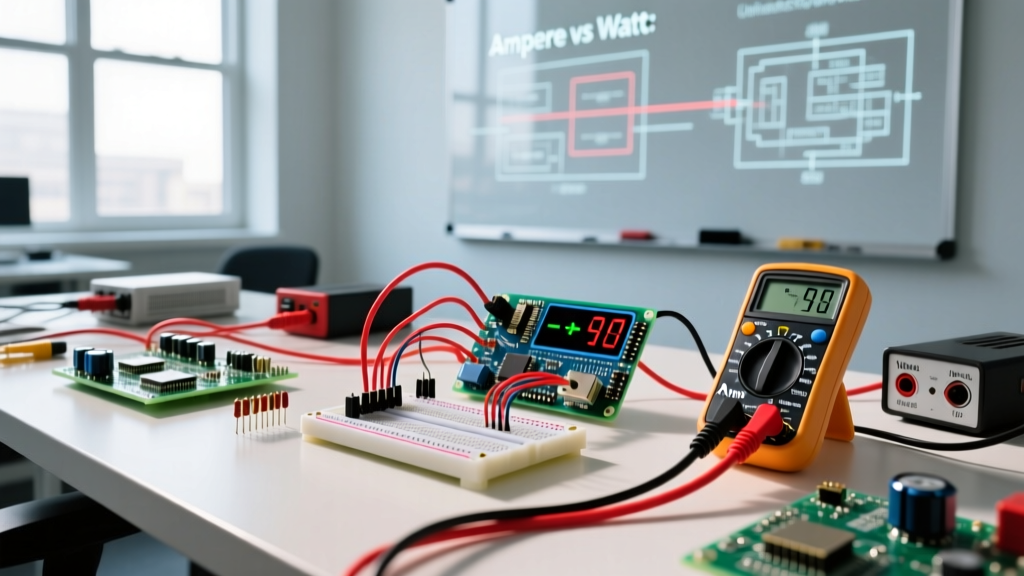

An ampere measures the physical flow rate of electrical charge through a conductor, while a watt measures the actual rate of energy transfer or work done by that current. When you are designing a circuit, sizing a solar array, or simply trying to figure out why a breaker keeps tripping, confusing these two units is the fastest way to burn up a wire or undersize a power supply. The distinction between the ampere and the watt dictates everything from the thickness of the copper in your walls to the monthly cost on your utility bill.
The Core Difference: Flow Rate vs. Work Done
To understand what each unit changes in a real installation, you have to look at what they physically govern. Amperes (Amps) dictate your thermal limits. The current flowing through a wire generates resistive heat. Therefore, amperage is the sole metric used to determine wire gauge (AWG), breaker sizing, and busbar capacity. If you push 20 amps through a 14 AWG wire, the insulation will melt, regardless of whether the system is 12V DC or 240V AC.
Watts, on the other hand, dictate your energy transfer and physical work. Wattage determines how much heat a space heater outputs, how bright a bulb shines, and how much you pay the power company. A 1500W load requires the same total energy whether it runs on 120V or 240V, but the amperage required to deliver that energy changes drastically based on the voltage.
The Water Analogy (Used Once): Think of electricity like water flowing through a pipe to turn a waterwheel. Amperes represent the volume of water flowing per minute (gallons per minute). Volts represent the water pressure pushing it. Watts represent the actual mechanical force hitting the waterwheel to do work. You can spin the wheel with a high volume of low-pressure water (high amps, low volts) or a low volume of high-pressure water (low amps, high volts), but the total work done (watts) remains the same.
For a deeper look at the physics behind Watt's Law and how power dissipation works in DC circuits, the All About Circuits textbook on electrical power provides an excellent foundational breakdown.
Real-World Load Table: Amps, Watts, and Circuit Sizing
The relationship between amperes and watts is defined by the formula Watts = Volts × Amps (for purely resistive DC or AC loads with a power factor of 1.0). Below is a reference table showing how common household loads translate between watts and amps, and how that dictates the physical hardware you must install. These values assume standard US residential split-phase power and copper conductors rated in the 60°C column of NEC Table 310.16.
| Appliance / Load | Nominal Voltage | Power Rating (Watts) | Calculated Current (Amps) | Min. Wire Size (AWG) | Standard Breaker |
|---|---|---|---|---|---|
| LED Desk Lamp | 120V AC | 15W | 0.125A | 14 AWG | 15A |
| Countertop Microwave | 120V AC | 1200W | 10.0A | 14 AWG | 15A or 20A |
| Portable Space Heater | 120V AC | 1500W | 12.5A | 14 AWG | 15A (Maxed) / 20A |
| Level 2 EV Charger | 240V AC | 7200W | 30.0A | 10 AWG | 40A |
| Electric Range / Oven | 240V AC | 12000W | 50.0A | 6 AWG | 50A |
Note: Breaker sizing for continuous loads (those expected to run for 3 hours or more, like an EV charger) requires multiplying the calculated amperage by 1.25 per NEC 210.20(A). A 30A continuous load requires a 40A breaker.
Worked Example: Sizing a Branch Circuit for a 240V Baseboard Heater
Let’s walk through a real installation scenario to see how ampere and watt calculations dictate your material list. You are installing a hardwired 2000W, 240V electric baseboard heater in a workshop.
Step 1: Calculate the baseline amperage.
Using the formula I = P / V:
2000W / 240V = 8.33 Amps.
Step 2: Apply the continuous load rule.
A baseboard heater is a thermostatically controlled heating load that can easily run for three hours or more in a cold climate. The NEC classifies this as a continuous load. You must multiply the baseline current by 125% (1.25) to size the overcurrent protection and conductors.
8.33A × 1.25 = 10.41 Amps.
Step 3: Select the breaker and wire.
Your calculated minimum circuit ampacity is 10.41A. The next standard breaker size up is 15A. Therefore, you will install a 15A double-pole breaker. For the wire, 14 AWG copper NM-B is rated for 15A, which meets the requirement. However, many electricians prefer to pull 12 AWG for 240V heating circuits to minimize voltage drop over long workshop runs and provide a margin of safety for future upgrades.
If you had mistakenly sized the circuit based purely on the 8.33A draw without applying the continuous load multiplier, you might have undersized the breaker, leading to nuisance tripping as the thermal element inside the breaker fatigues from running constantly near its threshold.
Where You Meet This in Practice
You will run into the ampere-watt distinction constantly across three specific areas of electrical work and electronics design:
- Branch Circuit Wiring: When you look at a breaker panel, the numbers on the switch (15, 20, 30) are amperes. The panel doesn't know or care about the wattage of the devices plugged in; it only monitors the thermal stress (current) on the busbars and wires. You must convert the appliance wattage to amps to ensure you don't exceed 80% of the breaker's rating for continuous loads.
- Solar and Off-Grid Power Systems: When sizing an inverter, you look at watts (e.g., a 3000W inverter). But when sizing the DC battery cables feeding that inverter, you must calculate amps. A 3000W load on a 12V battery bank pulls a massive 250 amps, requiring 4/0 AWG welding cable. That exact same 3000W load on a 48V battery bank pulls only 62.5 amps, allowing you to use much smaller, cheaper 4 AWG wire.
- DC Power Supplies and Bench Testing: When buying a bench power supply for ESP32 or Arduino projects, a supply rated for '100W' might output 5V at 20A, or 24V at 4.1A. If your motor driver needs 12V at 10A (120W), a 100W supply will fold back and shut down, even if the voltage matches. You must verify both the wattage capacity and the specific amperage limit of the output rail.
For estimating the wattage of standard household appliances to plan your electrical loads, the U.S. Department of Energy's appliance energy use guide provides reliable baseline figures.
Common Confusions and Mistakes to Avoid
Why do people confuse breaker amps with appliance watts?
Homeowners often see a '1500W' space heater and a '15A' breaker and assume they are completely different scales that don't interact. The danger arises when they plug a second 1500W appliance (like a hair dryer) into the same 15A circuit. 1500W + 1500W = 3000W. At 120V, 3000W draws 25 Amps. The 15A breaker will trip instantly to prevent the 14 AWG wire from catching fire. Always convert watts to amps before adding loads to a single branch circuit.
What is the difference between Watt-hours (Wh) and Amp-hours (Ah) in batteries?
This is the most common mistake in DIY solar and portable power. Amp-hours (Ah) only tell you the charge capacity, but they hide the voltage. A 12V 100Ah lead-acid battery holds 1200Wh of energy. A 3.7V 100Ah lithium pouch cell holds only 370Wh of energy, even though both are rated at '100Ah'. When comparing battery banks or sizing a BMS, always convert to Watt-hours to compare true energy capacity, and use Amp-hours strictly to size the physical wires and fuses connecting the cells.
Does power factor change the ampere-watt relationship?
Yes, heavily. In AC circuits with inductive loads (like AC motors, compressors, or fluorescent ballasts), the current and voltage waveforms fall out of phase. The formula becomes Watts = Volts × Amps × Power Factor. A 1200W motor with a poor power factor of 0.7 might draw 14.2 Amps instead of the 10 Amps you'd expect from a purely resistive heater. This is why motor nameplates list the actual Full Load Amps (FLA) rather than expecting you to calculate it from the wattage.
Mastering the translation between amperes and watts is the baseline requirement for safe electrical design. Watts tell you what the machine will do and what it will cost to run; amperes tell you what size copper and steel you need to safely deliver that power without burning the building down.


