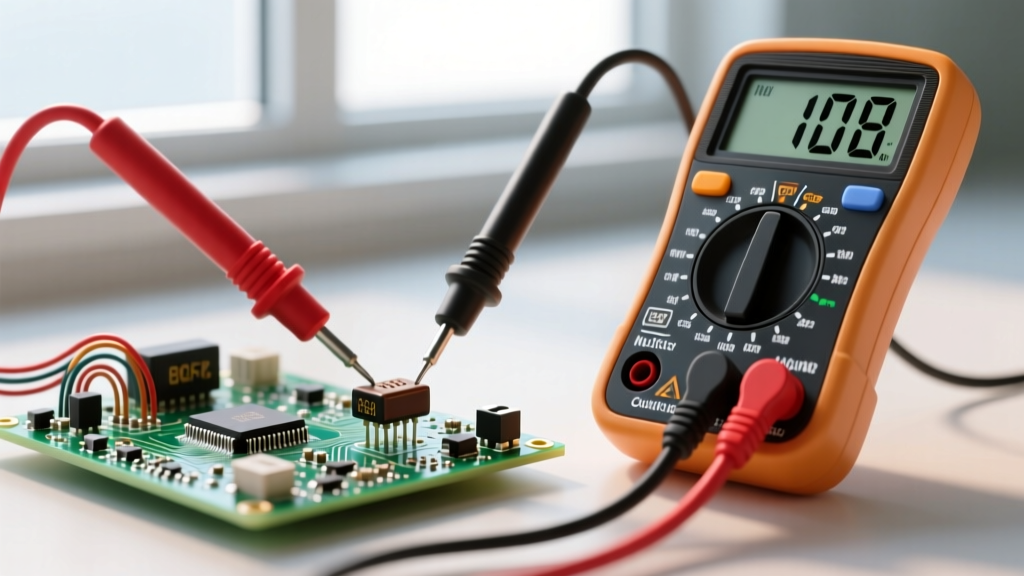
The ampere in SI units is the base measure of electric current, defined as the flow of exactly 1 / 1.602176634 × 10⁻¹⁹ elementary charges (electrons) per second. In any real circuit or installation, the ampere dictates the physical cross-section of your conductors, the thermal limits of your semiconductors, and the magnetic trip curves of your protective breakers. People commonly confuse the ampere (the rate of charge flow) with the coulomb (the total volume of charge moved) or the volt (the electromotive pressure pushing the charge).
The 2019 SI Redefinition: Counting Electrons Instead of Forces
For decades, the ampere was defined by a thought experiment involving the magnetic force between two infinitely long, parallel wires in a vacuum. It was elegant in theory but practically impossible to realize on a lab bench. In 2019, the General Conference on Weights and Measures (CGPM) fundamentally shifted how we define the ampere in SI units.
Instead of relying on macroscopic magnetic forces, the modern definition anchors the ampere to a fixed quantum value: the elementary charge (e = 1.602 176 634 × 10⁻¹⁹ coulombs). Because a coulomb is simply an ampere-second, fixing the charge of a single electron effectively defines the ampere by counting electrons. One ampere is exactly 6,241,509,074,460,762,607.776 electrons passing a cross-section of a conductor every second.
According to the National Institute of Standards and Technology (NIST), this shift means the ampere is now universally stable, tied to the fundamental fabric of the universe rather than a physical artifact or an idealized mechanical setup. For the hobbyist or electrician, your multimeter still reads the same, but the metrology labs calibrating it now use single-electron transistors and quantum Hall effect standards.
Worked Numeric Example: Calculating Charge and Current
Let’s translate this quantum definition into a practical bench scenario. Suppose you are testing a 12V DC heating element using a bench power supply, and the display reads a steady 2.5A. You leave the circuit energized for exactly 4 minutes.
- Convert time to SI base units (seconds): 4 minutes × 60 seconds/minute = 240 seconds.
- Calculate total charge (Coulombs): Current (I) = Charge (Q) / Time (t). Therefore, Q = I × t.
Q = 2.5A × 240s = 600 Coulombs. - Calculate total electrons moved: Divide the total charge by the elementary charge (e).
600 C / (1.602176634 × 10⁻¹⁹ C/electron) = 3.7449 × 10²¹ electrons.
While 2.5A sounds like a modest current for a bench supply, the sheer volume of physical charge carriers moving through your test leads in just four minutes is astronomically high. This massive movement of electrons colliding with the copper lattice is what generates the heat in your element.
Where You Meet the Ampere in Practice
Theory is useful, but you feel the ampere in the physical world through heat, magnetic fields, and silicon limits. Here is where current ratings dictate your design and installation choices:
- Wire Ampacity and Derating: The National Electrical Code (NEC) Table 310.16 dictates how many amps a specific AWG wire can carry before its insulation melts. A 12 AWG copper wire with 90°C THHN insulation is rated for 30A, but you must terminate it based on the 60°C or 75°C column of your breaker, often limiting it to 20A or 25A in practice.
- Breaker Trip Curves: A standard 20A thermal-magnetic breaker doesn't trip at exactly 20.01A. The thermal bimetallic strip allows a 25A load to run for several minutes before tripping, while the magnetic solenoid will instantly snap the contacts open at 100A+ during a dead short.
- Microcontroller GPIO Limits: If you are driving a relay directly from an ESP32-WROOM-32, you must respect the ampere. The absolute maximum current per GPIO pin is 40mA, but the recommended continuous limit is 12mA. Exceeding this causes internal silicon electromigration, permanently degrading the pin's output voltage.
- Shunt Resistors: You cannot measure an ampere directly with a standard voltmeter. Instead, you pass the current through a low-resistance shunt (e.g., 0.1Ω) and measure the voltage drop. At 2A, a 0.1Ω shunt yields a 200mV drop, which your ADC or multimeter translates back into amps using Ohm's Law.
Real-World Scenario Walkthrough: The Undersized Feeder Mistake
Understanding the ampere is critical when scaling up from breadboards to mains wiring. Here is a real-world failure scenario involving continuous loads and conduit derating.
The Setup
A maker is wiring a 240V, 38A electric kiln in their home workshop. The run from the main panel to the kiln receptacle is 50 feet. The builder pulls four current-carrying conductors (two hots, one neutral for a 120V control circuit, and one equipment ground—though the ground doesn't count for derating, the neutral does) through a single 1-inch PVC conduit. They install 8 AWG copper THHN wire and a 40A double-pole breaker.
The Numbers
Looking at NEC Table 310.16, 8 AWG copper at 75°C is rated for 50A. The kiln draws 38A. On the surface, 50A > 38A, and the 40A breaker seems perfectly sized to protect the wire.
The Outcome
After running the kiln for three hours, the 40A breaker trips. The builder resets it, but it trips again an hour later. The wire inside the conduit is noticeably warm to the touch.
What Went Wrong
The builder ignored two critical ampere-based rules:
1. Conduit Derating: With 4 current-carrying conductors in one raceway, NEC 310.15(C)(1) requires an 80% derating factor. The 50A ampacity of the 8 AWG wire drops to 40A (50 × 0.8).
2. Continuous Load Sizing: A kiln running for 3+ hours is a continuous load. NEC 210.20(A) requires the circuit to be sized at 125% of the continuous load. 38A × 1.25 = 47.5A.
The 8 AWG wire, derated to 40A, was being asked to safely dissipate the heat of a 47.5A continuous load requirement. The thermal buildup in the conduit caused the breaker's bimetallic strip to eventually yield. The Fix: Upgrade to 6 AWG THHN (65A × 0.8 = 52A derated ampacity) and install a 50A breaker.
Common Confusions: Amps, Volts, and Watts
To solidify your understanding of the ampere in SI units, it helps to separate it from its electrical siblings. Think of a busy highway system to visualize the relationship:
- Amps (Current): The number of cars passing a specific toll booth per second. (Rate of flow).
- Volts (Potential): The speed limit or the steepness of the downhill grade pushing the cars forward. (Electromotive force).
- Coulombs (Charge): The total number of cars that have passed the toll booth over an entire hour. (Accumulated volume).
- Watts (Power): The total tonnage of freight delivered past the toll booth per second. (Work done over time).
| SI Unit | Symbol | Measures | Base SI Equivalency |
|---|---|---|---|
| Ampere | A | Electric Current | Base Unit (C/s) |
| Volt | V | Electric Potential | kg⋅m²⋅s⁻³⋅A⁻¹ |
| Watt | W | Power | kg⋅m²⋅s⁻³ (or V × A) |
| Coulomb | C | Electric Charge | s⋅A |
| Ohm | Ω | Resistance | kg⋅m²⋅s⁻³⋅A⁻² (or V / A) |
FAQ: The Ampere in Everyday Electronics
Why do multimeters have a separate 10A fused jack?
Standard multimeter internal shunts and PCB traces are designed for low-current measurement (usually up to 200mA or 400mA). Pushing 5A through the standard mA jack will vaporize the internal trace or blow the small glass fuse. The dedicated 10A jack routes the current through a massive, heavy-duty bulkhead shunt and a high-rupture-capacity (HRC) ceramic fuse to safely handle the thermal and magnetic forces of high-amperage faults.
Can I measure amps directly with an oscilloscope?
No. Oscilloscopes measure voltage over time. To view current waveforms (like the inrush current of a BLDC motor or the switching ripple of a buck converter), you must use a current probe. These probes use a Hall-effect sensor for DC and low-frequency AC, or a Rogowski coil/current transformer for high-frequency AC, converting the magnetic field generated by the ampere flow back into a proportional voltage the scope can read.
Does the 2019 SI redefinition change my multimeter's calibration?
Practically, no. The 2019 redefinition was designed to be seamless. The numerical value of the elementary charge was chosen specifically so that the new ampere matched the old ampere within the uncertainty limits of the best existing realizations. Your Fluke or Keysight meter reads exactly the same today as it did in 2018; only the underlying metrological traceability chain changed.