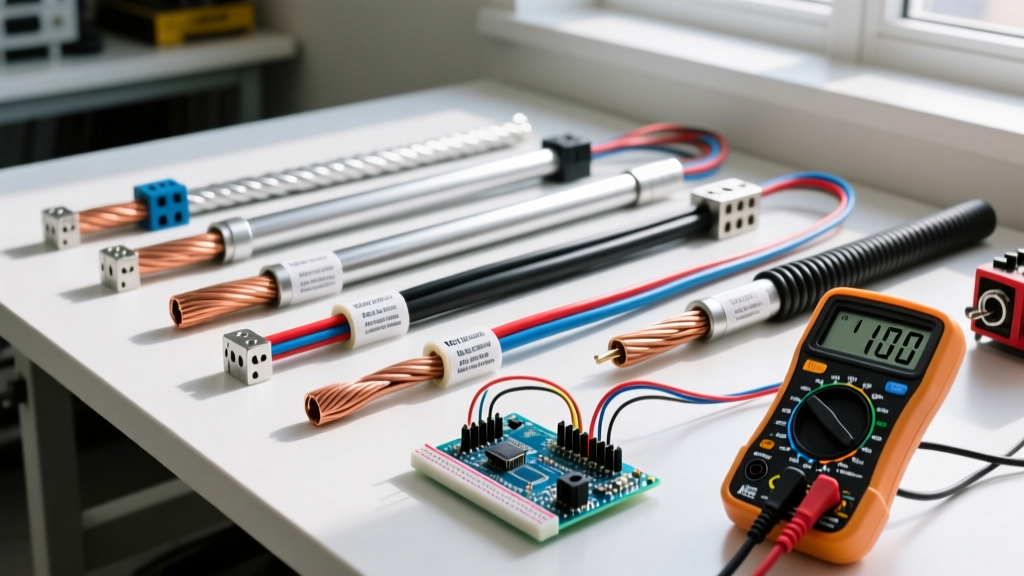

Aluminum resistance is the inherent opposition to electrical current flow within an aluminum conductor, which is approximately 1.6 times higher than copper, dictating that aluminum wires must be sized larger to carry the same current safely. In a real circuit or installation, this physical property fundamentally changes your AWG wire sizing, alters your voltage drop calculations over distance, and mandates stricter termination torque requirements to prevent thermal failure at the lugs.
The Physics of Aluminum Resistance (and the Alloy Shift)
At the bench, we measure resistivity in micro-ohm centimeters (µΩ·cm). Annealed copper sits at a baseline of 1.724 µΩ·cm, while electrical-grade aluminum sits at roughly 2.82 µΩ·cm. Because aluminum has a higher resistance per unit volume, a 1 AWG aluminum wire is required to carry the same ampacity as a 3 AWG copper wire in the 75°C column of the NEC ampacity tables.
Worked Example: Sizing a 100A Subpanel Feeder
To see how aluminum resistance impacts a real installation, let us calculate the voltage drop for a 100A, 240V subpanel feeder located 100 feet from the main panel. We will use the standard single-phase voltage drop formula: VD = (2 × L × I × R) / 1000, where L is length in feet, I is current in amps, and R is the conductor resistance in ohms per 1,000 feet (sourced from Cerrowire's standard resistance tables).
| Conductor Material & Size | Ampacity (75°C) | Resistance (Ω/kft) | Calculated Voltage Drop | Drop Percentage (of 240V) |
|---|---|---|---|---|
| 3 AWG Copper (THHN) | 100A | 0.245 | 4.90V | 2.04% |
| 1 AWG Aluminum (THHN) | 100A | 0.404 | 8.08V | 3.36% |
| 1/0 AWG Aluminum (THHN) | 120A | 0.319 | 6.38V | 2.65% |
The Takeaway: While 1 AWG aluminum is technically rated for 100A at 75°C, its higher resistance pushes the voltage drop to 3.36%. While the NEC does not strictly mandate a maximum voltage drop for feeders (it recommends 3% in Informational Note 4 to NEC 215.2), best practice dictates upsizing to 1/0 AWG Aluminum to bring the drop down to a highly efficient 2.65%, closely matching the performance of the much more expensive 3 AWG copper.
Where You Meet Aluminum Resistance in Practice
You do not just calculate aluminum resistance on paper; you fight it at the termination lugs. Because aluminum has higher resistance and a different coefficient of thermal expansion than the brass or tin-plated copper lugs inside breakers, improper terminations will literally cook themselves off the busbar.
Furthermore, you must apply an anti-oxidant compound (commonly known by the brand name Noalox) to the stripped aluminum conductor before termination. Aluminum instantly forms a microscopic layer of aluminum oxide when exposed to air. This oxide layer is highly resistive. The anti-oxidant paste contains zinc dust that breaks through this oxide layer during tightening, ensuring a low-resistance, gas-tight electrical connection.
Decision Tree: When to Specify Aluminum vs. Copper
Use this decision matrix to select your conductor material for your next rough-in.
| Installation Scenario | Primary Constraint | Recommended Material | Why This Wins |
|---|---|---|---|
| 15A / 20A Branch Circuits (Outlets/Lights) | Termination space & device compatibility | Copper (NM-B) | Standard receptacles and switches are not always rated for aluminum; copper fits easily in crowded back-boxes. |
| 60A to 200A Residential Subpanel Feeders | Material cost vs. ampacity | Aluminum (SER or XHHW-2) | Aluminum is roughly 40-50% cheaper than copper by the foot. The slight upsizing for voltage drop is easily offset by material savings. |
| Long Underground Runs (>150 ft) to Detached Garage | Voltage drop over distance | Aluminum (URD or XHHW-2 in conduit) | Copper at the required upsized gauge for long runs becomes prohibitively expensive and incredibly stiff to pull. |
| Tight Conduit Bends & High Fill Ratios | Physical pulling tension & bend radius | Copper (THHN) | Copper's smaller AWG footprint leaves more airspace in the conduit, easing pulls and reducing thermal derating concerns. |
Common Confusions and NEC Realities
When discussing aluminum on the jobsite, two major confusions constantly arise:
1. Confusing Electrical Resistance with Thermal Resistance: Makers and DIYers often look at aluminum heat sinks and assume aluminum is a universal conductor of all energy. While aluminum has excellent thermal conductivity (making it great for cooling CPUs), its electrical resistance is significantly higher than copper. Never use aluminum flat bar as a high-current busbar in a DIY battery pack without heavily oversizing it compared to copper equivalents.
2. The 'Aluminum is Banned' Myth: Many homeowners believe the National Electrical Code outlawed aluminum wire entirely due to the house fires of the 1970s. This is false. The NEC only restricts solid aluminum wire in small branch circuits. Stranded, AA-8000 series aluminum is the industry standard for service entrance cables and heavy feeders across North America today.
Frequently Asked Questions
Can I use copper lugs on aluminum wire?
Yes, but only if the lug is explicitly marked 'AL/CU' or 'CO/ALR'. Standard copper-only lugs will cause galvanic corrosion and high-resistance hotspots when mated with aluminum.
Does aluminum resistance change more with temperature than copper?
Both metals have a positive temperature coefficient, meaning resistance increases as they get hotter. However, because aluminum starts with a higher baseline resistance and has a higher coefficient of thermal expansion, the physical loosening of the termination under thermal cycling is a much greater risk than the raw resistance shift itself.