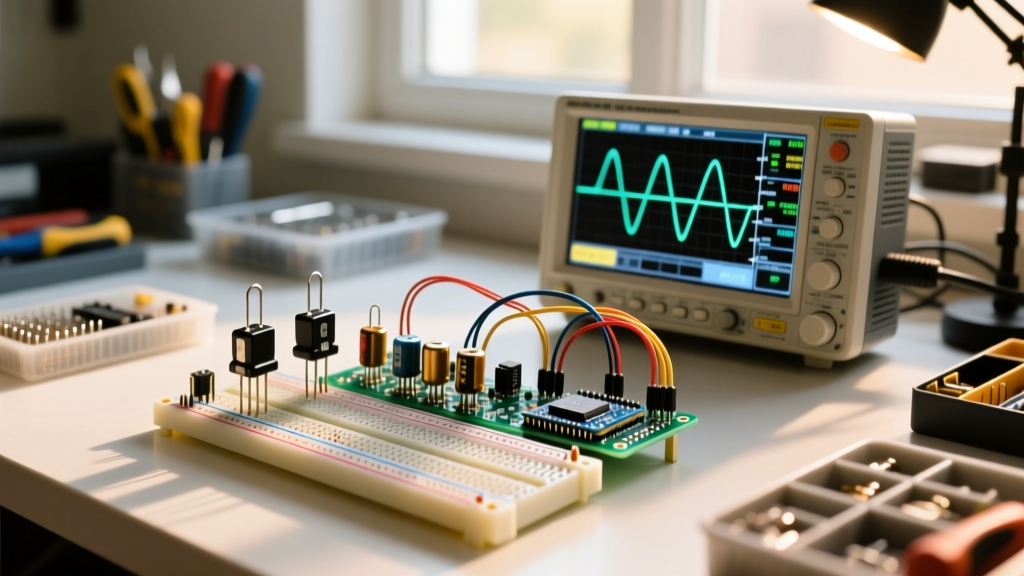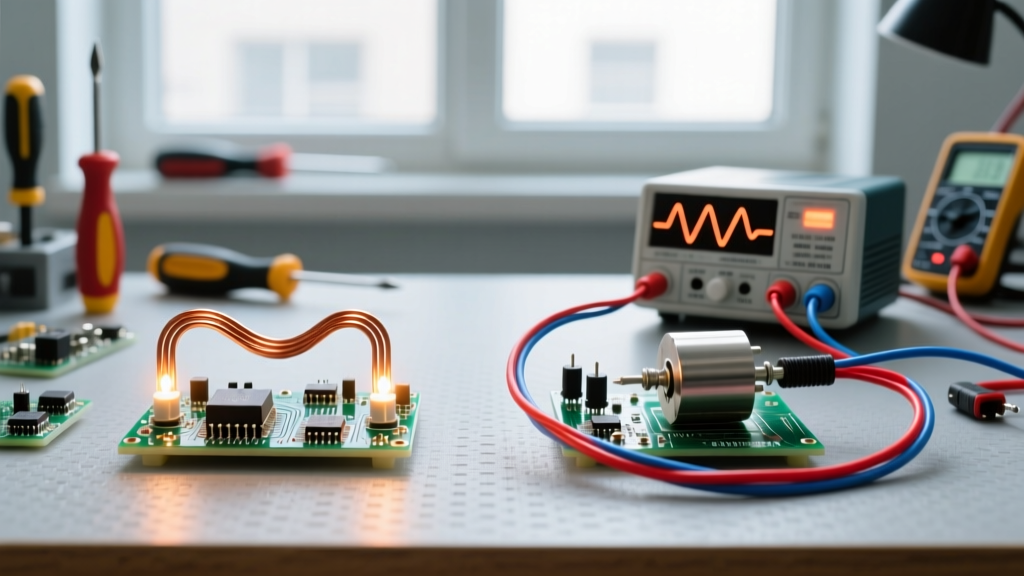

The 2 types of electrical current are Direct Current (DC), where charge flows continuously in a single direction, and Alternating Current (AC), where charge periodically reverses direction in a sinusoidal wave. While both deliver energy from a source to a load, the physics of how that energy moves fundamentally changes how we size wires, select protective breakers, and design power supplies. If you are wiring a solar array, building an ESP32 sensor node, or running a new 120V branch circuit, confusing these two will result in melted wires, sustained electrical arcs, or bricked microcontrollers.
The Core Difference: Unidirectional vs. Oscillating Flow
Direct Current (DC) provides a constant, unidirectional flow of electrons. On an oscilloscope, a pure DC signal looks like a flat, horizontal line. Batteries, solar panels, and the 3.3V or 5V rails on your Arduino all operate on DC. Because the voltage is steady, the current is limited purely by the circuit's resistance according to Ohm's Law (I = V/R).
Alternating Current (AC), on the other hand, pushes and pulls electrons back and forth. In North America, the grid operates at 60 Hz, meaning the current changes direction 120 times per second (completing 60 full sine wave cycles). According to Fluke's explanation of Alternating Current, this oscillation is what allows us to use transformers to step voltages up for efficient long-distance transmission and step them down for safe household use.
What AC vs DC Changes in a Real Circuit
The choice between AC and DC dictates three major physical realities in your installation: voltage drop, arc quenching, and skin effect.
Worked Numeric Example: Voltage Drop and Wire Sizing
Let's say you need to deliver 1,200W of power to a workshop heater located 50 feet away from your breaker panel, using standard 14 AWG copper wire.
- The DC Scenario (12V): To deliver 1,200W at 12V DC, you need 100 Amps of current (1200W / 12V = 100A). Standard 14 AWG wire has an ampacity of 15A. Pushing 100A through it will cause the wire to overheat, melt the insulation, and start a fire. Furthermore, the voltage drop over 50 feet at 100A would be roughly 25V—meaning your 12V source would need to output 37V just to get 12V at the load.
- The AC Scenario (120V): To deliver 1,200W at 120V AC, you only need 10 Amps (1200W / 120V = 10A). This falls well within the 15A ampacity of 14 AWG wire. The voltage drop is a negligible 0.31V.
Arc Quenching and Breaker Selection
Because AC crosses zero volts 120 times a second, the electrical arc that forms when a breaker trips under load naturally extinguishes itself at the zero-crossing point. DC never crosses zero. If you open a standard AC-rated breaker on a 48V DC solar array, the arc will sustain itself as a continuous plasma bridge, eventually melting the breaker housing and causing a fire. Always use DC-rated breakers (like the MidNite Solar MNEPV) for DC circuits, as they utilize internal magnets to physically blow the arc away from the contacts.
Where You Meet These 2 Types of Electrical Current in Practice
You will interact with both current types constantly, often within the same enclosure.
- Mains Wiring (AC): Your main service panel, 120V/240V receptacles, hardwired HVAC units, and NM-B (Romex) branch circuits. Here, you are dealing with RMS (Root Mean Square) voltages and 60Hz frequencies.
- Embedded Electronics (DC): Microcontrollers (ESP32, Raspberry Pi), logic gates, and sensors. These require ultra-stable, low-voltage DC (typically 3.3V or 5V). Even minor AC ripple on a DC logic rail can cause brownouts or erratic GPIO behavior.
- Energy Storage (DC): LiFePO4 battery banks, lead-acid cells, and photovoltaic solar panels inherently produce and store DC power.
- The Crossover: You bridge the two using rectifiers (AC to DC, like the power brick on your laptop) and inverters (DC to AC, like a Victron MultiPlus in an off-grid cabin).
Common Confusions and Dangerous Mix-Ups
When working at the bench or on the jobsite, hobbyists and apprentices frequently make three critical errors regarding AC and DC:
- Confusing RMS with Peak Voltage: A standard US wall outlet is 120V AC RMS. However, the peak voltage of that sine wave is actually 170V (120 × √2). If you are designing a DC power supply that rectifies mains AC, your smoothing capacitors must be rated for at least 200V or 250V, not 120V, or they will violently vent their electrolyte.
- Assuming DC is Always 'Low Voltage': People equate DC with safe, low-voltage battery work. However, High Voltage DC (HVDC) transmission lines operate at hundreds of thousands of volts. Even in DIY solar, a string of panels in series can easily produce 400V DC—a lethal voltage that will sustain a massive arc if disconnected under load.
- Ignoring Skin Effect in AC: At 60Hz, skin effect (where AC current travels mostly on the outer surface of the wire) is negligible for standard house wiring. But if you are working with high-frequency AC (like the PWM output from a variable frequency drive or a high-frequency inverter), the effective resistance of the wire increases, requiring stranded or Litz wire to manage heat.
Decision Tree: Choosing AC or DC for Your Next Build
When designing a power distribution layout for an off-grid workshop, a van build, or a large sensor network, use this decision matrix to select your architecture.
| Condition / Constraint | If True, Choose... | Why? |
|---|---|---|
| Distance from source to load is > 50 feet | AC (120V/240V) | Higher voltage minimizes voltage drop and allows the use of smaller, cheaper wire (e.g., 12 AWG NM-B). |
| Loads are primarily motors, compressors, or power tools | AC (120V/240V) | AC induction motors are cheaper, more robust, and don't require complex electronic speed controllers. |
| Loads are exclusively LEDs, microcontrollers, and USB devices | DC (12V, 24V, or 48V) | Eliminates the efficiency loss (typically 10-15%) of multiple individual AC-to-DC wall adapters. |
| System is directly tied to a battery bank without an inverter | DC (Match battery voltage) | Inverting DC to AC just to step it back down to DC for LEDs wastes energy and adds failure points. |
Frequently Asked Questions
Can I use standard AC THHN wire for a DC circuit?
Yes. Copper is copper, and the insulation ratings (like 600V THHN) apply to both AC and DC. However, you must verify the ampacity tables for your specific installation. According to the NFPA 70 National Electrical Code, if you are bundling more than three current-carrying conductors in a conduit, you must apply derating factors regardless of whether the current is AC or DC.
Why do multimeters read AC and DC differently?
When measuring DC, a multimeter simply reads the steady voltage. When measuring AC, the meter must calculate the RMS (Root Mean Square) value, which is the equivalent DC voltage that would produce the same heating effect in a resistor. Cheap multimeters assume a perfect sine wave to calculate this, while higher-end 'True RMS' meters (like those documented in Fluke's guide on Direct Current) actually sample the waveform to give accurate readings on distorted or noisy AC signals.
Is DC or AC more dangerous to humans?
Both are lethal at high enough voltages, but they affect the body differently. AC at 60Hz is particularly dangerous because it can cause ventricular fibrillation (disrupting the heart's natural electrical pacing) at lower currents (around 30-50mA). DC tends to cause a single, violent muscle contraction that can throw you away from the source, though it requires higher current to induce fibrillation. Always treat any circuit over 50V—AC or DC—as a lethal hazard and verify it is dead with a tested meter before touching it.