If you have ever typed ac alternative current into a search engine, you are not alone—it is one of the most common misnomers in electrical theory. The correct term is alternating current (AC), but the underlying question driving that search remains the same: how does AC actually differ from Direct Current (DC), and which one should you use for your next wiring job or electronics project?
The Verdict: AC wins decisively for long-distance grid transmission, high-power distribution, and heavy industrial motors due to the ease of voltage transformation via passive transformers. DC wins for energy storage (batteries), digital microelectronics (like your ESP32 or Raspberry Pi), and modern high-efficiency variable-speed drives. Neither is universally superior; they dominate completely different halves of the electrical ecosystem, and confusing the two will result in destroyed components or fire hazards.
The Single Physical Difference (And the "Alternative" Misnomer)
Let us clear up the terminology first. "Alternative" implies a substitute or a backup option. "Alternating" describes the actual physics. According to the U.S. Energy Information Administration (EIA), the single physical difference that drives every other electrical behavior is the direction of electron flow.
In a DC circuit, electrons flow unidirectionally from the negative terminal to the positive terminal. In an AC circuit, electrons periodically reverse direction. In North American 60Hz mains power, this reversal happens 120 times per second (two zero-crossings per cycle). This single physical trait—constant flow versus oscillating flow—dictates how the current interacts with magnetic fields, how it travels through wire, and how we must protect the circuit.
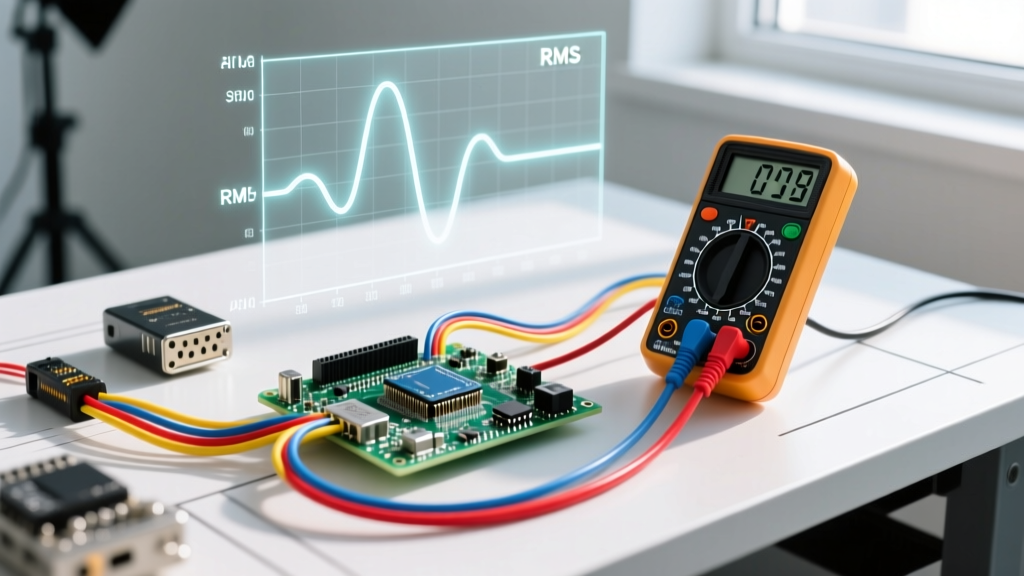
Bench Note: Because AC is constantly changing, we cannot use simple averages to measure its power. We use RMS (Root Mean Square). When you measure 120V AC at a wall outlet with your multimeter, the actual peak voltage hitting your device is roughly 170V. This is why a 120V-rated capacitor will explode if placed directly across raw rectified mains without proper derating.
Head-to-Head Spec Sheet: AC vs DC in the Real World
Before we look at use cases, you need to understand how these two waveforms behave on the workbench. The table below outlines the hard physical realities of AC and DC at standard utility and hobbyist scales.
| Parameter | AC (Alternating Current) | DC (Direct Current) | Practical Impact on the Bench |
|---|---|---|---|
| Electron Flow | Reverses periodically (e.g., 50/60Hz) | Unidirectional (one-way) | AC creates inductive/capacitive reactance; DC only sees pure resistance. |
| Voltage Measurement | RMS (Root Mean Square) | Average / Constant | 120V AC RMS peaks at ~170V; 12V DC is a flat 12V. |
| Skin Effect | Present (current crowds to conductor surface) | None (uses full wire cross-section) | High-amp AC requires stranded wire or busbars; DC can use solid core efficiently. |
| Zero-Crossing | 100 or 120 times/sec (at 50/60Hz) | Never | AC arcs self-extinguish at zero; DC arcs require magnetic blowouts to break. |
| Power Factor | Can be < 1.0 (requires VA vs W calculations) | Always exactly 1.0 | AC motors draw more apparent power than real work; DC draws only what is used. |
For a deeper mathematical breakdown of how these waveforms interact with passive components, All About Circuits provides excellent foundational reading on AC phase angles and impedance.
Core Comparison Matrix
| Criteria | AC Power Systems | DC Power Systems |
|---|---|---|
| Long-Distance Transmission | High loss unless stepped up to extreme voltages via transformers. | Lower loss over very long distances (HVDC lines), but requires expensive converter stations. |
| Energy Storage | Impossible to store directly in a passive state. | Native format for all chemical batteries (LiFePO4, Lead-Acid, Li-ion). |
| Voltage Transformation | Cheap, highly efficient, and passive via iron-core transformers. | Requires complex, active switching converters (Buck/Boost) with inherent switching losses. |
| High-Voltage Circuit Breaking | Inexpensive; the arc naturally dies at the zero-crossing point. | Very expensive; requires forced commutation, larger air gaps, or magnetic blowouts. |
Where They Are Strictly NOT Interchangeable
A common and dangerous beginner mistake is assuming that "12 volts is 12 volts" regardless of the waveform. They are absolutely not interchangeable in most applications.
Plugging DC Devices into AC Sources
I once saw a junior tech wire a 12V DC LiFePO4 battery bank directly into a 12V AC halogen lighting transformer, assuming the voltage matched. The AC waveform reverse-biased the battery's BMS protection diodes 60 times a second. The diodes failed short, the BMS vented, and the cells were ruined. Furthermore, feeding raw AC into a DC microcontroller (like an Arduino or ESP32) will instantly destroy the voltage regulator and fry the silicon, as the negative half of the AC sine wave exceeds the absolute maximum reverse-voltage ratings of the internal CMOS gates.
Plugging AC Devices into DC Sources
Conversely, applying DC to an AC-designed device is a fire hazard. If you apply 120V DC to the primary winding of a 120V AC iron-core transformer, the transformer will not step down the voltage. Transformers rely on a changing magnetic field (dΦ/dt) to induce voltage in the secondary coil. DC provides a static magnetic field. The primary coil will simply act as a low-resistance piece of copper wire, draw massive current, overheat, and catch fire. Similarly, standard AC induction motors will not start on DC; they require the alternating phases to create the rotating magnetic field that turns the rotor.
Choose AC When / Choose DC When (Cost & Availability)
When designing a system, wiring a subpanel, or building a solar array, use this decision framework to select the correct current type.
Choose AC When:
- You are wiring home branch circuits: NEC-standard NM-B (Romex) cable, standard duplex receptacles, and AFCI/GFCI breakers are designed exclusively for AC. The entire residential infrastructure assumes a 60Hz (or 50Hz) sine wave.
- You need to step voltages up or down cheaply: If your project requires dropping 240V to 12V at high current, a heavy iron-core AC transformer is cheaper, more robust, and requires less cooling than a high-wattage AC-to-DC switching power supply.
- You are running high-inertia industrial loads: 3-phase AC induction motors are the workhorses of industry because they are incredibly simple, lack brushes, and can be reversed by swapping two phases.
Choose DC When:
- You are building off-grid solar or battery backups: Solar panels output DC. Batteries store DC. Keep the system in DC as long as possible to avoid the 10-15% efficiency losses inherent in DC-to-AC inversion.
- You are working with digital logic and microcontrollers: Every logic gate, sensor, and processor on Earth runs on DC. You must use a rectifier and voltage regulator to convert AC to a clean, flat DC rail (e.g., 5V or 3.3V) before it touches your PCB.
- You need precise speed control: While AC motors are cheap, DC (specifically BLDC and stepper motors) offers vastly superior low-speed torque and precise positional control for CNC machines and robotics.
The Cost of Breaking the Circuit
The most overlooked cost difference between the two is circuit protection. A standard 2-pole 40A AC breaker (like a Square D QO240) costs roughly $15 at any hardware store. A 40A DC breaker rated for 125VDC (like a Midnight Solar MNEPV40) costs closer to $100. Because DC lacks a zero-crossing, the electrical arc that forms when the breaker trips will sustain itself and melt the contacts unless the breaker uses internal magnets to physically blow the arc into an extinguishing chamber. Never substitute a cheap AC breaker on a high-voltage DC battery bank; it will fail to clear a short circuit and will melt into the panel.