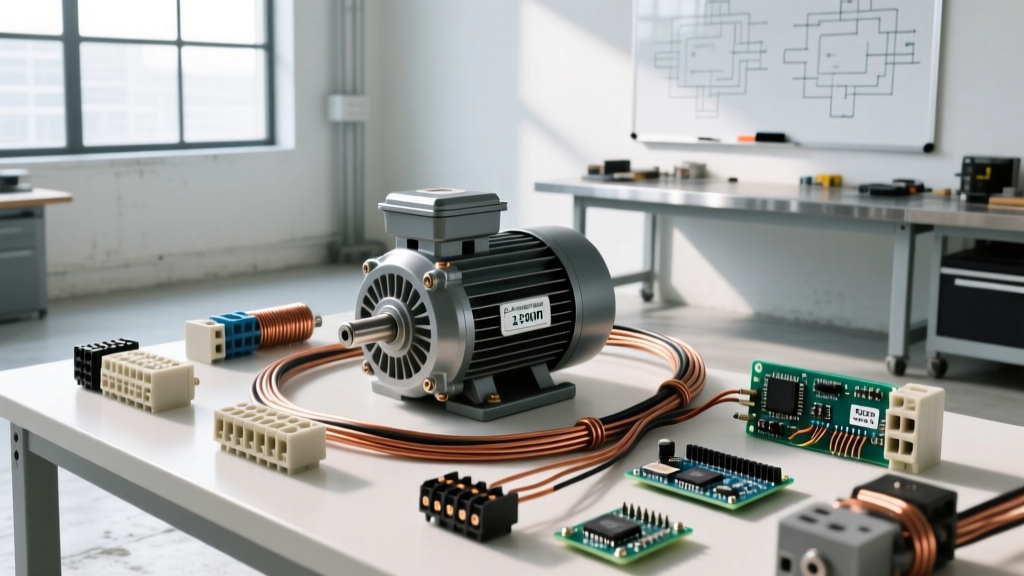

The full load current (FLC) for a standard 2 HP single-phase motor operating at 230V is 12 Amps. This value is established by the National Electrical Code (NEC) Table 430.248 and is the mandatory baseline for sizing branch circuit conductors, overload relays, and short-circuit protection. While the physical nameplate on your specific motor might show a Full-Load Amps (FLA) rating of 11.2A or 11.8A, electrical code requires you to use the standardized NEC table value of 12A for all upstream sizing calculations.
How to Read the NEC Single-Phase Motor Current Table
Before pulling wire or installing a breaker, you must understand how to read the motor current tables and, more importantly, the difference between nameplate FLA and NEC table FLC. The NEC table standardizes current draws to ensure safety margins account for older motors, voltage drop, and varying power factors across different manufacturers.
When using this table, remember that the temperature rating context applies to the wire, not the motor. The FLC value (12A) is your baseline. You multiply this by 125% to find your minimum conductor ampacity (15A). You then take that 15A requirement to NEC Table 310.16 to select your wire gauge, choosing either the 60°C or 75°C column based on the temperature rating of your breaker and motor terminals.
Complete Full-Load Current (FLC) Reference Table
The following data is sourced directly from NFPA 70 (NEC) Table 430.248. This table provides the full-load currents for single-phase alternating-current motors. Use these values to determine conductor ampacity, controller ratings, and overload settings.
| Motor HP | 115V (Amps) | 208V (Amps) | 230V (Amps) |
|---|---|---|---|
| 1/6 | 4.4 | 2.4 | 2.2 |
| 1/4 | 5.8 | 3.2 | 2.9 |
| 1/3 | 7.2 | 4.0 | 3.6 |
| 1/2 | 9.8 | 5.4 | 4.9 |
| 3/4 | 13.8 | 7.6 | 6.9 |
| 1 | 16 | 8.8 | 8 |
| 1.5 | 20 | 11.0 | 10 |
| 2 (Quick Jump) | 24 | 13.2 | 12 |
| 3 | 34 | 18.7 | 17 |
| 5 | 56 | 30.8 | 28 |
| 7.5 | 80 | 44 | 40 |
| 10 | 100 | 55 | 50 |
Bookmark note: The 2 HP row is highlighted above for quick reference. For high-torque or specialized duty motors (like crusher or compressor duty), always defer to the specific nameplate data for overload relay calibration, but use the table above for branch circuit sizing.
Derating, Sizing Rules, and What the Table Cannot Tell You
A common point of confusion for DIYers and junior electricians is how derating rows modify the base value. NEC Table 430.248 does not contain derating rows. Derating factors (for ambient temperature and conduit fill) modify the conductor's base ampacity found in NEC Table 310.16, not the motor's FLC. For example, if your 2 HP motor requires a wire with a 15A minimum ampacity, and you are routing it through a 110°F attic, you must derate the wire's table ampacity by 0.87. You do not multiply the motor's 12A FLC by a derating factor.
Furthermore, you must understand what this table cannot tell you. Table 430.248 provides zero information regarding:
- Locked Rotor Current (LRC): The massive inrush current when the motor starts (often 600% to 800% of FLC). For a 2 HP motor, this can briefly exceed 70 Amps.
- Power Factor and Efficiency: The table assumes a standard baseline. High-efficiency ECM or premium motors will draw less actual current, but code still mandates sizing based on the 12A table value.
- Thermal Protection Limits: The table does not indicate the motor's internal thermal cutoff thresholds.
For a complete breakdown of motor starting characteristics and efficiency curves, consult manufacturer resources like the WEG Motor Guide or equivalent engineering documentation.
Frequently Asked Questions
What size breaker do I need for a 2 HP 230V single phase motor?
According to NEC Article 430.52, the maximum rating for an inverse-time circuit breaker protecting a single-phase motor is 250% of the FLC. For a 2 HP motor (12A FLC), 12A × 2.50 = 30 Amps. Therefore, a 30A double-pole breaker is the maximum standard size allowed. However, if a 20A or 25A breaker can hold the starting surge without nuisance tripping, using the smaller breaker is recommended for better wire protection.
What size wire is required for a 2 HP motor at 230V?
NEC Article 430.22 requires motor branch circuit conductors to be sized at 125% of the motor FLC. For a 2 HP motor: 12A × 1.25 = 15 Amps minimum ampacity. Looking at the 60°C column of NEC Table 310.16, 14 AWG copper is rated for exactly 15A. While 14 AWG is technically the code minimum, 12 AWG copper is the standard bench and jobsite recommendation to mitigate voltage drop over longer runs and provide mechanical durability at the terminal lugs.
Why is the NEC table current higher than my motor's nameplate FLA?
The NEC table values are intentionally conservative. They are calculated based on standard historical motor efficiencies and power factors to ensure that if a motor is slightly overloaded, or if the supply voltage sags, the wiring and breaker will not overheat. The nameplate Full-Load Amps (FLA) reflects the specific tested draw of that exact manufacturing batch at perfect voltage. You use the nameplate FLA to set the overload relay, but you use the higher NEC FLC to size the wire and breaker.
Can I run a 2 HP 230V motor on a 208V supply?
Yes, if the motor nameplate explicitly lists 208V (or 208-230V) as an acceptable voltage range. However, as shown in the reference table above, operating at 208V increases the full-load current draw to 13.2 Amps. The motor will run hotter, produce less starting torque, and your voltage drop calculations must be based on the 208V baseline. If the motor nameplate only says 230V, running it on 208V will void the warranty and likely trip the internal thermal overload during heavy starts.


