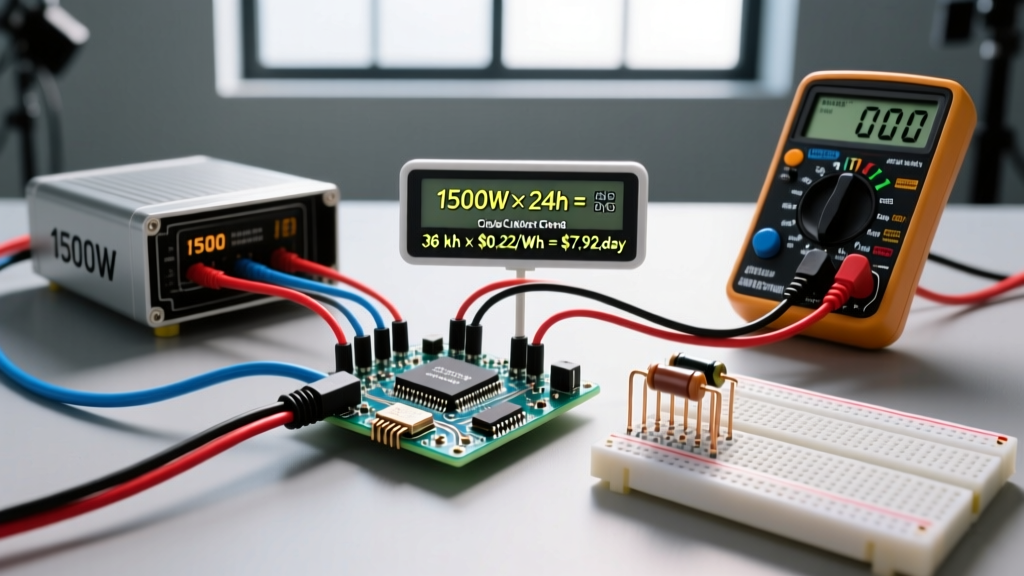

Running a 1500-watt continuous load for 24 hours at a rate of $0.22 per kilowatt-hour (kWh) consumes exactly 36 kWh of electrical energy, costing $7.92 per day. When makers, homelab builders, and homeowners search for the exact phrase 1500 watts times 24 hrs at .22 cents a kilowatt, they are usually trying to budget for a high-draw, always-on appliance while figuring out if their existing wall outlet can handle the thermal stress. Before we run the numbers, we need to clear up a universal shorthand error: when people type '.22 cents', they almost always mean $0.22 (22 cents). Actual 0.22 cents would be a fraction of a penny ($0.0022). For this guide, we will use the real-world high-tier residential rate of $0.22 per kWh, which is common in places like California, the UK, and parts of Europe in 2026.
The Math: 1500 Watts Times 24 Hrs at $0.22 a Kilowatt
To understand the financial impact of a continuous 1500W load, we first convert watts to kilowatts (kW), multiply by the hours of operation to get kilowatt-hours (kWh), and then multiply by your utility rate.
36 kWh × $0.22 = $7.92 per day.
While $7.92 a day might sound manageable, continuous loads compound aggressively over a billing cycle and a full calendar year. Below is the exact cost breakdown for a 1500W load running 24/7, compared against the US national average rate for context.
| Timeframe | Hours | Energy Consumed | Cost at $0.22/kWh | Cost at US Avg ($0.16/kWh) |
|---|---|---|---|---|
| 1 Day | 24 | 36 kWh | $7.92 | $5.76 |
| 1 Week | 168 | 252 kWh | $55.44 | $40.32 |
| 1 Month (30 Days) | 720 | 1,080 kWh | $237.60 | $172.80 |
| 1 Year (365 Days) | 8,760 | 13,140 kWh | $2,890.80 | $2,102.40 |
Source: US national average electricity rates are tracked by the U.S. Energy Information Administration (EIA). The $0.22/kWh figure represents high-tier residential pricing or international equivalents.
If you are running a 1500W load continuously in a high-cost energy market, you are spending nearly $2,900 a year. This is the exact threshold where investing in a 240V circuit upgrade, a high-efficiency heat pump, or a dedicated solar string begins to show a rapid return on investment.
What This Changes in a Real Circuit or Installation
Calculating the cost is only half the battle; the physical reality of pushing 1500 watts through a standard residential circuit 24 hours a day introduces strict electrical code requirements.
In North America, a standard wall outlet provides 120V. Using Ohm's Law (Power = Voltage × Current), a 1500W load draws exactly 12.5 Amps (1500 ÷ 120 = 12.5A). On paper, 12.5A fits comfortably inside a standard 15-Amp breaker. However, because this load runs for 24 hours, it triggers a critical rule in the National Electrical Code (NEC).
Any load that is expected to operate for 3 hours or more is classified as a 'continuous load.' The NEC mandates that the branch circuit overcurrent device (the breaker) must be rated at no less than 125% of the continuous load.
Here is how that changes your installation:
- The Deration Math: 12.5 Amps × 1.25 (125% rule) = 15.625 Amps.
- The Breaker: A 15A breaker is now undersized and will eventually trip due to thermal buildup in the bimetallic strip. You must step up to the next standard breaker size, which is 20 Amps.
- The Wire: You cannot use 14 AWG wire on a 20A breaker. You must pull 12 AWG copper wire (either NM-B Romex or THHN in conduit). According to NEC Table 310.16, 12 AWG copper is rated for 20A in the 60°C column, which is the limiting factor for most residential receptacle terminations.
- The Receptacle: You must use a commercial-grade or heavy-duty 20A-rated duplex receptacle (identified by the T-shaped neutral slot) if you are plugging into a dedicated 20A circuit, though standard 15A plugs are legally allowed to be plugged into 20A circuits.
If you plug a 1500W space heater or server rack into a 15A breaker that also shares the circuit with a 2A LED lighting load, you are pulling 14.5A continuously on a 15A breaker. This is a severe fire hazard that will degrade the breaker's internal contacts and melt the wire insulation over time.
Where You Meet This in Practice
You will rarely see a device labeled '1500W continuous' outside of a few specific hobbyist and household scenarios. Here is where this exact math applies in the real world, and how to mitigate the costs and circuit strain.
1. Portable Space Heaters
1500W is the hard legal limit for a standard 120V/15A portable plug-in appliance in the US. If you use a space heater to warm a drafty garage or basement 24/7 during winter, you will hit the $237/month mark. Mitigation: Switch to a 240V hardwired baseboard heater or a mini-split heat pump. A heat pump moves heat rather than generating it via resistance, often achieving a Coefficient of Performance (COP) of 3.0 or higher, effectively cutting that $7.92 daily cost down to $2.64.
2. Indoor Horticulture and Grow Tents
A mid-sized 4x4 grow tent utilizing a high-intensity LED grow light (600W), inline exhaust fans (150W), circulating fans, and dehumidifiers can easily hover around 1200W to 1500W total draw. Because plants require strict photoperiods and climate control, these systems run near 24/7. Mitigation: Install a dedicated 20A, 12 AWG circuit directly from the panel to the grow room to prevent voltage drop, and utilize smart relays to stagger the startup of inductive loads like dehumidifier compressors.
3. Homelab Server Racks and Crypto Nodes
A rack containing a few 1U enterprise servers, a NAS array, and a PoE network switch will easily idle at 800W and peak at 1500W under compute load. Unlike space heaters, servers generate massive amounts of ambient heat, forcing your home's AC system to work harder (adding hidden secondary kWh costs). Mitigation: Consolidate virtual machines, spin down unused HDD arrays, and move the rack to an unconditioned space like a basement to utilize the thermal mass of the earth.
Common Confusions: Power, Energy, and the 'Cents' Typo
When discussing electrical theory and utility billing, three major confusions constantly lead to miscalculated budgets and improperly sized solar/battery systems.
Confusion 1: '.22 Cents' vs. '$0.22'
As mentioned in the introduction, utility bills are priced in dollars per kilowatt-hour. A rate of $0.22 means 22 cents. If a rate were truly '0.22 cents' ($0.0022), your monthly bill for 1080 kWh would be $2.37 instead of $237.60. Always convert your utility rate to a full decimal dollar amount before running your math.
Confusion 2: Watts (Power) vs. Kilowatt-Hours (Energy)
Watts measure Power, which is the instantaneous rate of work. Kilowatt-hours measure Energy, which is power consumed over time. Think of it like water flowing through a pipe: Watts is the flow rate (gallons per minute), while kWh is the total volume of water that ends up in the bucket at the end of the day. Your utility company only bills you for the water in the bucket (kWh), not the speed at which it flowed (Watts).
Confusion 3: Apparent Power (VA) vs. Real Power (W)
If you are sizing a UPS (Uninterruptible Power Supply) or an inverter for your 1500W server rack, you cannot just look at watts. Devices with motors or large power supplies have a Power Factor (PF) less than 1.0. A 1500W load with a 0.8 PF actually draws 1875 Volt-Amps (VA). If you buy a '1500VA' UPS, it will overload and shut down, even if your watt meter reads 1500W. Always size inverters and UPS systems using the VA rating, not just the W rating.