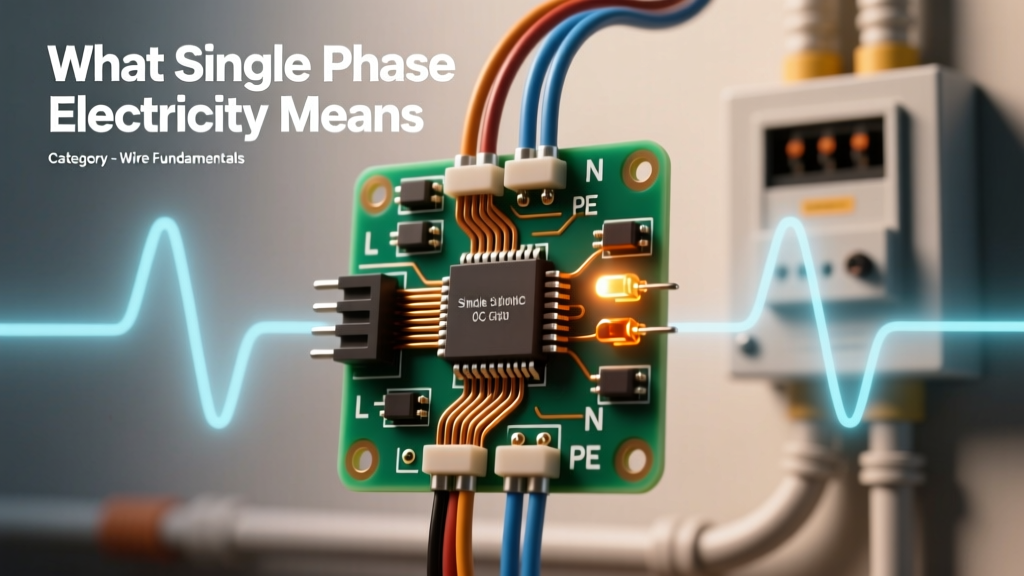

The Core Definition: What Does Single Phase Electricity Mean?
When beginners ask, what does single phase electricity mean, they are usually trying to understand the invisible force flowing through their home outlets. In electrical engineering, single-phase electricity refers to an alternating current (AC) power system where all the voltage waveforms are in sync. They peak, drop, and cross the zero-voltage line at the exact same time. Unlike polyphase systems (such as three-phase power used in industrial settings), single-phase power relies on a single continuous sine wave to transfer energy.
For the vast majority of residential homes across the globe, single-phase power is the standard. It is perfectly optimized for lighting, heating, and small to medium-sized appliances. However, understanding how this single wave is manipulated, stepped down, and distributed is critical for anyone working with residential wiring, sizing conductors, or troubleshooting household circuits.
Understanding the Sine Wave and RMS Voltage
To truly grasp single-phase power, you must look at the waveform. Alternating current does not flow in a steady, flat line like direct current (DC) from a battery. Instead, it oscillates. In North America, this oscillation happens 60 times per second (60 Hertz), while in Europe and much of the rest of the world, it operates at 50 Hertz.
When you measure a standard North American wall outlet with a multimeter, it reads 120V. However, this is the Root Mean Square (RMS) voltage, which is a mathematical average of the wave's power delivery. The actual peak voltage of that single-phase sine wave reaches approximately 170V before dropping to -170V. According to the comprehensive guides on All About Circuits, understanding RMS versus peak voltage is vital when selecting components like capacitors and surge suppressors, which must be rated to handle the peak voltage, not just the RMS average.
The North American Split-Phase System (120V/240V)
A massive point of confusion for DIYers is the 240V power used for heavy appliances like electric dryers, ovens, and HVAC systems. Many mistakenly believe 240V is a "two-phase" system. It is not. It is still strictly single-phase power, utilizing a clever transformer design known as split-phase.
When the utility company delivers high-voltage electricity to your neighborhood, a pole-mounted or pad-mounted distribution transformer steps it down. The secondary winding of this transformer has a wire connected to the exact physical center of the coil. This is called the center tap, and it is bonded to ground, becoming your Neutral wire.
- Leg 1 to Neutral: Yields 120V (using the top half of the transformer winding).
- Leg 2 to Neutral: Yields 120V (using the bottom half of the transformer winding), but the sine wave is 180 degrees out of phase with Leg 1.
- Leg 1 to Leg 2: Yields 240V (using the full transformer winding). Because the waves are 180 degrees opposed, their potentials add together mathematically (120V - (-120V) = 240V).
As detailed by the U.S. Energy Information Administration (EIA), this split-phase delivery allows utility companies to provide both standard 120V for everyday electronics and 240V for heavy loads using only three service entrance wires: two hot legs and one neutral.
Single Phase vs. Three Phase Power
Why don't we use three-phase power in homes? The answer lies in cost, complexity, and necessity. Three-phase power delivers a constant, non-pulsating flow of energy, which is incredible for massive industrial motors. Single-phase power pulses, hitting zero volts 120 times a second in a 60Hz system. Here is how they compare in practical applications:
| Feature | Single Phase Power | Three Phase Power |
|---|---|---|
| Waveform | One single sine wave | Three overlapping sine waves (120° apart) |
| Standard Voltages | 120V, 240V (NA) / 230V (EU) | 208V, 480V (NA) / 400V (EU) |
| Primary Use Case | Residential homes, small offices, lighting | Industrial manufacturing, data centers, heavy HVAC |
| Motor Starting | Requires start capacitors to create a rotating field | Self-starting due to natural rotating magnetic field |
| Wiring Complexity | 2 or 3 wires (Hot, Neutral, Ground) | 3 or 4 wires (3 Hots, Optional Neutral, Ground) |
For a deeper dive into the mechanical advantages of polyphase systems over single-phase, Fluke's electrical testing resources provide excellent diagnostic perspectives on why three-phase motors run cooler and more efficiently under heavy industrial loads.
Real-World Wiring: Identifying Single Phase Conductors
If you are opening a residential subpanel or main breaker box in North America, you are looking at a single-phase split-phase system. Identifying the conductors correctly is a matter of life and death. The National Electrical Code (NEC) mandates strict color-coding for these wires:
- Hot Leg 1 (Black): Carries 120V relative to neutral. Typically connected to single-pole 15A or 20A breakers for standard receptacles. Uses 14 AWG or 12 AWG copper wire.
- Hot Leg 2 (Red): Carries 120V relative to neutral, but 240V relative to Leg 1. Used in multi-wire branch circuits (MWBC) or 240V double-pole breakers.
- Neutral (White): The center-tap return path. It carries the unbalanced current between the two hot legs. If Leg 1 draws 10A and Leg 2 draws 8A, the neutral only carries 2A.
- Ground (Bare Copper or Green): A safety path that carries zero current under normal conditions. It exists solely to trip the breaker and provide a safe path to earth in the event of a short circuit.
The Danger of a Floating Neutral in Single-Phase Systems
One of the most critical troubleshooting concepts for single-phase split-phase systems is the "floating neutral." Because the neutral wire is the center-tap that establishes the 120V baseline, losing the neutral connection at the main panel or the utility pole is disastrous.
Warning: If the main neutral wire breaks, your 120V circuits effectively become a series circuit connected across 240V. The voltage will no longer be balanced. Depending on the resistance of the appliances turned on, one side of your home might experience a severe voltage drop (e.g., 40V), while the other side experiences a massive voltage spike (e.g., 200V), instantly destroying sensitive electronics and creating a severe fire hazard.
If you notice lights dimming when the microwave turns on, or outlets reading 140V on one side of the house and 90V on the other, immediately shut off the main breaker and contact a licensed electrician or your utility provider. This is a hallmark symptom of a compromised neutral in a single-phase split-phase delivery system.
Summary
So, what does single phase electricity mean for the everyday DIYer? It means you are working with a single, oscillating AC waveform that has been cleverly center-tapped to provide both 120V and 240V to your home. By understanding the relationship between RMS voltage, the split-phase transformer, and the critical role of the neutral conductor, you can safely size your wires, select the correct breakers, and troubleshoot household electrical anomalies with confidence and precision.