
The Core Question: Is Rubber a Conductor or an Insulator?
When an electrician, engineer, or DIY enthusiast asks, "is rubber a conductor or an insulator," the textbook answer is straightforward: pure, unvulcanized rubber is a highly effective electrical insulator. Its molecular structure features tightly bound valence electrons that resist the free flow of electrical charge. In its pristine state, natural rubber boasts a dielectric strength of approximately 20 to 30 kV/mm, making it an excellent barrier against current leakage.
However, in the real world of electrical troubleshooting, the question rarely arises in a vacuum. Professionals usually ask this when a circuit is misbehaving—when a GFCI breaker trips unpredictably, when a welding cable feels warm, or when a megohmmeter reveals unexpected leakage current. In these scenarios, the insulating properties of rubber jackets (like those found on SOOW, SJOOW, or EPR cables) have been compromised, effectively turning an insulator into a partial conductor.
When Insulation Fails: Troubleshooting Rubber Conductivity
To troubleshoot effectively, you must understand how an insulator transitions into a conductive path. Rubber does not suddenly lose its insulating properties without a physical or chemical catalyst. Here are the primary failure modes that cause rubber to conduct electricity.
1. Thermal Degradation and Carbon Tracking
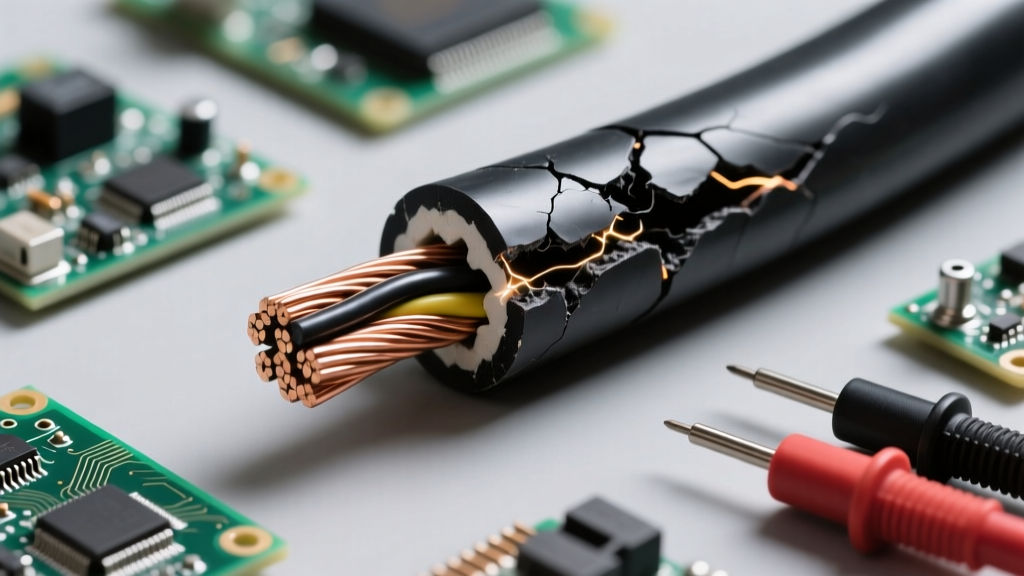
Overcurrent events, poor terminations, or sustained overloading generate excessive heat. When rubber insulation (such as Neoprene or EPDM) is subjected to temperatures beyond its thermal rating, it begins to pyrolyze. This chemical breakdown releases volatile compounds and leaves behind carbon residue. Because carbon is highly conductive, this creates microscopic conductive pathways across the rubber surface—a phenomenon known as carbon tracking. Once a carbon track forms, it acts as a resistor that generates even more heat, accelerating the failure until a dead short or ground fault occurs.
2. Moisture Ingress and Water Treeing
Rubber is generally water-resistant, but it is not entirely impermeable. In medium-voltage EPR (Ethylene Propylene Rubber) cables, prolonged exposure to moisture and electrical stress can cause "water treeing." These are microscopic, dendritic channels that form within the insulation. While the rubber itself remains an insulator, the trapped moisture and dissolved ions within these trees create localized conductive paths, drastically reducing the cable's dielectric strength and leading to eventual catastrophic breakdown.
3. Surface Contamination and Leakage
In industrial environments, rubber-jacketed cords are often dragged across floors covered in conductive dust, metallic shavings, or saline moisture. If the rubber jacket becomes deeply embedded with these contaminants, the surface of the rubber can become conductive. This surface leakage won't show up on a standard multimeter but will easily trip a 5mA GFCI receptacle.
Field Diagnostics: Testing Rubber-Jacketed Cables
If you suspect a rubber-insulated cable is conducting, a standard digital multimeter (DMM) is virtually useless for diagnosis. A DMM typically applies less than 3 volts DC to measure resistance, which is entirely insufficient to detect microscopic insulation breakdowns in a 600V SOOW cable.
Instead, you must use an Insulation Resistance Tester (commonly known as a Megger), such as the Fluke 1587 or Megger MIT485. According to Megger's insulation testing guidelines, testing a standard 600V rubber-jacketed cable requires applying 500V DC between the conductor and the ground/armor for one minute.
The 1-Megohm Rule: The National Electrical Code (NFPA 70) and NETA standards generally dictate that insulation resistance should be at least 1 megohm per 1,000 volts of operating voltage. If your 600V rubber cable reads below 1 megohm at 500V DC, the rubber has degraded and is leaking current.
Common Failure Modes in Rubber-Insulated Wiring
Use the following diagnostic matrix to identify why your rubber insulation is failing and allowing conductivity.
| Failure Mode | Visual Indicator | Electrical Symptom | Troubleshooting Action |
|---|---|---|---|
| Carbon Tracking | Blackened, charred pathways on the jacket or terminations | Intermittent ground faults, GFCI tripping | Replace cable; inspect lugs for high-resistance connections causing heat |
| Ozone Cracking | Micro-fissures perpendicular to cable bends (common in Neoprene) | Leakage current when cable is flexed or exposed to humidity | Upgrade to ozone-resistant EPDM or Silicone rubber jackets |
| Swell/Degradation | Spongy, swollen jacket (indicates oil/chemical exposure) | Reduced dielectric strength, potential short circuits | Verify chemical compatibility; replace with CPE or specialized oil-resistant rubber |
| Mechanical Abrasion | Exposed copper strands, flattened jacket sections | Direct ground faults, breaker trips instantly | Implement physical cable protection (cord covers, strain reliefs) |
Environmental Factors: Ozone and UV Degradation
Not all rubbers are created equal. When troubleshooting outdoor or industrial equipment, the specific polymer blend matters immensely. Natural rubber and standard Neoprene are highly susceptible to ozone cracking. Ozone (O3) attacks the double bonds in the polymer chains, causing microscopic fissures. When these fissures fill with conductive moisture or industrial dust, the rubber effectively becomes a conductor along its surface.
Conversely, Southwire's material specifications highlight that EPDM (Ethylene Propylene Diene Monomer) and Silicone rubbers lack these vulnerable double bonds, making them inherently resistant to ozone and UV degradation. If you are repeatedly troubleshooting ground faults on outdoor rubber cords, verify the jacket material. Swapping a failing Neoprene cord for an EPDM SOOW cable is a common, permanent fix for outdoor conductivity issues.
The Exception: Specialty Conductive Rubbers
While troubleshooting usually focuses on rubber failing as an insulator, it is vital to recognize that engineered conductive rubbers exist. By loading a silicone or EPDM matrix with high concentrations of carbon black, metallic flakes, or carbon nanotubes, manufacturers create elastomers with volume resistivities as low as 0.01 ohm-cm.
These materials are intentionally used for:
- EMI/RFI Shielding: Gaskets in military and aerospace electronics enclosures.
- Anti-Static Matting: Floor mats in explosive environments or sensitive server rooms to safely bleed off static charge.
- High-Voltage Stress Grading: Semi-conductive layers in medium-voltage cable designs to smooth the electric field.
If you encounter a black rubber component in a specialized chassis and measure continuity across it, do not assume it is a degraded insulator; it may be a purpose-built conductive elastomer.
Summary Checklist for Electricians and DIYers
- Never trust a DMM for insulation testing. Use a Megger at the correct DC voltage to test rubber jackets.
- Look for carbon. Any black, powdery residue on or near rubber insulation indicates thermal breakdown and conductive tracking.
- Check the environment. Match the rubber type (Neoprene vs. EPDM) to the presence of ozone, oils, and UV light.
- Remember the 1-Megohm rule. Anything less means the rubber is no longer functioning as an insulator.