
The Legacy of the IMX219: Why Compare the Raspberry Pi Camera V2 Today?
When the Raspberry Pi Foundation released the Camera Module V2 in 2016, the Sony IMX219 sensor became the undisputed gold standard for hobbyist computer vision, DIY security, and 3D printer monitoring. Fast forward to today, and the SBC landscape has shifted dramatically. With the introduction of the Pi 5, the RP1 I/O controller, and advanced ISP (Image Signal Processor) pipelines in Raspberry Pi OS Bookworm, builders are forced to ask: is the legacy Raspberry Pi Camera V2 still worth deploying in new hardware builds, or should you exclusively reach for the V3, HQ, or Global Shutter modules?
In this deep-dive hardware comparison, we strip away the marketing fluff and examine the electrical realities, optical benchmarks, and real-world failure modes of the V2 against its modern successors. Whether you are wiring up a Home Assistant node or building an edge-AI sorting robot, understanding the silicon-level differences is critical for your bill of materials.
Sensor Architecture & Optical Benchmarks
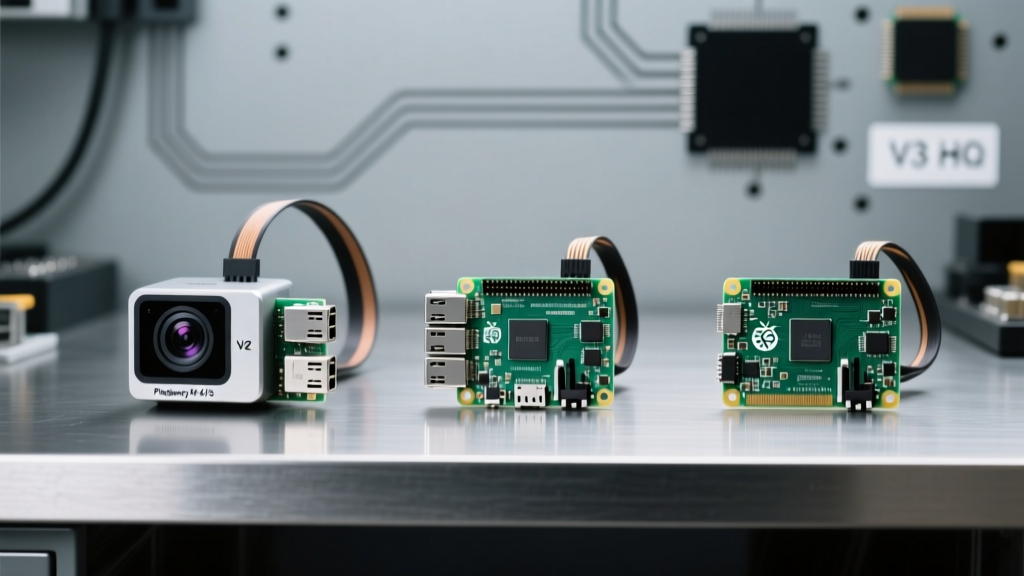
To understand the performance delta between these modules, we must look at the underlying silicon. The Raspberry Pi Camera V2 relies on the Sony IMX219, an 8-megapixel rolling-shutter CMOS sensor with a 1.12µm pixel size. While revolutionary at its launch, modern modules have vastly surpassed its light-gathering capabilities.
| Camera Module | Sensor Model | Resolution | Pixel Size | Focus Mechanism | Shutter Type | Approx. Price |
|---|---|---|---|---|---|---|
| Camera V2 | Sony IMX219 | 8MP (3280 x 2464) | 1.12µm | Fixed (Manual) | Rolling | $25 - $30 |
| Camera V3 | Sony IMX708 | 12MP (4608 x 2592) | 1.4µm | PDAF (Motorized) | Rolling | $30 - $35 |
| HQ Camera | Sony IMX477 | 12.3MP (4056 x 3040) | 1.55µm | Interchangeable Lens | Rolling | $50 (Body Only) |
| GS Camera | Sony IMX296 | 1.6MP (1456 x 1088) | 3.45µm | Interchangeable Lens | Global | $50 (Body Only) |
Low-Light Performance & Dynamic Range
The most glaring limitation of the Raspberry Pi Camera V2 in modern deployments is its low-light performance. The 1.12µm pixels on the IMX219 struggle with photon starvation, resulting in significant luminance noise (chroma artifacts) when the gain is pushed past ISO 400 in libcamera. By contrast, the IMX708 in the V3 module features larger 1.4µm pixels and native HDR (High Dynamic Range) interleaving. The V3 can capture alternating long and short exposure lines simultaneously, merging them in the Pi's ISP to prevent blown-out highlights in high-contrast scenes—something the V2 simply cannot do natively without severe software-based bracketing latency.
Autofocus vs. Fixed Focus Mechanics
The V2 features a fixed-focus lens with a factory-set focal distance of roughly 0.5 meters to infinity. While the tiny plastic lens can be manually rotated with tweezers to achieve macro focus (a popular hack for 3D printer nozzle monitoring), it is permanently locked in place by a drop of UV adhesive. The V3, however, introduces PDAF (Phase Detection Auto Focus). By utilizing dedicated mask pixels on the IMX708 sensor, the V3 calculates phase differences to drive its internal voice coil motor (VCM), achieving rapid, continuous autofocus without the contrast-hunting latency that plagues older software-based AF algorithms.
Real-World Failure Modes: Cable, Connector, and Thermal Issues
Hardware theory is only half the battle. As domain experts who have deployed hundreds of Pi cameras in industrial and outdoor environments, we track failure modes. The V2 has a very specific set of vulnerabilities that builders must account for.
Expert Insight: The number one cause of catastrophic failure on the Raspberry Pi Camera V2 is hot-plugging the CSI ribbon cable. The 15-pin, 1mm pitch FFC (Flexible Flat Cable) does not have a guaranteed hot-swap sequence. If the 5V line makes contact before the ground pins, or if a static discharge hits the MIPI CSI-2 data lanes, you will instantly fry the LDO voltage regulator (U3) on the V2 PCB or permanently damage the Pi's CSI receiver IC.
- FFC Ribbon Degradation: The standard 15-pin cable is highly susceptible to micro-fractures at the fold points. In environments with high vibration (e.g., CNC machines, robotics), the copper traces inside the Kapton sheath will snap, leading to I2C timeout errors (
mmal: mmal_vc_port_enable: failed to enable port). - Thermal Drift: The IMX219 generates noticeable heat during continuous 1080p60 video streaming. Because the V2 PCB lacks dedicated thermal vias or a heatsink pad, prolonged operation in unventilated enclosures can cause thermal throttling of the sensor, manifesting as horizontal banding in the raw Bayer data.
- Dust Intrusion: The V2's lens is mounted directly over the sensor glass with minimal sealing. In dusty workshops, particulate matter easily bypasses the adhesive ring, settling on the IR filter. This creates permanent, out-of-focus shadows on the image plane that no amount of software sharpening can remove.
Software Compatibility: Libcamera vs. Legacy MMAL
Perhaps the most critical consideration for deploying the Raspberry Pi Camera V2 today is the software stack. Older tutorials heavily reference raspistill and raspivid. These tools rely on the MMAL (Multi-Media Abstraction Layer) framework, which has been entirely deprecated and removed from Raspberry Pi OS Bullseye and Bookworm.
Today, all camera operations are handled by the libcamera framework. The V2 is fully supported by libcamera, but the tuning files (imx219.json) are vastly different from the V3's. Because the V2 lacks a motorized focus element, the libcamera-af daemon will simply ignore contrast-based focus sweeps on the V2, defaulting to a fixed hyperfocal distance. If you are porting legacy OpenCV or Python Picamera2 scripts, you must ensure your code calls the modern Picamera2 API rather than the deprecated Picamera library, which will fail to initialize the V2 on a Pi 4 or Pi 5 running modern kernels.
For authoritative setup details and tuning file configurations, always refer to the Raspberry Pi Official Camera Documentation. Furthermore, the transition to hardware-accelerated ISP pipelines on the Pi 5's RP1 chip means that the V2's MIPI lane timing is handled entirely differently than on the Pi 4's Unicam peripherals, occasionally requiring specific config.txt overlays for third-party SBCs like the Orange Pi or Jetson Nano.
Cost-to-Performance Decision Framework
Should you buy the Raspberry Pi Camera V2, or has it been entirely superseded? The answer depends strictly on your project's physical and computational constraints. Below is our decision framework for SBC builders.
When to Choose the V2
- Legacy Enclosures & Mounts: If you are replacing a dead module in an existing 3D-printed enclosure or a commercial kiosk designed specifically for the V2's exact 25mm x 24mm PCB footprint, the V2 remains the most frictionless drop-in replacement.
- High-Frame-Rate Edge AI: The IMX219 can output 720p at 180fps and VGA at 200fps by utilizing sensor cropping and binning. For fast-moving object detection (like projectile tracking or high-speed conveyor belt sorting) where resolution is secondary to temporal fidelity, the V2's high-speed MIPI readout modes are still highly competitive.
- Strict Budget Constraints: At bulk pricing, the V2 can often be found for under $20, making it viable for swarm robotics or disposable environmental monitoring nodes where replacing a $50 HQ camera would be financially unfeasible.
When to Upgrade to V3 or HQ
- Smart Home & Security (Frigate / Home Assistant): If you are feeding RTSP streams into Frigate for person detection, the V3's superior low-light HDR and PDAF will drastically reduce false-positive ghosting and motion blur at dusk. The V2's rolling shutter will warp fast-moving subjects, confusing YOLO-based AI models.
- Macro Photography & PCB Inspection: If your project involves automated optical inspection (AOI) of solder joints or macro timelapses, the HQ Camera with a dedicated C-mount macro lens is mandatory. The V2's fixed plastic lens lacks the optical resolution to resolve sub-millimeter trace details.
- Machine Vision with Strobes: If you are using external LED strobes to freeze motion on a production line, the rolling shutter of the V2 will cause severe skewing. You must upgrade to the Global Shutter (GS) module to ensure all pixels expose simultaneously.
Final Verdict for SBC Builders
The Raspberry Pi Camera V2 is a masterclass in hardware longevity. Its IMX219 sensor laid the groundwork for an entire generation of DIY computer vision. However, as we navigate the hardware landscape of 2026, it has transitioned from a 'general-purpose' module to a 'niche legacy' component. For new, ground-up builds requiring reliable autofocus, low-light clarity, or modern HDR pipelines, the V3 is the undisputed successor and offers vastly superior value per dollar. Reserve the V2 for high-speed edge-AI cropping, strict budget constraints, or maintaining legacy physical deployments. Always prioritize ESD-safe handling and never hot-plug the CSI ribbon to ensure your hardware survives the build process.
For further reading on sensor tuning and ISP pipelines, the Raspberry Pi Camera Module 3 Launch Announcement provides excellent architectural context on how modern sensors interface with the Pi's hardware ISP.