
The NEC 110.14(C) Termination Rule: The 75°C Bottleneck
When determining the correct 250 amp wire size for a heavy-duty feeder, residential service entrance, or commercial subpanel, the most common mistake electricians and DIYers make is referencing the 90°C column of NEC Table 310.16. While modern insulation types like THHN and XHHW-2 are indeed rated for 90°C, the National Electrical Code (NEC) imposes a strict bottleneck at the termination points.
According to NEC Article 110.14(C), the termination provisions of equipment for circuits rated over 100 amperes are generally limited to the 75°C column. Unless your breaker, lug, and busbar are explicitly listed and marked for 90°C—which is exceptionally rare in standard commercial and residential switchgear—you must size your ungrounded conductors using the 75°C ampacity column. Using the 90°C column for a 250A feeder will result in an undersized wire, a failed inspection, and a severe fire hazard due to thermal degradation of the breaker lugs.
Sizing the Ungrounded Conductors: Copper vs. Aluminum
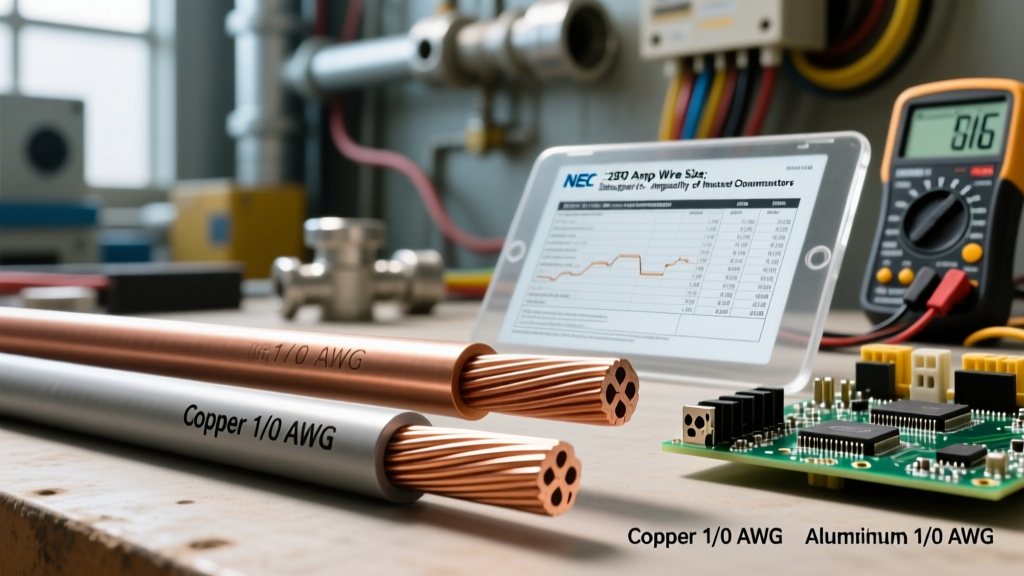
To safely carry 250 amps continuously without tripping the overcurrent protection device (OCPD) or exceeding terminal temperature ratings, you must select the appropriate kcmil (thousand circular mils) gauge. Below is the definitive breakdown based on the 75°C column of NEC Table 310.16.
| Conductor Material | Required Gauge (75°C) | Ampacity at 75°C | Approx. Outside Diameter |
|---|---|---|---|
| Copper (THHN/THWN-2) | 250 kcmil | 255 Amps | 0.68 inches |
| Aluminum (XHHW-2) | 350 kcmil | 250 Amps | 0.75 inches |
Scenario A: Copper Feeders (250 kcmil)
Copper is the gold standard for conductivity and physical durability. A 250 kcmil copper conductor yields 255 amps at 75°C, safely clearing the 250A requirement. However, copper is heavy, expensive, and notoriously stiff. Pulling three strands of 250 kcmil copper through 2-inch PVC conduit requires significant physical effort, specialized pulling lubricant, and careful attention to the conduit's bend radius to avoid damaging the insulation or work-hardening the metal.
Scenario B: Aluminum Feeders (350 kcmil)
For long service entrance runs, aluminum is the industry standard due to its vastly lower cost and lighter weight. However, because aluminum has roughly 61% the conductivity of copper, you must step up to 350 kcmil aluminum to achieve exactly 250 amps at 75°C. When using aluminum, it is a code-mandated best practice (and often a manufacturer requirement) to apply an anti-oxidant compound like Noalox to the stripped conductor ends before torquing them into the lugs. This prevents galvanic corrosion and the formation of aluminum oxide, which is highly resistive and a leading cause of thermal failures at the panel.
Equipment Grounding Conductor (EGC) Sizing per Table 250.122
Sizing the hot and neutral conductors is only half the battle. The NEC requires an Equipment Grounding Conductor (EGC) sized specifically to the rating of the overcurrent device, not the ampacity of the ungrounded conductors. This ensures that in the event of a ground fault, the EGC can carry enough instantaneous current to trip the 250A breaker in milliseconds, preventing electrocution and arc flashes.
Referencing NEC Table 250.122, the minimum EGC sizes for a 250A breaker are:
- Copper EGC: 4 AWG
- Aluminum EGC: 2 AWG
Pro-Tip: If you are upsizing your ungrounded conductors to compensate for voltage drop over a long distance (e.g., running 300 feet to a detached barn), NEC 250.122(B) requires you to increase the size of your EGC proportionally. You cannot leave the ground wire at 4 AWG if you've bumped your hots to 350 kcmil copper for voltage drop mitigation.
Ambient Temperature Correction and Conduit Derating
The ampacities listed above assume an ambient temperature of 30°C (86°F) and no more than three current-carrying conductors in a raceway. Real-world installations rarely match these laboratory conditions.
The Attic and Rooftop Penalty
If your 250A feeder is routed through an unventilated attic in the summer, or exposed to direct sunlight on a rooftop, the ambient temperature can easily exceed 50°C (122°F). According to NEC Table 310.15(B)(1)(1), you must apply a correction factor. At 50°C, the correction factor for 90°C-rated wire is 0.82. You multiply the 90°C base ampacity (290A for 250 kcmil Cu) by 0.82, yielding 237A. This is below your 250A requirement, meaning you must upsize to 300 kcmil copper to maintain code compliance in high-heat environments.
XHHW-2 vs. THHN-2 Conduit Fill
When pulling 350 kcmil aluminum, conduit fill becomes a major logistical hurdle. Many electricians default to THHN, but XHHW-2 is vastly superior for large feeders. XHHW-2 features a cross-linked polyethylene (XLPE) insulation that is significantly thinner than the PVC/nylon jacket of THHN. This smaller outside diameter drastically reduces conduit fill percentage, allowing you to potentially drop from a 2.5-inch conduit to a 2-inch conduit, saving hundreds of dollars in PVC, fittings, and pulling labor.
Real-World Installation: Torque Specifications and Failure Modes
Since the 2017 NEC cycle, Article 110.14(D) has strictly required that all terminations be torqued to the manufacturer's specified values using a calibrated torque tool. Guessing the tightness by 'feel' on a 250A lug is a catastrophic error.
A typical 250 kcmil or 350 kcmil mechanical lug requires between 300 and 500 inch-pounds of torque. If under-torqued, the high resistance will generate immense heat under a 200A continuous load, eventually melting the lug and igniting the surrounding insulation. If over-torqued, you risk snapping the lug's set screw, stripping the threads, or cold-flowing the aluminum conductor, which creates a loose connection that will fail within months due to thermal expansion and contraction cycles.
Always use a calibrated dial or digital torque wrench, verify the lug manufacturer's spec sheet (often stamped directly on the breaker or busbar), and perform annual thermographic (infrared) inspections on the panel under full load to ensure the 250 amp wire size and terminations are performing safely over the life of the installation.