
The Hidden Dangers of Misusing a Digital Multimeter
When beginners ask, "how do you use a digital multimeter," they are usually focused on reading the display. However, professional electricians and electronics engineers know that the real challenge lies in doing so without causing an arc flash, destroying the equipment, or injuring yourself. A digital multimeter (DMM) is a high-impedance diagnostic tool, but when used incorrectly, it can become a dead-short pathway across high-energy circuits.
According to OSHA Electrical Safety guidelines, improper testing equipment and faulty measurement techniques are leading contributors to electrical workplace incidents. This guide shifts the focus from basic operation to critical safety protocols, measurement category (CAT) ratings, and the physical failure modes of multimeters. Whether you are using a premium Fluke 87V or a budget-friendly Klein Tools MM400, understanding the physics of your tool is your first line of defense.
Decoding CAT Ratings: Your Primary Defense Against Transients
Before you even touch a probe to a conductor, you must verify the Measurement Category (CAT) rating printed on the meter's faceplate. Many hobbyists assume a CAT II 600V meter is safe for industrial panels because 600V is higher than the 480V they are measuring. This is a fatal misconception. CAT ratings do not just measure steady-state voltage; they define the meter's ability to withstand transient overvoltages (spikes that can exceed 8,000V at the service entrance).
| CAT Rating | Environment | Typical Sources | Transient Risk Level |
|---|---|---|---|
| CAT I | Electronics & Telecom | PCBs, signal generators, audio gear | Low (Protected by building wiring) |
| CAT II | Single-Phase Receptacles | Appliances, portable tools, standard 120V/240V outlets | Moderate (Impedance of branch wiring limits spikes) |
| CAT III | Three-Phase Distribution | Motor controls, lighting panels, sub-panels, HVAC systems | High (Close to main distribution, low impedance path) |
| CAT IV | Service Entrance / Origin | Utility meters, main breakers, underground vaults, solar arrays | Extreme (Direct connection to high-capacity utility transformers) |
Best Practice: Always use a meter rated for the environment or higher. If you are troubleshooting a 480V CAT III motor starter, a CAT III 600V or CAT IV 600V meter is mandatory. For a deeper dive into transient protection, refer to Fluke's Electrical Safety resources.
The Mandatory Pre-Flight Inspection
Never assume your multimeter is safe to use simply because it worked yesterday. Environmental stress, drops, and previous over-current events can compromise the tool's integrity.
- Inspect Probe Insulation: Look for micro-tears, burn marks, or melted tips. Exposed copper on a probe wire can lead to accidental contact with adjacent phases, causing a phase-to-phase short.
- Verify Finger Guards: Ensure the tactile ridge (finger guard) on your test leads is intact. This physical barrier prevents your fingers from slipping past the safe grip zone and touching the energized metal tip.
- Check the Battery: A low battery can cause erratic readings. More importantly, some DMMs disable their internal protection circuitry or give false 'safe' readings when power is critically low.
The "Live-Dead-Live" Verification Protocol
Before trusting a meter to tell you a circuit is de-energized (Dead), you must prove the meter is functioning correctly. The NFPA 70E Standard mandates the Live-Dead-Live test for any work on circuits over 50V.
- Live: Test your DMM on a known, verified live voltage source (e.g., a dedicated proving unit or a known live receptacle). Confirm the meter reads the expected voltage.
- Dead: Test the target circuit you intend to work on. Verify the reading is 0.00V across all phase-to-phase and phase-to-ground combinations.
- Live: Immediately return to the original known live source to ensure the meter's internal fuse or circuitry did not fail during the 'Dead' test.
How Do You Use a Digital Multimeter for Voltage Safely?
When measuring AC or DC voltage, the internal impedance of the DMM is typically around 10 Megohms. This high resistance limits current flow, making voltage measurement inherently safer than current measurement—provided you follow the One-Hand Rule.
When probing live panels, keep one hand in your pocket or behind your back. If you use both hands to hold the probes and accidentally contact an energized source with both hands, the current will travel across your chest, directly through your heart, increasing the risk of ventricular fibrillation. Use your dominant hand to probe, and use your non-dominant hand to secure the ground reference or hold the meter itself.
The 10-Amp Jack Trap: Preventing Catastrophic Shorts
The most common cause of multimeter explosions is attempting to measure voltage while the red probe is plugged into the 10-Amp (or mA) current jack.
The Physics of the Failure: To measure current, the multimeter uses an internal shunt resistor. In the 10A jack, this shunt is extremely low resistance (often around 0.01 ohms) to prevent voltage drop. If you place the probes across a 240V AC source while in current mode, Ohm's Law (I = V/R) dictates that 24,000 Amps will attempt to flow through the meter.
This creates an instantaneous dead short. If you are using a cheap multimeter with a standard glass fuse, the glass will shatter, the internal vaporization will create a conductive plasma, and the meter will explode in your hands. High-quality meters use High Rupturing Capacity (HRC) ceramic fuses filled with sand to quench the arc and contain the blast. Never measure voltage with the probes in the current jacks. Many modern meters feature physical warning beeps or LCD alerts if the dial is set to Volts but the lead is in the Amp jack.
Continuity and Resistance: The Golden Rule
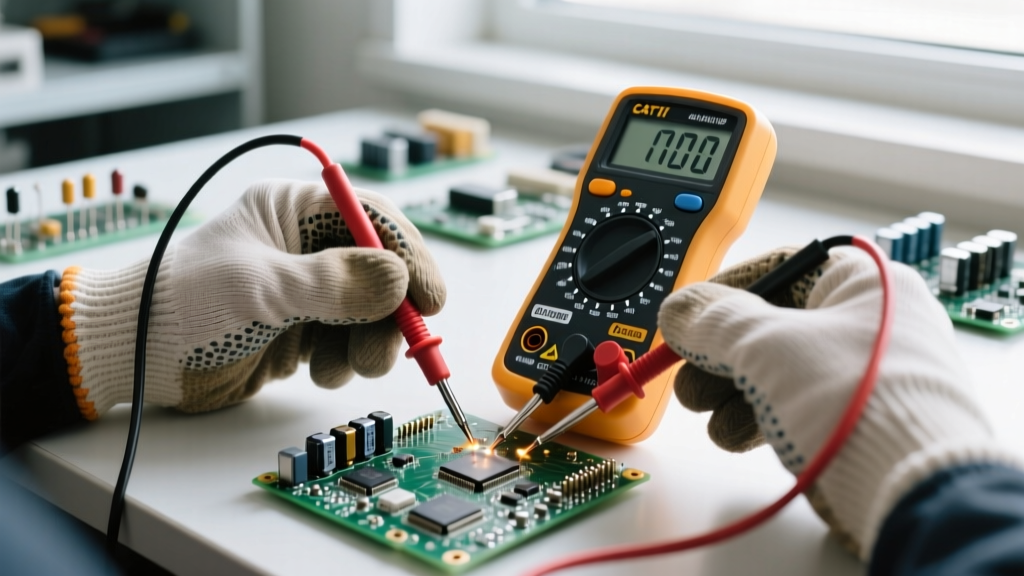
The Golden Rule of Ohmmeters: A digital multimeter outputs its own voltage from the internal battery to measure resistance. Applying an external voltage to the probes while in Ohms or Continuity mode will instantly destroy the meter's internal analog-to-digital converter and protection thermistors.
Always verify the circuit is completely de-energized before testing continuity. Furthermore, be aware of large capacitors in the circuit (such as those in power supplies or HVAC run capacitors). Even if the power is disconnected, a charged capacitor will dump its stored DC voltage into your multimeter's resistance circuitry, causing catastrophic internal failure. Always discharge capacitors using a properly rated high-wattage bleeder resistor before taking resistance measurements.
Probe Maintenance and PPE Requirements
Your test leads are the weakest link in your safety chain. Standard silicone leads degrade over time when exposed to high ambient temperatures, UV light, and soldering flux. Replace test leads annually if used in harsh industrial environments, or immediately if the silicone feels hard or cracked.
Finally, your personal protective equipment (PPE) must match the hazard. Based on the arc flash boundary calculations outlined in NFPA 70E, measuring a 480V MCC bucket may require Category 2 PPE, including an 8 cal/cm² arc-rated face shield, balaclava, and voltage-rated rubber insulating gloves with leather protectors. A CAT IV multimeter will not protect your skin from the thermal blast of an arc flash triggered by a dropped probe.
Summary Checklist for Every Measurement
- Verify the CAT rating exceeds the measurement environment.
- Inspect leads for cracked insulation and exposed wire.
- Perform the Live-Dead-Live test before trusting a zero-voltage reading.
- Practice the One-Hand Rule to prevent cross-chest current paths.
- Ensure probes are in the correct V/Ω jacks, never the A/mA jacks for voltage.
- Discharge capacitors before testing continuity or resistance.