
Understanding the Grounding Electrode Conductor (GEC)
In electrical engineering and field installations, confusing the Equipment Grounding Conductor (EGC) with the Grounding Electrode Conductor (GEC) is a common and costly mistake. While an EGC provides a low-impedance fault-current path back to the source to trip a breaker, the GEC serves an entirely different purpose. The GEC connects the electrical system's grounded conductor (usually the neutral) or the equipment grounding busbar to the earth via a grounding electrode system. Its primary jobs are to stabilize system voltage during normal operation and to dissipate high-voltage transients, such as lightning strikes or utility line cross-overs, into the earth.
Determining the correct grounding electrode conductor size is not based on the overcurrent protection device (OCPD) rating, as it is with EGCs. Instead, the National Electrical Code (NEC) mandates that the GEC be sized based on the cross-sectional area of the largest ungrounded service-entrance conductor. This tutorial will walk you through the exact calculations, parallel run mathematics, and critical NEC exceptions that save copper and money on real-world job sites.
The Core Calculation: Decoding NEC Table 250.66
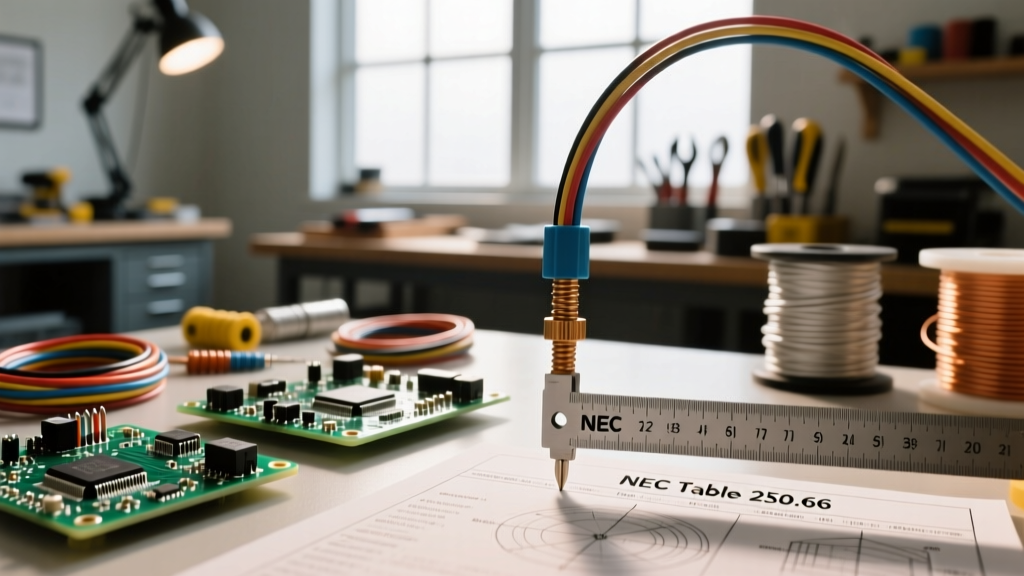
The foundational rule for sizing the GEC is found in NEC Article 250.66. The code requires you to identify the largest ungrounded (hot) service-entrance conductor feeding the main service disconnect. Once you have the American Wire Gauge (AWG) or thousand circular mils (kcmil) of that conductor, you simply cross-reference it with NEC Table 250.66.
| Size of Largest Ungrounded Service-Entrance Conductor | Copper GEC Size | Aluminum GEC Size |
|---|---|---|
| 2 AWG or smaller | 8 AWG | 6 AWG |
| 1/0 AWG | 6 AWG | 4 AWG |
| 250 kcmil | 2 AWG | 1/0 AWG |
| 500 kcmil | 1/0 AWG | 3/0 AWG |
| 900 kcmil | 2/0 AWG | 4/0 AWG |
| Over 1100 kcmil through 1750 kcmil | 3/0 AWG | 250 kcmil |
For a standard 200-amp residential service utilizing 2/0 AWG copper service-entrance conductors, Table 250.66 dictates a minimum 4 AWG copper GEC. However, commercial and industrial applications rarely rely on single conductor runs, which brings us to the most complex part of the calculation.
Handling Parallel Service-Entrance Conductors (Circular Mils Math)
When service-entrance conductors are run in parallel to handle massive ampacities (e.g., 800A to 4000A services), you cannot simply look at the size of one wire in the parallel set. According to NEC 250.66 Note 1, if ungrounded service-entrance conductors are installed in parallel, the size of the GEC must be based on the equivalent cross-sectional area of the parallel conductors. This requires calculating the total circular mils.
Calculation Example:
Imagine a 1200-amp commercial service using three parallel runs of 500 kcmil copper conductors per phase.
1. Identify the circular mils of one conductor: 500,000 cmil.
2. Multiply by the number of parallel runs: 500,000 x 3 = 1,500,000 cmil (or 1500 kcmil).
3. Consult Table 250.66 for 'Over 1100 kcmil through 1750 kcmil'.
4. The required grounding electrode conductor size is 3/0 AWG copper.
Pro-Tip: If your parallel sets are installed in multiple raceways, the GEC does not need to be run in parallel. A single 3/0 AWG copper conductor is sufficient to tie the entire system to the grounding electrode, provided it is routed in accordance with NEC 250.64 regarding physical protection and routing.
Material Constraints: Copper vs. Aluminum Sizing
While aluminum conductors are significantly cheaper and lighter than copper, their use as a GEC comes with strict environmental limitations. NEC 250.62(C) explicitly forbids the use of bare aluminum conductors in direct contact with masonry, the earth, or where subject to corrosive conditions. Furthermore, aluminum GECs cannot be terminated within 18 inches of the earth.
Because aluminum has a lower conductivity per cross-sectional area than copper, Table 250.66 requires larger aluminum conductors to achieve the same fault-dissipation capability. For instance, where a 1/0 AWG copper GEC is required for a 600 kcmil service entrance, you must step up to a 3/0 AWG aluminum GEC. Always verify the terminal ratings on your main switchboard; many modern main breaker lugs are rated for 75°C and are approved for either copper or aluminum, but older equipment may require specific anti-oxidant compounds and torque settings when terminating aluminum grounding conductors.
Critical Exceptions: When You Can Downsize the GEC
The most frequent area of overspending in electrical contracting is ignoring the exceptions in NEC 250.66. The general rule states the GEC must not be smaller than Table 250.66, but it shall not be required to be larger than specific thresholds depending on the electrode type it connects to. Understanding these exceptions provides massive information gain for value-engineering a project.
NEC 250.66(A) Connections to Rod, Pipe, or Plate Electrodes:
If your GEC connects solely to a ground rod (or a pipe/plate electrode), the grounding electrode conductor shall not be required to be larger than 6 AWG copper or 4 AWG aluminum. Even if your service entrance is 2000 kcmil (which normally demands a 3/0 AWG copper GEC), if the only electrode available is a driven ground rod, you can legally and safely downsize the GEC to 6 AWG copper.
Additional Sizing Caps:
- 250.66(B) Concrete-Encased Electrode (Ufer Ground): The GEC connecting to a Ufer ground shall not be required to be larger than 4 AWG copper. Since the concrete-encased electrode provides an incredibly low-resistance path to earth, the NEC recognizes that a massive copper wire is unnecessary to dissipate transients into the foundation's rebar network.
- 250.66(C) Ground Ring: A ground ring consists of at least 20 feet of bare copper conductor buried in the earth. The GEC connecting the service to the ground ring shall not be required to be larger than 2 AWG copper.
Important Caveat: These downsizing exceptions only apply to the portion of the GEC that connects exclusively to those specific electrodes. If you are bonding a metal water pipe (which requires the full Table 250.66 size) and a ground rod, the main GEC from the service panel to the water pipe must be fully sized (e.g., 3/0 AWG). However, you can tap off that main GEC or run a separate supplemental GEC to the ground rod, and that specific tap conductor can be reduced to 6 AWG copper.
Step-by-Step GEC Sizing Workflow for Field Electricians
To ensure compliance and pass inspection on the first attempt, follow this standardized calculation workflow:
- Identify the Service Size: Determine the AWG or kcmil of the largest ungrounded service-entrance conductor. If parallel, calculate the total equivalent circular mils.
- Consult Table 250.66: Find the baseline required copper or aluminum GEC size.
- Map the Electrode System: Identify exactly what electrodes are present (Metal water pipe, Ufer ground, ground ring, driven rod, or structural steel).
- Apply Exceptions: If the GEC connects only to a rod, Ufer, or ground ring, apply the maximum size caps (6 AWG, 4 AWG, or 2 AWG copper respectively) to save material costs.
- Verify Routing and Protection: If the GEC is 6 AWG or larger, it can generally be run exposed along the surface. If it is 8 AWG or smaller, NEC 250.64(B) requires it to be protected in a raceway or cable armor. If using a ferrous metal raceway to protect the GEC, ensure it is bonded at both ends to prevent the 'choking' effect caused by magnetic fields during a fault.
Final Thoughts on System Integrity
Sizing the grounding electrode conductor correctly bridges the gap between theoretical code compliance and practical, cost-effective installation. By mastering the circular mil calculations for parallel feeds and leveraging the NEC 250.66 exceptions for specific electrodes, electrical professionals can ensure maximum safety against transient overvoltages without wasting hundreds of dollars on oversized copper. For further reading on grounding and bonding topologies, refer to the National Fire Protection Association's NEC resources or consult technical breakdowns provided by EC&M Magazine. Always consult your local Authority Having Jurisdiction (AHJ), as local amendments can occasionally supersede baseline NEC tables.