
When electrical engineers, solar installers, and DIY enthusiasts ask, what is direct current used for, the answer spans from microscopic silicon pathways to cross-continental submarine power grids. Unlike alternating current (AC), which periodically reverses direction, direct current (DC) maintains a unidirectional flow of electrical charge. This fundamental difference dictates entirely different wiring methodologies, component selections, and safety protocols.
This comprehensive reference guide and chart breaks down the modern applications of DC power, categorizing them by voltage tiers and providing critical wire sizing considerations for each use case.
The Core Advantage: Why Choose Direct Current?
Before diving into the reference chart, it is essential to understand why DC is irreplaceable in specific scenarios. DC provides a constant, stable voltage that is mandatory for semiconductor operation, electrochemical processes (like battery charging and electroplating), and high-efficiency variable-speed motor drives. Furthermore, DC eliminates the "skin effect" seen in AC transmission, allowing the entire cross-section of a conductor to carry current, which fundamentally alters how we calculate wire ampacity and voltage drop.
Master Reference Chart: What Is Direct Current Used For?
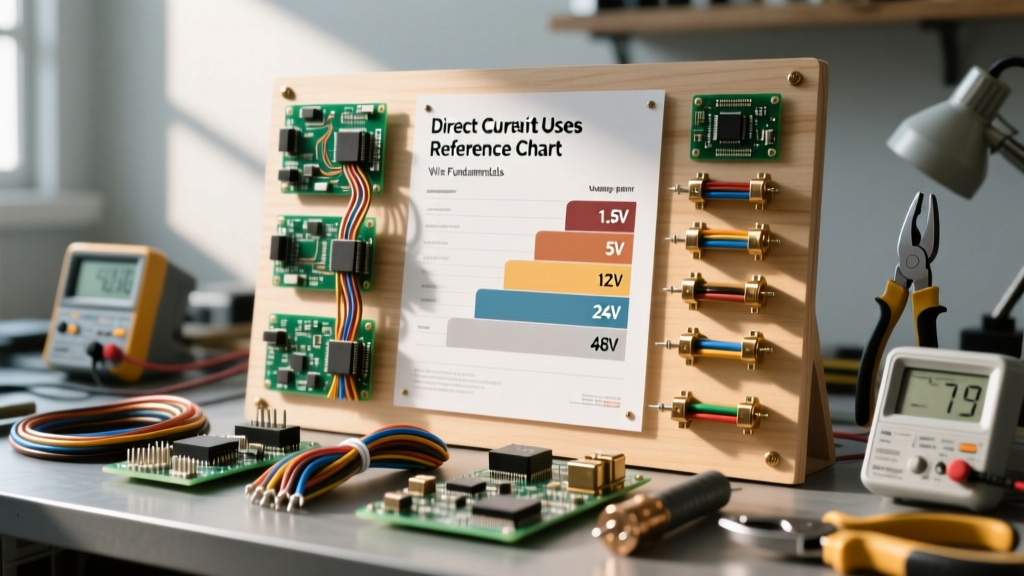
The following table serves as a quick-reference matrix for the most common DC applications, mapping the use case to standard voltages and baseline wiring requirements.
| Application Sector | Specific Use Case | Standard DC Voltage | Typical Wire Sizing (AWG) | Key Connector / Component |
|---|---|---|---|---|
| Consumer Electronics | Laptops, Smartphones, IoT | 5V - 20V | 24 AWG - 28 AWG | USB-C, Barrel Jacks |
| Telecommunications | Cell Towers, PoE Switches | -48V DC / 90W PoE | 12 AWG - 16 AWG | RJ45, Terminal Blocks |
| Automotive & Marine | 12V Accessories, Winches | 12V - 24V | 10 AWG - 2/0 AWG | Anderson Powerpole, Lugs |
| Renewable Energy | PV Solar Arrays | 600V - 1500V | 10 AWG - 12 AWG PV Wire | MC4 Connectors, Fuses |
| EV Powertrains | Traction Batteries, Fast Charging | 400V - 800V | 2 AWG - 500 MCM | High-Voltage Orange Shielding |
| Grid Transmission | Submarine Cables, Interconnects | ±320kV - ±800kV | Custom Extruded Copper/Al | Thyristor / IGBT Converters |
Deep Dive into Primary DC Application Tiers
Tier 1: Extra-Low Voltage (ELV) & Micro-DC (Under 48V)
The vast majority of consumer-facing DC applications fall into the ELV category. Digital logic boards, microcontrollers (like Arduino and ESP32), and LED lighting require precisely regulated DC voltage. A major modern application here is Power over Ethernet (PoE). The IEEE 802.3bt standard (Type 4) pushes up to 90W of DC power over standard Cat6a Ethernet cabling, utilizing the 48V DC standard to power PTZ security cameras and Wi-Fi 6 access points without needing dedicated AC wiring. Because 90W generates noticeable heat in the cable bundles, the NEC mandates specific bundle sizing limits to prevent insulation degradation.
Tier 2: Medium-Voltage DC (MVDC) & Mobility (48V – 1500V)
This tier represents the fastest-growing sector for DC power, driven by the green energy transition. In solar photovoltaic (PV) systems, panels are wired in series to create high-voltage DC strings (often 600V to 1500V) before being inverted to AC. Sizing wire for PV strings requires specialized PV wire (often 10 AWG or 12 AWG) with XLPE insulation rated for sunlight resistance and wet locations.
Similarly, modern Electric Vehicles (EVs) utilize medium-voltage DC architectures. While older EVs relied on 400V battery packs, modern platforms like the Hyundai E-GMP or Porsche 800V architecture use higher DC voltages to reduce current. Because heat generation scales with the square of the current (I²R), doubling the voltage halves the current, allowing engineers to use lighter, thinner copper wiring harnesses, directly reducing vehicle weight and increasing range. For DC fast charging, liquid-cooled CCS (Combined Charging System) cables are now required to handle the massive 350kW+ DC transfer rates without melting the conductors.
Tier 3: High-Voltage DC (HVDC) Grid Transmission (100kV+)
When addressing what direct current is used for on a macro scale, HVDC is the definitive answer for long-distance and submarine power transmission. AC transmission suffers from capacitive losses over long underwater cables and requires complex phase synchronization across different regional grids. HVDC eliminates reactive power losses. According to the U.S. Department of Energy, HVDC lines can transmit power over 1,000 miles with significantly lower line losses than equivalent AC lines, utilizing voltages often exceeding ±500kV.
Wire Sizing and Safety Fundamentals for DC Circuits
Calculating wire size for DC is fundamentally different from AC. Because DC does not experience the skin effect or proximity effect, the entire cross-sectional area of the conductor is utilized. However, DC circuits are highly susceptible to voltage drop over distance, which can severely impact the performance of low-voltage motors and sensitive electronics.
The standard formula for DC voltage drop is:
Voltage Drop = (2 × L × I × R) / 1000
Where:
L = One-way length of the wire in feet
I = Current in Amperes
R = Resistance of the wire per 1,000 feet (found in NEC Chapter 9, Table 8)
Practical Example: If you are wiring a 12V DC marine windlass drawing 80 Amps, located 15 feet from the battery bank, using 4 AWG copper wire (which has a resistance of roughly 0.292 ohms per 1,000 ft), the voltage drop is: (2 × 15 × 80 × 0.292) / 1000 = 0.70 Volts. This represents a 5.8% drop. For critical motor starting, the National Electrical Code (NEC) and ABYC marine standards recommend keeping voltage drop under 3% for critical loads, meaning you would need to step up to 2 AWG or 1 AWG wire to ensure reliable cranking torque.
Expert Insights: DC Arc Faults and Connector Degradation
One of the most dangerous aspects of DC power is its tendency to sustain electrical arcs. In an AC circuit, the voltage crosses zero 120 times a second (in a 60Hz system), which naturally extinguishes electrical arcs. DC voltage never crosses zero. If a connection is pulled apart under load, or if wire insulation degrades and shorts, the resulting DC arc can sustain extremely high temperatures, leading to catastrophic fires.
This is why the National Renewable Energy Laboratory (NREL) and the NEC (Article 690.11) mandate Arc-Fault Circuit Interrupters (AFCIs) for solar PV systems operating above 80V DC. When working with DC, always use ratcheting crimpers for terminal lugs, apply dielectric grease to prevent galvanic corrosion in marine environments, and never disconnect MC4 solar connectors while the circuit is under load.
Summary
Understanding what direct current is used for requires looking at both the micro and macro scales of modern electrical infrastructure. From the 5V logic powering your microcontrollers to the ±800kV HVDC lines stabilizing continental power grids, DC is the backbone of modern electronics, renewable energy, and electric mobility. Proper wire sizing, an understanding of voltage drop, and strict adherence to DC-specific safety protocols are essential for any successful electrical installation.