
The Short Answer: Copper is a Premier Conductor
When asking is copper an insulator or conductor, the definitive answer is that copper is one of the most efficient electrical conductors known to science. It is the global benchmark against which all other conductive materials are measured. In electrical engineering, wiring, and PCB design, copper's primary role is to facilitate the unhindered flow of electrons. However, understanding its exact behavior requires looking beyond a simple binary answer, especially when factoring in surface oxidation, high-frequency RF applications, and thermal dynamics.
Quick Reference Verdict: Pure copper is a conductor. It serves as the baseline for electrical conductivity, rated at exactly 100% IACS (International Annealed Copper Standard).
Atomic Breakdown: Why Copper Conducts Electricity
To understand why copper is a conductor rather than an insulator, we must examine its atomic structure. Copper (Cu) has an atomic number of 29. Its electron configuration is [Ar] 3d10 4s1. The critical factor here is the single valence electron in the 4s orbital. This outermost electron is very loosely bound to the nucleus, requiring minimal energy to break free.
In a solid copper crystal lattice, these loosely bound valence electrons detach from their parent atoms and form a 'sea of electrons' (or electron gas). When an electrical potential difference (voltage) is applied across a copper wire, this sea of free electrons drifts in a unified direction, creating electrical current. Insulators, by contrast, have tightly bound valence electrons (usually in full outer shells) that require massive amounts of energy to dislodge, effectively preventing current flow under normal conditions.
Resistivity and the IACS Standard
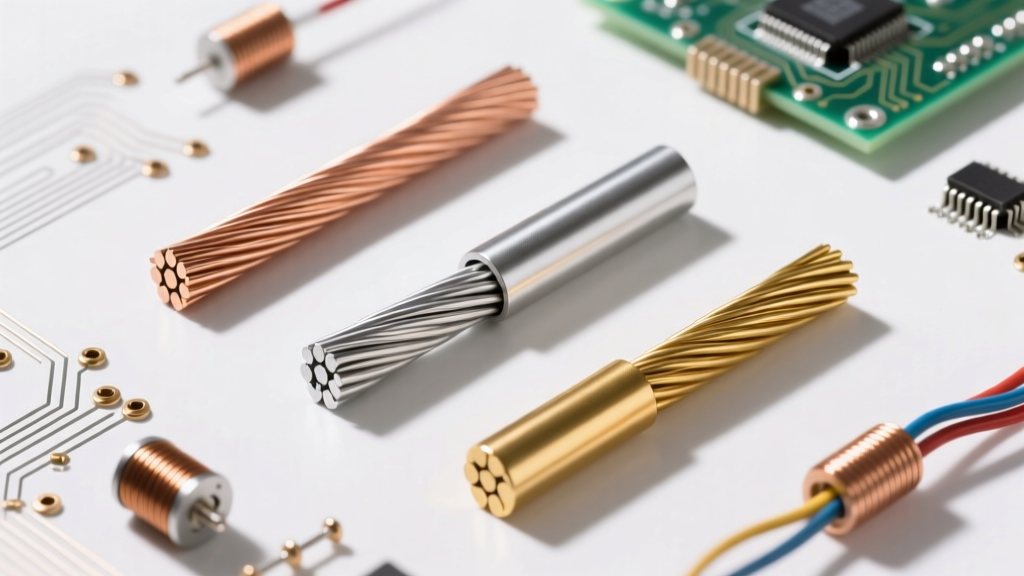
According to Georgia State University HyperPhysics, the electrical resistivity of pure annealed copper at 20°C is approximately 1.68 × 10^-8 Ω·m. This exceptionally low resistivity is why the Copper Development Association (CDA) and international bodies use it as the 100% IACS baseline. Any material with a higher IACS percentage (like silver at ~105%) is a better conductor, while anything lower (like aluminum at ~61%) is less conductive.
Quick Reference Comparison: Copper vs. Other Materials
The table below contextualizes copper's conductive properties against common conductors and insulators used in electrical systems.
| Material | Classification | Resistivity (Ω·m at 20°C) | Conductivity (% IACS) | Primary Electrical Application |
|---|---|---|---|---|
| Silver | Conductor | 1.59 × 10^-8 | 105% | RF contacts, high-end audio, satellite components |
| Copper | Conductor | 1.68 × 10^-8 | 100% | Branch wiring, busbars, PCB traces, motor windings |
| Gold | Conductor | 2.44 × 10^-8 | 70% | Corrosion-resistant connector plating, IC bonding |
| Aluminum | Conductor | 2.82 × 10^-8 | 61% | Overhead transmission lines, heavy feeder cables |
| PVC (Polyvinyl Chloride) | Insulator | ~1.0 × 10^14 | 0% | Wire jacketing, conduit insulation |
| Glass / Ceramic | Insulator | ~1.0 × 10^12 | 0% | High-voltage standoff insulators, fuse bodies |
The Anomaly: When Does Copper Act Like an Insulator?
While the bulk material of copper is undeniably a conductor, there are specific real-world scenarios where copper interfaces exhibit insulating or semiconducting properties. Recognizing these failure modes is critical for electricians and electronics engineers.
1. The Copper Oxide Semiconductor Layer
When exposed to oxygen and moisture, copper oxidizes. It forms two primary oxides: Cuprous oxide (Cu2O) and Cupric oxide (CuO). Unlike aluminum oxide, which is a strict and highly durable electrical insulator, copper oxides are actually p-type semiconductors. While they do not conduct electricity as efficiently as pure copper, they allow partial current flow under certain voltage thresholds. In low-voltage, high-current DC applications (like solar panel busbars or battery banks), this oxide layer introduces significant contact resistance, leading to localized heating, voltage drops, and potential thermal runaway. This is why antioxidant compounds (like Noalox) or tin-plating are applied to copper lugs to prevent the oxide layer from forming.
2. Magnet Wire and Intentional Insulation
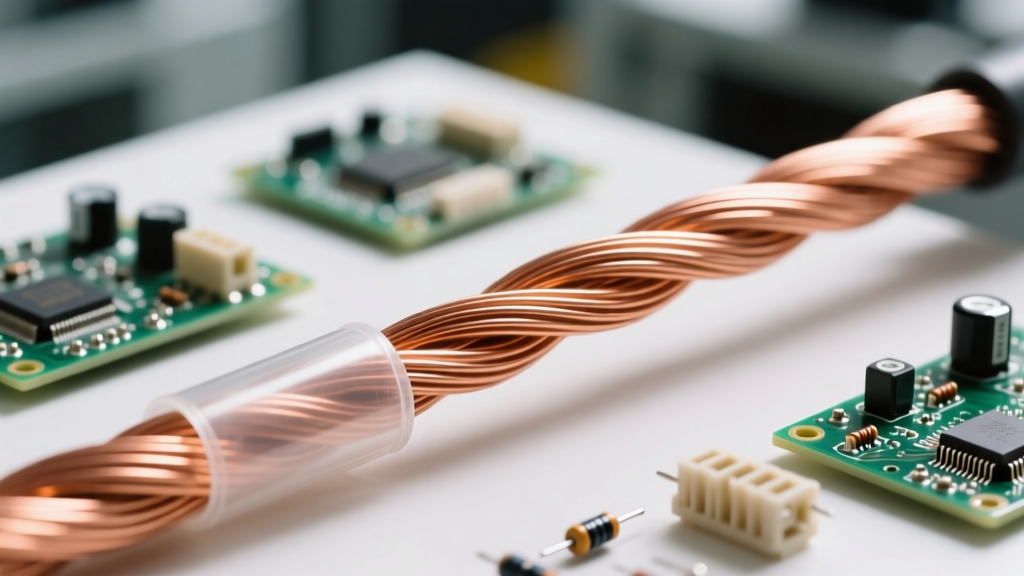
In transformers, inductors, and electric motors, you will frequently encounter 'magnet wire.' This is solid copper wire coated in a microscopically thin layer of dielectric enamel (such as polyurethane, polyester, or polyimide/Kapton). In this specific application, the copper core acts as the conductor, while the engineered polymer coating acts as the insulator, allowing the wire to be wound tightly coil-over-coil without creating short circuits.
High-Frequency Behavior: The Skin Effect
In AC (Alternating Current) systems, particularly at high radio frequencies (RF), current does not flow uniformly through the entire cross-section of a copper conductor. Due to the 'skin effect,' the electromagnetic field forces the majority of the electron flow to the outer surface (the 'skin') of the wire.
If the surface of the copper is heavily oxidized or contaminated, the effective conductivity of the wire plummets, mimicking the behavior of a poor conductor or partial insulator. To combat this in high-frequency RF applications, engineers often use silver-plated copper wire. Silver has a higher conductivity than copper and resists the formation of high-resistance surface oxides, ensuring the 'skin' of the conductor remains highly efficient.
Thermal Dynamics and NEC Ampacity Derating
Copper's conductivity is highly sensitive to temperature. The temperature coefficient of resistance for copper is approximately 0.00393 /°C. This means that for every 1°C increase in temperature, the electrical resistance of the copper increases by roughly 0.393%.
As resistance increases, conductivity decreases. If a copper wire is undersized for a given load, it will heat up. This heat increases resistance, which generates even more heat—a dangerous positive feedback loop. To prevent insulation meltdown and fires, the National Electrical Code (NFPA 70) mandates strict ampacity tables and thermal derating factors. For example, a 12 AWG THHN copper conductor might be rated for 30 amps in a free-air, 30°C environment, but if bundled with other current-carrying conductors in a hot attic (40°C+), its effective ampacity must be mathematically derated to prevent the copper from exceeding its safe thermal limits.
Summary Checklist for Electrical Professionals
- Bulk Material: Copper is fundamentally a conductor (100% IACS).
- Surface Condition: Unprotected copper forms oxide layers that act as semiconductors, increasing contact resistance.
- Thermal Limit: Copper's resistance rises with heat; always apply NEC temperature correction factors.
- RF Applications: High-frequency AC travels on the surface; keep copper surfaces clean or use silver-plating to avoid skin-effect losses.
- Magnet Wire: The copper core conducts, but the outer enamel coating insulates to prevent short circuits in coils.