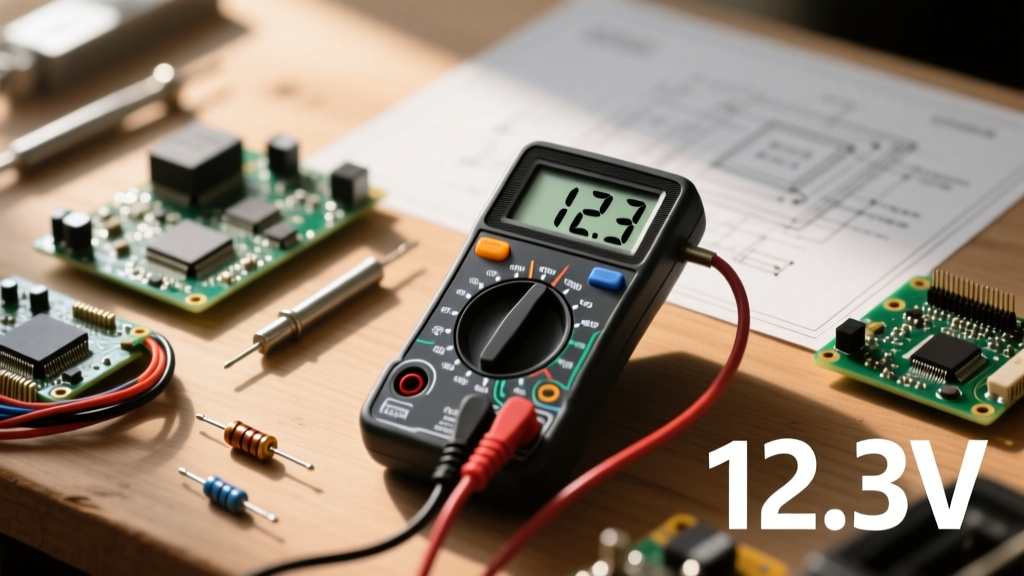

When it comes to electrical diagnostics and electronics repair, checking voltage with a multimeter is the most fundamental yet potentially dangerous task you can perform. Whether you are troubleshooting a dead HVAC control board, verifying mains power at a receptacle, or debugging a microcontroller's power rail, the tool you choose dictates both your safety and your diagnostic accuracy. In this comprehensive tool review and guide, we evaluate three industry-standard multimeters through the specific lens of voltage measurement, input impedance, and safety ratings.
The Hidden Dangers of Ghost Voltage and Input Impedance
Before diving into specific models, it is critical to understand why certain multimeters excel at voltage testing while others lead you astray. Standard digital multimeters (DMMs) feature a high input impedance, typically around 10MΩ (megohms). This is excellent for testing sensitive electronic circuits because it prevents the meter from drawing current and altering the circuit's behavior.
However, in industrial and residential wiring, high impedance creates a phenomenon known as ghost voltage. When de-energized wires run parallel to live wires in the same conduit or Romex sheathing, capacitive coupling can induce a phantom voltage of 40V to 90V. A standard 10MΩ multimeter will read this ghost voltage as real, leading technicians to believe a circuit is live when it is actually safe to touch. To combat this, advanced multimeters feature a LoZ (Low Impedance) mode, which drops the internal resistance to roughly 3kΩ, bleeding off the capacitive charge and revealing the true 0V state. For a deeper dive into this phenomenon, refer to Fluke's official guide on Low Impedance testing.
Top Multimeters Reviewed for Voltage Accuracy and Safety
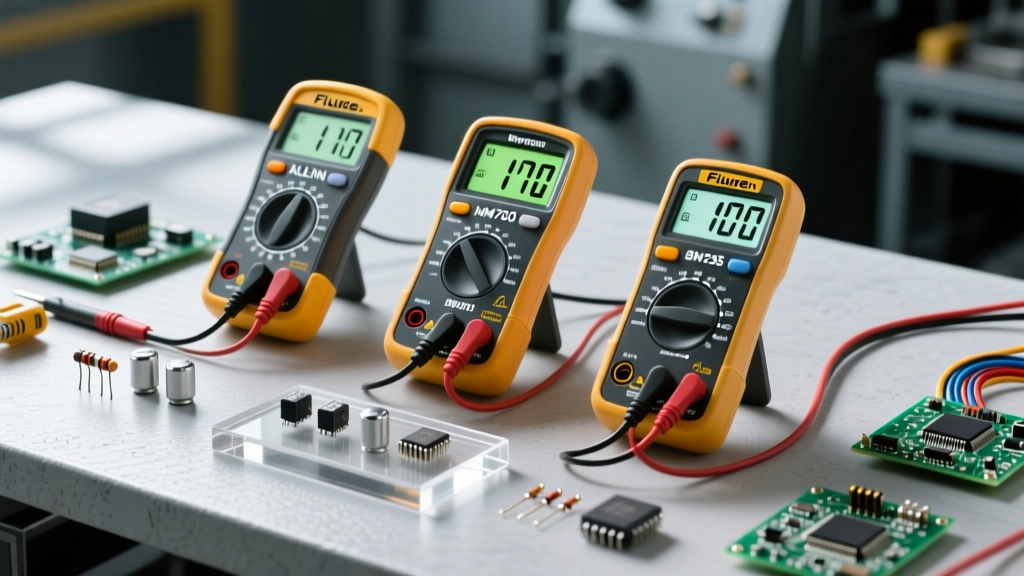
We selected three multimeters that dominate the market across different budget tiers, evaluating them specifically on their voltage testing capabilities, transient protection, and ergonomic design for field use.
1. Fluke 117 True RMS Multimeter (The Professional Standard)
The Fluke 117 (typically priced around $210) is the undisputed king of commercial electrical voltage testing. Its standout feature for voltage checking is the dedicated LoZ mode, which instantly eliminates ghost voltages without requiring the user to change probe jacks. Additionally, the 117 features VoltAlert, a non-contact voltage (NCV) detector built into the top of the casing. While NCV should never replace physical contact testing, it provides a crucial secondary verification layer before you expose live busbars.
- Voltage Resolution: 6000 counts (provides two decimal places on the 6V range, crucial for low-voltage control circuits).
- Safety Rating: CAT III 600V. Independently verified by UL.
- Failure Mode Protection: Uses high-energy wire-wound resistors and a polycarbonate blast shield to contain internal arc flashes.
2. Klein Tools MM700 (The Best Budget Auto-Ranging Option)
Retailing for approximately $55, the Klein Tools MM700 is a favorite among DIYers and hobbyists. It features True RMS AC voltage measurement, which is essential for getting accurate readings on non-linear loads like variable frequency drives (VFDs) or modern LED drivers that distort the AC sine wave. However, the MM700 lacks a LoZ mode. If you are checking voltage in long cable runs, you must be prepared to interpret potential ghost voltages manually or use a dedicated solenoid voltage tester (wiggy) in parallel. For more on its specifications, see the Klein Tools MM700 product page.
- Voltage Resolution: 4000 counts.
- Safety Rating: CAT III 1000V / CAT IV 600V (Note: Always verify independent lab certification on budget meters).
- Best For: Automotive diagnostics, basic household receptacle testing, and low-voltage electronics.
3. Brymen BM235 (The Enthusiast's Safety Champion)
Widely popularized by the EEVblog engineering community, the Brymen BM235 (approx. $140) bridges the gap between budget and premium. When checking voltage on high-energy mains, safety is paramount. The BM235 boasts exceptional transient protection and utilizes high-breaking-capacity (HBC) ceramic fuses. While fuses primarily protect current measurements, the overall internal spacing and MOV (Metal Oxide Varistor) placement ensure that a voltage spike on the probes won't result in a catastrophic meter explosion.
- Voltage Accuracy: ±0.5% for DC, which rivals meters costing twice as much.
- Safety Rating: CAT III 1000V / CAT IV 600V.
- Special Feature: HBM (Human Body Model) ESD protection on the voltage input jacks, preventing static discharge from destroying the meter's internal ADC.
Step-by-Step Framework: Checking Voltage With a Multimeter Safely
Regardless of whether you are using a $50 Klein or a $200 Fluke, the physical methodology of checking voltage with a multimeter must adhere to strict safety protocols to prevent arc flash injuries or electrocution.
- Inspect the Probes: Check for cracked insulation or exposed metal shafts. Use probes with finger guards (the raised plastic ridge) to prevent your fingers from slipping onto the metal tip.
- Verify Meter Settings: Insert the black probe into the COM (Common) jack and the red probe into the V/Ω jack. Never leave the red probe in the Amps jack when testing voltage; doing so will create a dead short across the circuit, resulting in an immediate arc flash.
- Select the Correct Mode: Choose V⎓ (DC) for batteries, solar panels, and microcontrollers. Choose V~ (AC) for wall outlets, transformers, and mains power.
- Execute the One-Hand Rule: When measuring live AC mains, keep one hand in your pocket or behind your back. If a fault occurs and current enters your hand, this prevents the current from crossing your chest cavity and inducing ventricular fibrillation. For more on electrical safety protocols, consult the OSHA Electrical Safety guidelines.
- Test a Known Live Source: Always verify your meter is functioning by testing a known live receptacle before testing a suspected dead circuit (the Live-Dead-Live testing method).
Troubleshooting Common Voltage Reading Anomalies
When your multimeter displays unexpected voltage readings, use this diagnostic framework to identify the root cause before tearing apart your wiring or circuit board.
Pro Tip: If your digital multimeter displays 'OL' or '1' on the far left of the screen while checking voltage, it means 'Overload'. The voltage exceeds the current range setting. Immediately remove the probes and select a higher voltage range or switch to auto-ranging.
| Symptom | Likely Cause | Solution |
|---|---|---|
| Reads 40V-90V on a disconnected wire | Capacitive coupling (Ghost Voltage) | Switch to LoZ mode or apply a 10kΩ pull-down resistor across the probes. |
| Fluctuating AC Voltage (e.g., 115V to 125V) | Non-linear load distortion or poor neutral bond | Ensure meter is True RMS; check main panel neutral-to-ground bond. |
| Reads 0V but circuit is verified live | Blown internal meter fuse or broken probe wire | Perform continuity test on probes; check internal PCB trace fuses. |
| DC Voltage reads negative (e.g., -12V) | Reverse polarity on probes | Swap red and black probes; the reading is mathematically correct but inverted. |
Spec Comparison Chart: Voltage Testing Capabilities
Use this quick-reference chart to select the right tool for your specific voltage checking requirements.
| Feature | Fluke 117 | Klein MM700 | Brymen BM235 |
|---|---|---|---|
| Approx. Price | $210 | $55 | $140 |
| Counts (Resolution) | 6000 | 4000 | 6000 |
| LoZ (Ghost Voltage) | Yes | No | No |
| True RMS AC | Yes | Yes | Yes |
| NCV (Non-Contact) | Yes | Yes | No |
| Best Application | Commercial Electricians, HVAC | DIY, Automotive, Basic Home | Electronics Repair, Lab Use |
Final Verdict: Which Tool Should You Buy?
If your primary focus is checking voltage with a multimeter in residential or commercial buildings, the Fluke 117 is a mandatory investment. The LoZ mode alone will save you hours of misdiagnosing 'hot' neutral wires and phantom switch legs. For electronics hobbyists working with DC microcontrollers and bench power supplies, the Brymen BM235 offers superior DC accuracy and ESD protection without the premium price tag of industrial meters. Finally, for casual home DIYers who simply need to verify if a wall outlet is live before replacing a light fixture, the Klein MM700 provides more than enough capability and safety for the price.