
Understanding the Uruguay Electrical Outlet Ecosystem
Uruguay's electrical grid, operated by the state-owned UTE (Administración Nacional de Usinas y Trasmisiones Eléctricas), delivers 230V at 50Hz. Whether you are renovating a classic apartment in Montevideo's Ciudad Vieja or wiring a new eco-home in José Ignacio, understanding the local receptacle standards is critical for safety and compliance. According to the IEC World Plugs database, Uruguay primarily utilizes the Type F (Schuko) and legacy Type L (Italian) standards.
While older buildings may still feature the 10A or 16A Type L receptacles, modern UTE regulations and contemporary construction practices have overwhelmingly adopted the Type F (CEE 7/3) Schuko standard. This transition is driven by the Schuko's superior grounding mechanism, recessed safety cavity, and compatibility with high-draw appliances. The World Standards electrical registry confirms that while Type C (Europlug) devices are compatible with both wall infrastructures, permanent installations must prioritize the grounded Type F for any circuit exceeding basic lighting loads.
Tools and Materials for a UTE-Compliant Installation
Before beginning any electrical work, ensure you have the correct materials rated for 230V/50Hz operation. Using undersized wire or non-compliant backboxes is a primary cause of thermal failure in South American residential wiring.
- Receptacle: 16A Type F Schuko outlet (e.g., Schneider Electric Odace or Legrand Valena Life series).
- Backbox: 68mm diameter European standard flush-mount box (minimum 45mm depth for standard, 60mm for USB-integrated models).
- Wiring: 2.5 mm² solid copper wire (THHN/THWN equivalent) in IEC standard colors: Brown (Line), Blue (Neutral), Green/Yellow (Earth).
- Breaker: 16A or 20A Miniature Circuit Breaker (MCB) with a 30mA Residual Current Device (RCD) for socket circuits.
- Tools: Fluke 1AC-II non-contact voltage tester, Knipex automatic wire strippers, calibrated torque screwdriver, and a digital multimeter.
Step-by-Step Installation Procedure
Step 1: Isolate and Verify the Circuit
Navigate to your main distribution board and switch off the MCB controlling the room's outlet circuit. Never rely solely on the breaker labeling. Insert your non-contact voltage tester into the existing outlet or test the exposed wires in the backbox. Verify the absence of voltage on both the Line and Neutral conductors before proceeding.
Step 2: Prepare the 68mm Backbox
If you are replacing an old Type L Italian-style box, you may need to chisel out the masonry to accommodate the wider 68mm European flush box. Clean all plaster dust and debris from the cavity. Moisture and conductive dust trapped behind the receptacle can cause tracking and short circuits over time. Ensure the mounting lugs inside the box are intact and aligned horizontally.
Step 3: Wire Stripping and Routing
Route the 2.5 mm² cables through the backbox knockouts. Using your automatic wire strippers, remove exactly 12mm of insulation from the Brown, Blue, and Green/Yellow wires. Expert Tip: Do not nick the copper conductor during stripping; a scored wire creates a localized hot spot under load, leading to insulation meltdown and potential fire hazards.
Step 4: Terminate the Connections
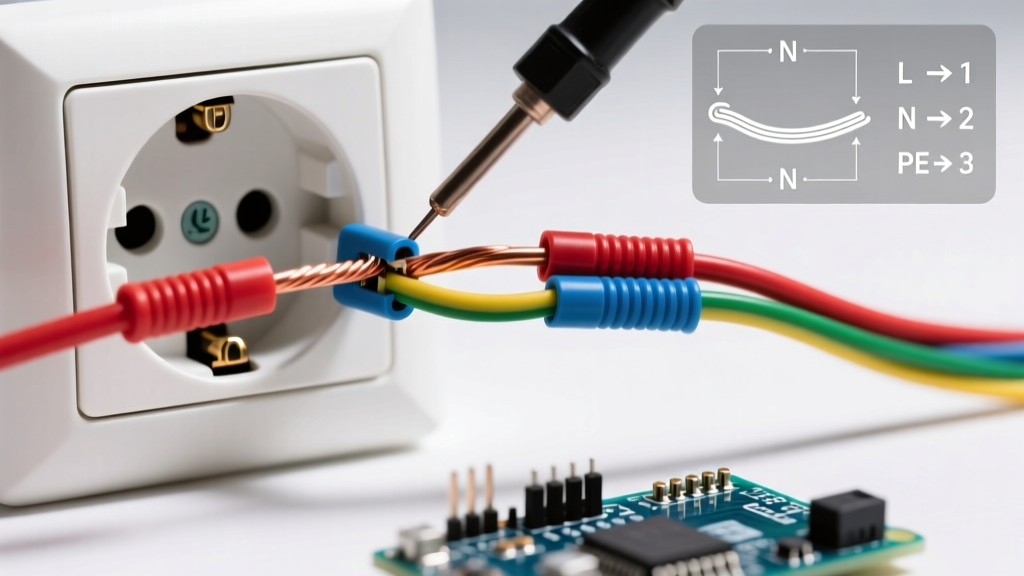
Insert the wires into the appropriate terminals on the back of the Type F Schuko mechanism. UTE follows standard IEC color coding:
| Wire Color | Function | Terminal Marking | Placement on Schuko |
|---|---|---|---|
| Brown | Line / Phase (L) | L | Right side (when facing front) |
| Blue | Neutral (N) | N | Left side (when facing front) |
| Green/Yellow | Protective Earth (PE) | ⏚ or PE | Center top/bottom grounding clips |
Use your calibrated torque screwdriver to tighten the terminal screws to the manufacturer's specification—typically between 0.5 Nm and 0.8 Nm for 16A residential outlets. Under-tightening causes arcing; over-tightening can shear the screw or crush the copper strands.
Step 5: Mount and Secure the Faceplate
Carefully fold the wires into the backbox in a Z-pattern to avoid pinching them behind the metal mounting yoke. Insert the yoke into the 68mm box and tighten the two lateral expansion screws until the mechanism sits perfectly flush and level with the wall surface. Snap on the decorative faceplate.
Commissioning and Multimeter Testing
Before plugging in any appliances, you must verify the wiring integrity. Restore power at the main distribution board. Set your digital multimeter to AC Voltage (V~) and perform the following three-point test:
- Line to Neutral (L-N): Insert probes into the main socket holes. Expected reading: 220V - 240V.
- Line to Earth (L-PE): Insert one probe into a main hole and the other into the side grounding clip. Expected reading: 220V - 240V.
- Neutral to Earth (N-PE): Insert probes into the remaining main hole and the grounding clip. Expected reading: 0V - 2V.
If your L-PE reading is 0V, the earth wire is disconnected or broken upstream—a critical safety failure that must be rectified immediately. If N-PE reads >5V, you likely have a shared neutral issue or high impedance on the grounding path.
Troubleshooting Legacy Montevideo Wiring (Type L to Type F Upgrades)
When upgrading older properties, electricians frequently encounter legacy 1.5 mm² aluminum or early copper wiring originally intended for 10A Type L circuits. The U.S. Department of State travel guidelines note the 230V standard in Uruguay, emphasizing the need for proper infrastructure to handle modern appliance loads. You cannot simply swap a 10A Type L faceplate for a 16A Type F Schuko if the upstream wire remains 1.5 mm².
The Upgrade Protocol:
- Pull new 2.5 mm² copper conductors from the distribution board to the first outlet in the daisy chain.
- Upgrade the circuit breaker from a 10A MCB to a 16A or 20A MCB.
- Install a 30mA RCD (Residual Current Device) if the legacy board lacks ground-fault protection, which is mandatory for all modern socket circuits under current safety codes.
Coastal Environment Considerations (Punta del Este & Rocha)
For installations in coastal regions like Punta del Este or La Pedrera, salt-laden humidity accelerates galvanic corrosion on standard brass terminal screws. For exterior patios, garages, or oceanfront properties, specify IP44-rated Type F Schuko outlets with spring-loaded weather flaps. Furthermore, consider using tinned copper wire or applying a dielectric antioxidant paste (like Noalox) to the terminal connections to prevent oxidation, which increases contact resistance and causes thermal tripping of the MCB over time.
Frequently Asked Questions
Can I use a US 120V outlet in Uruguay?
No. Uruguay operates on a 230V/50Hz grid. Installing a standard US NEMA 5-15R (120V) receptacle is highly dangerous, as it will allow users to plug in 120V appliances directly into 230V, instantly destroying the appliance and creating a severe fire hazard. Always use 230V-rated IEC standard receptacles.
Are Type C plugs safe to use in Type F outlets?
Yes. The Type C Europlug is ungrounded and designed to fit seamlessly into the recessed cavity of a Type F Schuko outlet. However, Type C should only be used for double-insulated (Class II) appliances that do not require an earth ground connection.