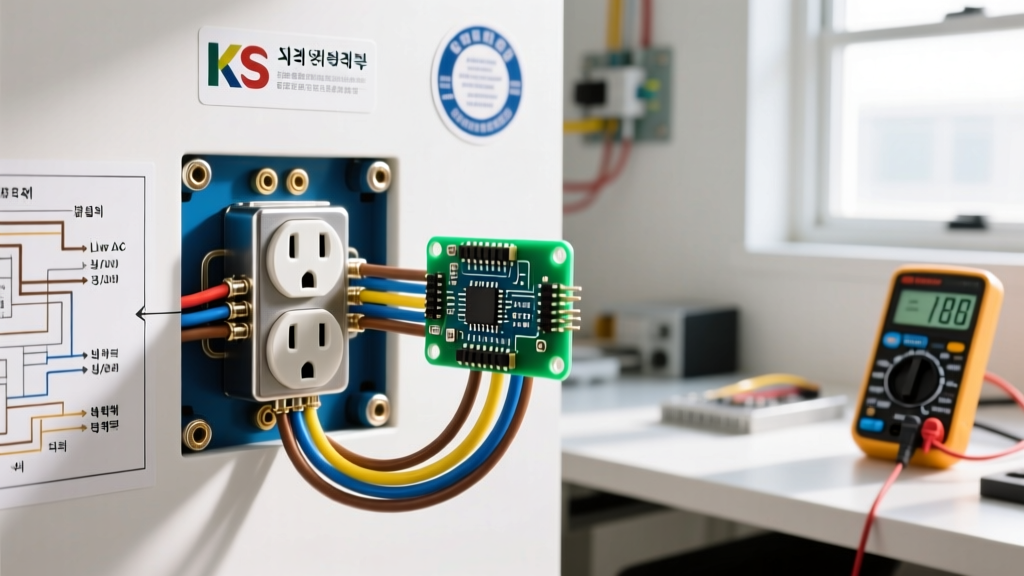
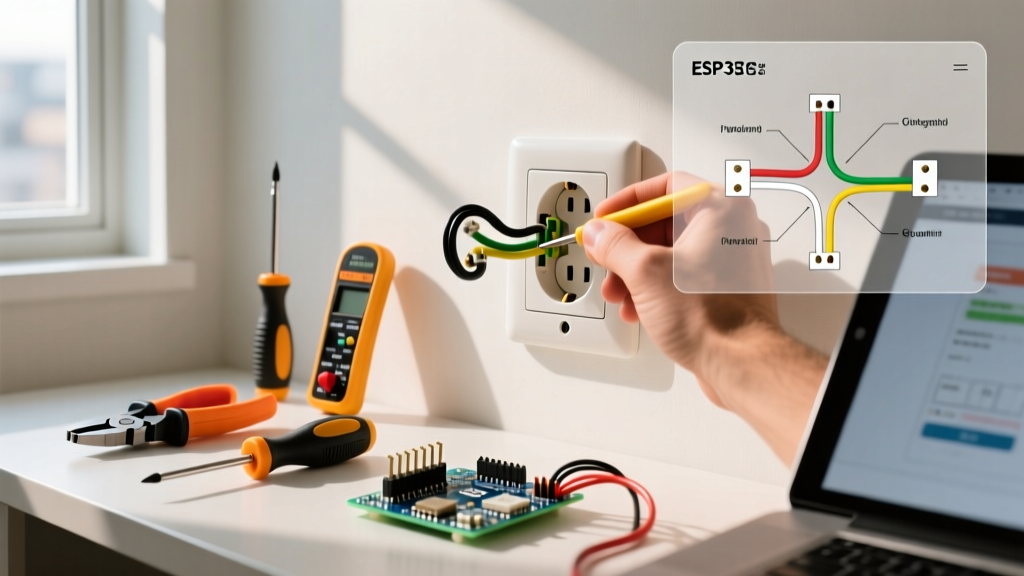
Wire size for a 240-volt circuit refers to the American Wire Gauge (AWG) cross-sectional area required to safely carry the specific amperage of a 240V load without exceeding the conductor's temperature rating or causing excessive voltage drop. For standard residential 240V circuits, a 20-amp load requires 12 AWG copper, a 30-amp load requires 10 AWG, a 40-amp load requires 8 AWG, and a 50-amp load requires 6 AWG, based on the 60°C or 75°C ampacity columns in NEC Table 310.16.
The Core Concept: How 240V Changes Wire Sizing
What wire size changes in a real 240V installation is the current (amperage) required to deliver a specific amount of power, which directly dictates the physical thickness of the copper or aluminum conductor. Power (Watts) equals Voltage multiplied by Current (P = V × I). Because 240V provides twice the electrical "pressure" of a standard 120V circuit, it requires only half the current to deliver the exact same wattage.
Think of it like a highway system: voltage is the speed limit, current is the number of cars, and the wire gauge is the number of lanes. If you double the speed limit (240V instead of 120V), you need fewer lanes (a thinner wire) to move the same number of cars (watts) through the system in the same amount of time. This is why a 240V circuit actually allows you to use smaller wire than a 120V circuit for the same high-wattage appliance.
The most common confusion among DIYers is mixing up the circuit voltage with the insulation voltage rating. You do not need to buy special "240V wire." Standard THHN or NM-B (Romex) wire has an insulation rating of 600V. The wire size is chosen strictly based on the amperage of the breaker protecting the circuit, not the 240V potential difference between the two hot legs.
Worked Example: Sizing Wire for a 7,200W EV Charger
Let’s walk through a real-world calculation for a Level 2 Electric Vehicle (EV) charger, referencing the Department of Energy's EV installation guidelines and NEC branch circuit rules.
Step 1: Calculate the base amperage.
Using Ohm’s Law (I = P / V):
7,200 Watts ÷ 240 Volts = 30 Amps.
Step 2: Apply the NEC Continuous Load Rule.
EV charging routinely runs for more than three hours, classifying it as a continuous load under NEC Article 210.20(A). Continuous loads require the branch circuit to be rated at 125% of the base amperage.
30 Amps × 1.25 = 37.5 Amps.
Step 3: Select the breaker size.
Per NEC 240.6, you must round up to the next standard breaker size. The standard sizes are 15, 20, 25, 30, 35, 40, 45, 50. The next size up from 37.5A is a 40-amp double-pole breaker.
Step 4: Determine the wire size.
We need a copper wire rated for at least 40 amps. Looking at NEC Table 310.16:
• If using NM-B (Romex) cable, we are restricted to the 60°C column. 8 AWG copper in the 60°C column is rated for exactly 40A.
• If pulling individual THHN conductors in conduit, we can use the 75°C column, where 8 AWG is rated for 50A.
In both installation methods, 8 AWG copper is the correct, code-compliant wire size.
Step 5: Check for voltage drop.
For a 60-foot run with 8 AWG copper at 30A (the actual continuous draw, not the breaker size), the voltage drop is approximately 1.5% (well under the NEC recommended 3% maximum). No upsizing is required for distance.
Where You Meet 240V Wire Sizing in Practice
You will encounter 240V wire sizing requirements whenever you install major household appliances, HVAC equipment, or subpanels. The table below outlines standard residential 240V loads and their corresponding copper wire sizes. Note: Aluminum wire requires upsizing by two AWG steps (e.g., use 4 AWG aluminum instead of 6 AWG copper for a 50A load).
| Appliance / Load | Typical Wattage | Breaker Size | Copper Wire (NM-B / 60°C) | Copper Wire (THHN / 75°C) |
|---|---|---|---|---|
| Window AC / Mini-Split | 2,400W | 20A | 12 AWG | 12 AWG |
| Electric Water Heater | 4,500W | 30A | 10 AWG | 10 AWG |
| Electric Dryer | 5,500W | 30A | 10 AWG (4-wire) | 10 AWG (4-wire) |
| Level 2 EV Charger | 7,200W - 9,600W | 40A - 50A | 8 AWG - 6 AWG | 8 AWG - 6 AWG |
| Electric Range / Oven | 8,000W - 12,000W | 50A | 6 AWG (4-wire) | 6 AWG (4-wire) |
| 60A Subpanel Feeder | N/A | 60A | 6 AWG | 6 AWG |
Common Confusions and Code Caveats
When sizing wire for 240V circuits, a few edge cases frequently trip up hobbyists and DIYers:
- The "Next Size Up" Breaker Rule: If your calculated continuous load is exactly 32A (125% = 40A), and 8 AWG wire is rated for 40A, you might be tempted to use a 45A breaker. Don't. Standard breakers jump from 40A to 50A. If you use a 50A breaker, you must upsized the wire to 6 AWG, because 8 AWG is not protected by a 50A breaker under NEC 240.4.
- Equipment Grounding Conductors: A 240V circuit still requires a ground wire. When using NM-B cable, the bare copper inside serves as the ground. If pulling THHN in conduit, you must pull a separate green or bare ground wire, sized according to NEC Table 250.122 (e.g., 10 AWG ground for a 30A to 60A breaker).
- Pure 240V vs. 120/240V Split Phase: Pure 240V loads (like baseboard heaters or older water heaters) only need two hot wires and a ground (3 wires total). Appliances with 120V control boards, timers, or lights (like modern dryers and ranges) require a neutral wire, making it a 4-wire setup (Hot, Hot, Neutral, Ground).
Frequently Asked Questions
What wire size for 240 volt 30 amp circuits?
For a standard 30-amp, 240-volt circuit (commonly used for electric water heaters, dryers, and small air compressors), you must use 10 AWG copper wire. If you are using aluminum wire, you must upsize to 8 AWG aluminum. This assumes a standard residential run under 100 feet where voltage drop does not require further upsizing.
Can I use 12 AWG wire for a 240 volt outlet?
Yes, but only if the circuit is protected by a maximum 20-amp double-pole breaker. 12 AWG copper wire is perfectly safe for 240V loads that draw 20 amps or less, such as 240V window air conditioners, small mini-split heat pumps, or 240V baseboard heaters rated up to 4,800W (non-continuous) or 3,840W (continuous). You cannot use 12 AWG on a 30-amp breaker under any circumstances.
Does a 240 volt circuit need a neutral wire?
It depends on the appliance. A "pure" 240V load, like a resistive water heater or a baseboard heater, does not need a neutral; it only requires two hot legs and a ground. However, modern electric ranges, dryers, and smart EV chargers contain 120V electronics (timers, displays, Wi-Fi modules). These require a 120/240V split-phase circuit, which mandates a neutral wire (typically a white or gray insulated conductor) to complete the 120V return path.
What size wire for a 240 volt 50 amp breaker?
A 50-amp, 240-volt breaker requires 6 AWG copper wire (or 4 AWG aluminum). This setup is standard for large electric ranges, heavy-duty welders, hot tubs, and high-amperage Level 2 EV chargers (like a 40A continuous charger requiring a 50A breaker). Ensure you are using a 4-wire configuration (two hots, one neutral, one ground) if the appliance requires 120V for internal controls.