
The Diagnostic Approach to Receptacle Failures
When a wall receptacle stops working, sparks, or repeatedly trips a breaker, homeowners are immediately faced with two questions: What is wrong, and what is the cost of electrical outlet repair? In 2026, with electrical labor rates averaging between $95 and $160 per hour depending on your metropolitan area, accurately diagnosing the root cause before calling a professional can save you hundreds of dollars in unnecessary diagnostic fees. Conversely, misdiagnosing a failing neutral or an overloaded multi-wire branch circuit (MWBC) as a simple bad receptacle can lead to catastrophic electrical fires.
According to the National Fire Protection Association (NFPA), electrical distribution and lighting equipment remains one of the leading causes of home structure fires. Many of these originate at the receptacle yoke due to loose connections, degraded insulation, or improper DIY repairs. This guide provides a professional-grade troubleshooting protocol to isolate receptacle faults and details the exact material and labor costs associated with fixing them.
Step-by-Step Fault Isolation Protocol
Before replacing any hardware, you must verify the electrical characteristics of the circuit. Grab a non-contact voltage tester (like the Klein Tools NCVT-1), a plug-in receptacle tester (Klein RT310), and a digital multimeter (Fluke 117). Follow this isolation sequence:
- Verify Power at the Panel: Ensure the breaker is fully in the ON position. If it has tripped to the middle position, turn it fully OFF, then ON. If it immediately trips, you have a dead short or ground fault. Stop and consult a professional.
- Perform a Plug-In Test: Insert the RT310 tester. Note the LED sequence. An 'Open Neutral' or 'Hot/Ground Reverse' reading indicates a wiring topology issue, not necessarily a failed receptacle.
- Multimeter Voltage Drop Test: Remove the receptacle cover and carefully measure voltage. Hot-to-Neutral should read 120V (±5%). Hot-to-Ground should also read 120V. Neutral-to-Ground should read less than 1.5V. If Neutral-to-Ground reads high (e.g., 3V to 10V), you have a loose neutral connection upstream, which is a severe fire hazard.
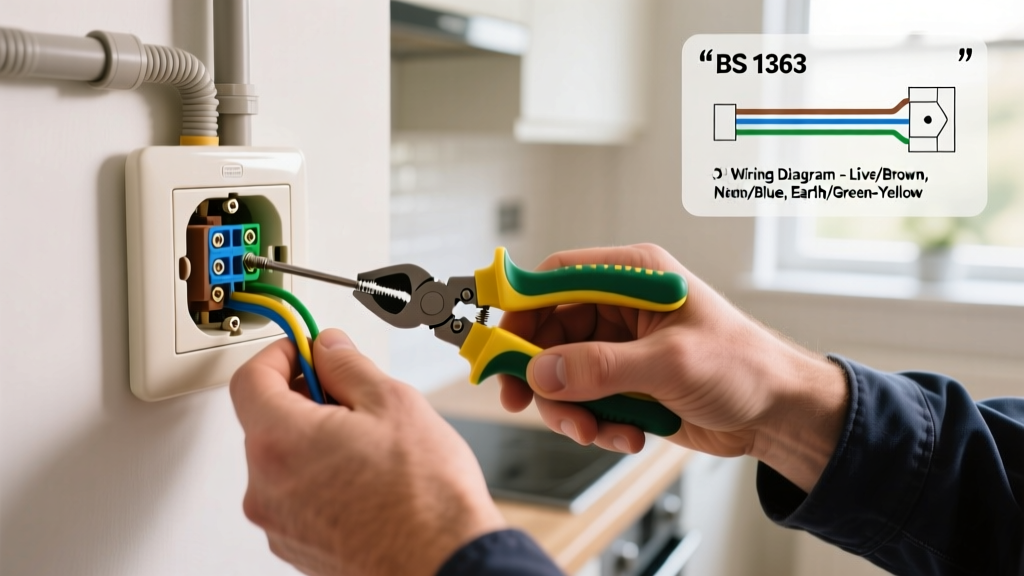
- Physical Inspection: Turn off the breaker, verify zero voltage, and pull the receptacle from the gang box. Inspect the wire terminations. Look for melted thermoplastic, blackened copper, or push-in (backstab) connectors that have loosened over time due to thermal cycling.
2026 Cost Breakdown: Parts, Labor, and Complexity
The cost of electrical outlet repair varies wildly based on whether the issue is localized to the device itself or involves the branch circuit wiring. Below is a realistic pricing matrix for 2026, reflecting current supply chain realities and updated labor rates.
| Repair Scenario | DIY Part Cost | Pro Labor Cost | Total Pro Cost |
|---|---|---|---|
| Standard 15A Duplex Replacement | $3 - $8 | $85 - $150 | $90 - $160 |
| 20A Commercial Grade Upgrade | $10 - $18 | $95 - $160 | $105 - $180 |
| 15A/20A GFCI Receptacle Swap | $18 - $30 | $110 - $180 | $130 - $210 |
| Upstream Open Neutral Repair | $5 - $15 | $200 - $350 | $205 - $365 |
| AFCI/GFCI Dual Function Swap | $35 - $50 | $125 - $200 | $160 - $250 |
| Full Circuit Rewire (Aluminum/Cu) | $50 - $150 | $800 - $1,500+ | $850 - $1,650+ |
Deep Dive: Specific Failure Modes and Component Costs
1. Backstab Connection Burnout (The $5 Fix)
The most common cause of a dead outlet in homes built between 1990 and 2015 is the failure of push-in (backstab) wire connectors. These spring-loaded clamps lose tension over years of thermal expansion and contraction, leading to high-resistance connections that melt the polycarbonate housing. If your Fluke multimeter shows 120V at the wire nuts but 0V at the receptacle face, the device is dead.
The Fix: Cut back the damaged wire to clean copper, strip 3/4 inch of insulation, and terminate using the side-screw bindings. For a standard 15A circuit, upgrade from a cheap builder-grade unit to a commercial-spec receptacle like the Hubbell HBL5262 or the Leviton 5362-W (approx. $6 to $9). These feature heavy-gauge steel yokes and deep screw terminals that resist thermal deformation.
2. GFCI Nuisance Tripping and Internal Relay Failure ($25 - $45)
Ground Fault Circuit Interrupters (GFCIs) contain internal solid-state circuitry that degrades over time, especially in damp environments like bathrooms and garages. If a GFCI trips with no load attached, or refuses to reset despite correct line/load wiring, the internal sensing coil has failed.
The Fix: Replace the unit. For standard wet locations, the Leviton 8280-W (20A GFCI) is an industry standard, costing around $22. However, if the circuit is in a bedroom or living area where the 2026 NEC requires both arc-fault and ground-fault protection, you must install a Dual Function (DF) receptacle, such as the Pass & Seymour DF20-W3, which retails for $38 to $45. Always ensure you wire the 'LINE' and 'LOAD' correctly; reversing these will leave downstream outlets unprotected while allowing the GFCI face to function normally—a dangerous false-positive.
3. Upstream Neutral Open or Shared Neutral (The $250+ Nightmare)
If your receptacle tester shows an 'Open Neutral' but the wires are securely fastened to the current receptacle, the fault lies upstream. This is incredibly common in Multi-Wire Branch Circuits (MWBCs) where two hot legs share a single neutral. If a previous DIYer removed a receptacle upstream and broke the neutral daisy-chain without using a pigtail, the downstream outlets will lose their return path, or worse, experience 240V across 120V appliances, destroying electronics.
The Fix: This requires tracing the circuit, opening upstream junction boxes, and repairing the neutral continuity. While the parts (wire nuts, 12 AWG THHN pigtails) cost less than $5, the diagnostic labor to fish through walls and trace the fault typically pushes the cost of electrical outlet repair into the $250 to $400 range when hiring a licensed electrician.
Safety Warning: The U.S. Consumer Product Safety Commission (CPSC) strongly warns against using standard 15A receptacles on 20A circuits. Always verify the breaker size and wire gauge (12 AWG for 20A) before installing a replacement device. Furthermore, all 15A and 20A receptacles in dwelling units must be Tamper Resistant (TR) to prevent childhood shock injuries.
When DIY Diagnosis Ends: Edge Cases and Hazards
Not all outlet issues are solved with a $5 part swap. You must abort DIY troubleshooting and call a licensed master electrician if you encounter any of the following scenarios:
- Aluminum Wiring (Pre-1974): If you pull the receptacle and see silver-colored wire, you have aluminum branch wiring. Standard copper-rated receptacles will cause galvanic corrosion and eventual fires. You must use CO/ALR rated devices or have an electrician perform AlumiConn pigtailing. Repair costs for a whole house can exceed $5,000.
- Federal Pacific or Zinsco Panels: If your breaker fails to trip during a dead short, your panel may be a known defective model (like FPE Stab-Lok). Replacing the outlet won't fix the underlying fire hazard; the entire panel must be replaced ($1,800 - $3,500).
- Scorched Gang Boxes or Melted Insulation: If the plastic wire insulation is brittle, flaking, or melted back more than an inch into the box, the circuit has been chronically overloaded. The wire must be cut back or entirely replaced.
Frequently Asked Questions
Is a buzzing or humming electrical outlet an emergency?
Yes. A buzzing sound indicates arcing or severe harmonic distortion caused by a loose connection or failing device. Arcing generates immense localized heat and is a primary precursor to electrical fires. Turn off the breaker immediately and do not restore power until the receptacle and wire terminations have been inspected and replaced.
Why does my outlet cost more to repair than my neighbor's?
The cost of electrical outlet repair is heavily dependent on accessibility and local code requirements. If your home requires AFCI/GFCI dual-function upgrades to meet current 2026 NEC codes, the parts alone are 5x more expensive than standard duplex receptacles. Additionally, homes with plaster and lath walls require significantly more labor time to fish new wires or repair upstream faults compared to modern drywall construction.
Can I replace a 2-prong ungrounded outlet with a 3-prong GFCI?
Yes, the NEC allows replacing an ungrounded 2-prong receptacle with a GFCI receptacle to provide shock protection, provided the faceplate is labeled 'No Equipment Ground' and 'GFCI Protected'. This costs about $25 in parts and provides life-saving ground fault protection, though it will not provide a true equipment ground for sensitive electronics like surge protectors or audio equipment. For more on workplace and residential electrical safety standards, refer to the Occupational Safety and Health Administration (OSHA) guidelines.