
Navigating the Sri Lanka Electrical Outlet Landscape
When planning a residential or commercial installation in Sri Lanka, understanding the local electrical codes is not just a matter of compliance—it is a critical safety imperative. Sri Lanka operates on a 230V, 50Hz alternating current (AC) supply. While the nation's electrical infrastructure shares deep historical roots with the British system, modern code requirements are governed locally by the Sri Lanka Standards Institution (SLSI) and enforced by the Ceylon Electricity Board (CEB) and LECO.
For electricians, DIY enthusiasts, and expatriate homeowners, navigating the Sri Lanka electrical outlet regulations requires a firm grasp of the SLS 114 standard (the local adoption of BS 1363), harmonized IEC wiring colors, and the unique challenges of TT earthing systems prevalent across the island. This guide breaks down the exact code requirements, wiring matrices, and failure modes you need to know for safe, compliant installations in 2026.
The Core Standard: SLS 114 and Type G Dominance
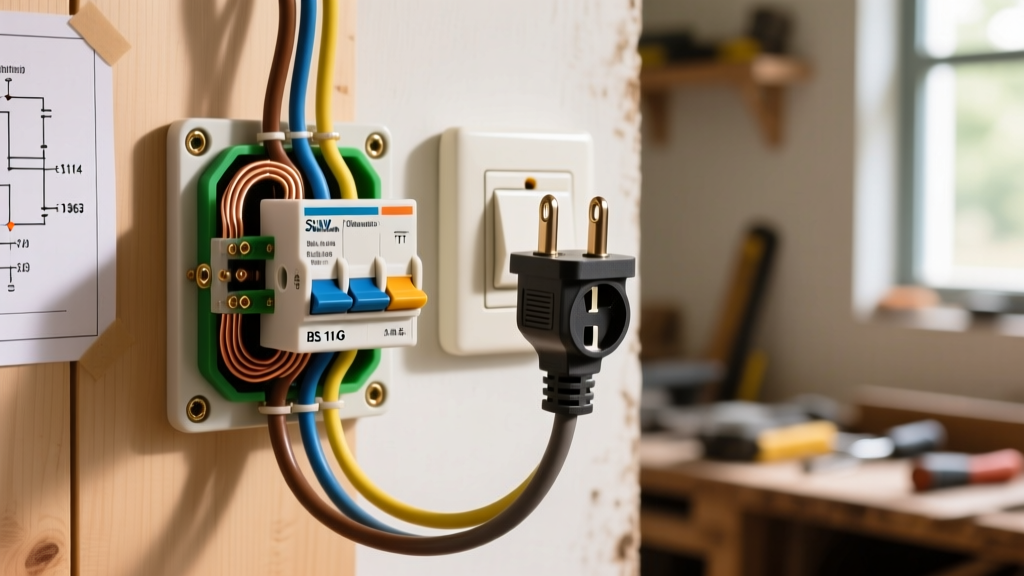
The standard Sri Lanka electrical outlet is the 13-amp rectangular 3-pin socket, universally known as Type G. Under local regulations, this is defined by SLS 114, which is directly derived from the British Standard BS 1363. According to the IEC World Plugs database, Type G outlets feature three rectangular pins in a triangular pattern and incorporate a built-in fuse within the plug head, rather than the socket itself.
⚠️ Legacy System Warning: Older properties in Colombo and Kandy may still feature 5A and 15A round-pin sockets (BS 546 / Type D and Type M). While legal to maintain in existing circuits, the SLSI and CEB strictly prohibit the installation of new round-pin socket outlets in modern residential wiring. All new circuits must utilize 13A SLS 114 compliant outlets.
Why the Fuse is in the Plug
A common point of confusion for foreign electricians is the fused plug design. Because the ring final circuit (or radial equivalent) is protected by a 20A or 32A breaker at the distribution board, a 0.5mm² appliance flex cable could catch fire before the main breaker trips. The 13A (or 3A/5A) cartridge fuse inside the plug protects the appliance cord, allowing the use of smaller, flexible wiring for low-draw devices.
Wiring Specifications and Harmonized Color Codes
Sri Lanka officially adopted the IEC harmonized cable color codes in the mid-2000s to align with international safety standards. If you are troubleshooting an older home, you may encounter the legacy BS 308 colors (Red for Live, Black for Neutral, Green for Earth). However, all new installations and modifications must use the modern harmonized colors:
- Live (Phase): Brown
- Neutral: Blue
- Earth (CPC): Green/Yellow striped
Cable Sizing and Circuit Breaker Matrix
Under local adaptations of the IET Wiring Regulations (BS 7671), socket circuits are typically wired using PVC-insulated Twin and Earth (T&E) cables. Below is the compliance matrix for standard residential outlet circuits:
| Circuit Type | Cable Size (T&E) | MCB Rating | Max Coverage Area | RCD Requirement |
|---|---|---|---|---|
| Radial Circuit | 2.5mm² | 20A (Type C) | 75m² | 30mA Mandatory |
| Ring Final Circuit | 2.5mm² | 32A (Type C) | 100m² | 30mA Mandatory |
| Heavy Duty (AC/Heater) | 4.0mm² | 32A or 40A | Point-to-Point | 30mA Mandatory |
The TT Earthing Challenge: Earth Loop Impedance (Ze)
This is where local expertise separates safe installations from hazardous ones. Unlike the UK, which predominantly uses TN-C-S (PME) earthing where the earth is tied to the utility neutral, Sri Lanka primarily relies on TT earthing systems. This means the earth connection is provided by a local earth rod driven into the ground at the property.
Because soil resistivity in Sri Lanka can vary wildly—from dry, sandy coastal soils to wet, clay-rich inland terrains—the Earth Loop Impedance (Ze) is often too high to guarantee that a standard Miniature Circuit Breaker (MCB) will trip fast enough during a ground fault.
Mandatory RCD Protection
Due to the high Ze inherent in TT systems, the CEB mandates that all socket outlets intended for general use must be protected by a 30mA Residual Current Device (RCD). In modern distribution boards, this is achieved via an RCCB (Residual Current Circuit Breaker) or RCBOs on every individual circuit. Relying solely on MCBs for fault clearing in a Sri Lankan TT system is a severe code violation and a fatal shock hazard.
Zone Restrictions and Bathroom Compliance
Wiring a bathroom in Sri Lanka requires strict adherence to IP (Ingress Protection) rating zones, mirroring international safety standards:
- Zone 0 (Inside the bath/shower): No standard outlets permitted. Only SELV (Separated Extra Low Voltage) equipment rated IPX7 is allowed.
- Zone 1 (Directly above bath/shower to 2.25m): No 13A sockets. IPX4 minimum required for fixed equipment like electric showers.
- Zone 2 (60cm outside the bath perimeter): IPX4 minimum. Standard 13A outlets are prohibited.
The Shaver Socket Exception: You may install a specialized shaver supply unit in Zone 2 or outside zones, provided it complies with BS EN 61558-2-5. These units contain an internal isolating transformer that separates the output from the main earth, drastically reducing shock risk in damp environments.
Common Installation Failures & Edge Cases
When inspecting existing properties or auditing contractor work, look out for these frequent code violations specific to the region:
- Unfused Spurs on Ring Circuits: While a ring final circuit can have spurs, code dictates that an unfused spur can only feed one single or one double socket. If you are adding multiple outlets to a spur, a 13A fused connection unit (FCU) must be installed at the origin of the spur.
- Missing CPC (Earth Wire) Connections: In older Colombo homes, DIYers often upgrade the faceplate to a modern metal-clad SLS 114 outlet but fail to connect the Green/Yellow earth wire to the faceplate's earth terminal. Metal faceplates must be earthed to prevent them from becoming live during an internal fault.
- Overloaded Radial Circuits: Using 1.5mm² lighting cable for a 13A socket radial circuit. This will result in cable melting long before the 20A breaker trips. Always verify 2.5mm² minimum for standard outlets.
Sourcing SLS-Certified Outlets in 2026
Counterfeit electrical products are a known issue in South Asian markets. When purchasing a Sri Lanka electrical outlet, you must verify the SLS certification mark embossed on the rear casing of the socket. Reputable brands widely available and certified in Sri Lanka include:
- Anchor (Roma / Viva series): Highly prevalent, reliable, and fully SLS 114 compliant. Pricing ranges from LKR 1,200 to LKR 2,500 per switched socket.
- MK (Logic Plus): Premium British-manufactured imports. Excellent for high-load areas. Expect to pay LKR 3,500 to LKR 5,500 per unit.
- Schneider Electric (Avatar / Zencelo): Modern aesthetic with robust internal brass contacts. Priced between LKR 2,800 and LKR 4,500.
Always purchase from authorized distributors or major hardware chains like Nawaloka or hardware hubs in Pettah, avoiding unverified street vendors where the internal fuse clips may be made of substandard, high-resistance alloys.
FAQ: Sri Lanka Electrical Outlet Compliance
Can I install a US-style 120V outlet in my Sri Lankan home?
No, not directly from the mains. Sri Lanka's grid is strictly 230V. If you need a NEMA 5-15R (US standard) outlet for imported electronics, you must install a dedicated step-down transformer (230V to 120V) and wire the US outlet to the transformer's secondary side. This outlet must be physically distinct and labeled to prevent 230V appliances from being plugged in.
Is it legal to use a 13A socket without a switch in Sri Lanka?
While unswitched 13A sockets exist and are technically legal for specific fixed appliances (like a fridge or washing machine hidden behind cabinetry), the SLSI and local electricians heavily favor switched socket outlets. The switch allows for safe isolation of the appliance without unplugging it, which is vital in a tropical climate where moisture-induced leakage currents can occur.
How do I test the earth rod resistance in a TT system?
You must use an Earth Electrode Resistance Tester (not a standard multimeter). Drive two auxiliary test spikes into the soil at 5m and 10m intervals from the main earth rod. The SLSI and CEB generally require an earth rod resistance (Ra) of less than 200 ohms, though achieving less than 50 ohms is highly recommended to ensure the 30mA RCD operates within the required 40ms disconnection time.
For further regulatory updates and certification verification, always consult the official Sri Lanka Standards Institution (SLSI) and reference the local adaptations of the IET Wiring Regulations.