
The Iberian Standard: Type F (Schuko) and Type C Explained
When undertaking electrical renovations, expatriate relocations, or DIY smart-home integrations on the Iberian Peninsula, understanding the local receptacle standards is non-negotiable. Both Spain and Portugal utilize the Type F (CEE 7/3 "Schuko") socket as the primary standard for grounded 230V appliances, alongside the ungrounded Type C (CEE 7/16 "Europlug") for low-draw devices. According to the IEC World Plugs database, the Type F system is defined by its 4.8mm pin diameter, 19mm pin spacing, and side-grounding clips, designed to provide a secure, recessed connection that prevents accidental contact with live pins during insertion.
Unlike North American NEMA 5-15R outlets, the Schuko system is inherently unpolarized. This means the line (phase) and neutral can be inserted in either orientation, a critical factor when wiring smart switches, dimmers, or IoT relays that require a dedicated neutral reference. Furthermore, both Spain (under the REBT - Reglamento Electrotécnico para Baja Tensión) and Portugal (under the RTIEE) mandate strict adherence to European harmonized wiring color codes and specific circuit breaker curves for residential socket outlets.
Technical Specifications & Physical Dimensions
| Parameter | Type F (Schuko / CEE 7/3) | Type C (Europlug / CEE 7/16) |
|---|---|---|
| Nominal Voltage | 230V AC | 230V AC |
| Frequency | 50 Hz | 50 Hz |
| Pin Diameter | 4.8 mm | 4.0 mm |
| Pin Spacing | 19.0 mm | 19.0 mm |
| Grounding Mechanism | Side Earth Clips | None (Ungrounded) |
| Max Current Rating | 16A (Standard Residential) | 2.5A (Appliance Plug Only) |
| Receptacle Depth | Recessed (approx. 15mm) | Flush or Recessed |
Source reference: World Standards Type F Guide
Iberian Wiring Color Codes & Diagram Mapping
Spain and Portugal adhere strictly to the CENELEC HD 308 S2 harmonized color code standard for fixed wiring. Misidentifying these colors, especially in older properties where legacy codes might still exist, is a primary cause of RCD (Residual Current Device) tripping and severe shock hazards.
- Line (Phase / L): Brown (Historically Red in pre-1970s Spanish builds)
- Neutral (N): Blue (Historically Black or Grey)
- Protective Earth (PE): Green/Yellow Stripe (Mandatory for all Type F installations)
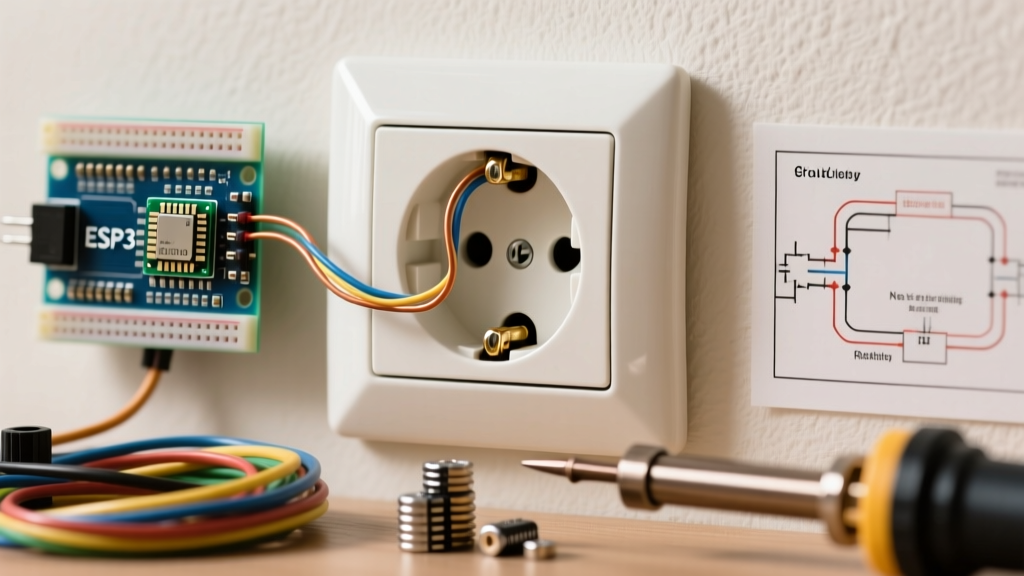
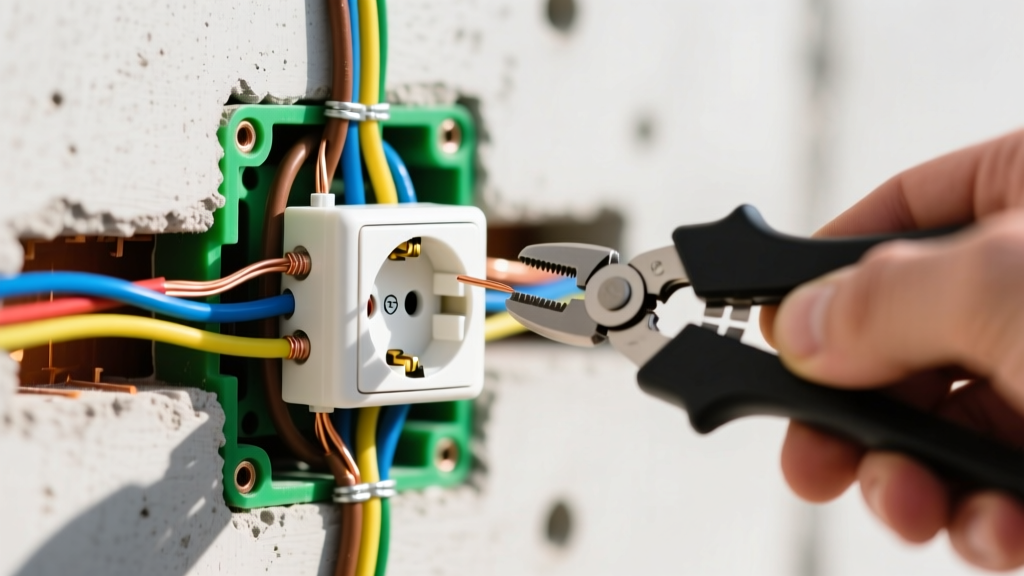
Terminal Mapping Diagram (Type F Recessed Socket)
Because the Schuko socket is unpolarized, there is no strict "left" or "right" mandate for Line and Neutral in standard wall receptacles. However, professional Iberian electricians typically follow a standardized convention for consistency during troubleshooting:
- Left Terminal (facing the socket): Neutral (Blue)
- Right Terminal (facing the socket): Line / Phase (Brown)
- Center/Side Busbar: Protective Earth (Green/Yellow) - This connects internally to both top and bottom grounding clips.
Spain (REBT) and Portugal (RTIEE) Circuit Requirements
Wiring the outlet is only half the battle; the circuit feeding it must comply with local low-voltage directives. Under the European Commission Low Voltage Directive and local Iberian adaptations, standard socket circuits demand specific parameters:
- Conductor Cross-Section: Minimum 2.5mm² solid copper wire for standard 16A socket circuits. (1.5mm² is strictly reserved for lighting circuits).
- Circuit Breaker (MCB): 16A or 20A maximum, Type C curve (trips at 5-10x In). Type B is rarely used in Iberian residential due to inrush currents from modern SMPS (Switched-Mode Power Supply) appliances.
- RCD Protection: A 30mA differential switch (RCD) is legally mandatory for all socket outlets in both Spain and Portugal to prevent lethal ventricular fibrillation in the event of a ground fault.
- Backbox Depth: Standard European flush-mounted backboxes are 45mm to 50mm deep. When wiring smart relays (e.g., Shelly Plus 1PM) behind a Type F socket, a 60mm deep backbox is highly recommended to accommodate the 2.5mm² stiff copper wires and the relay module without crimping.
Step-by-Step Type F Recessed Outlet Installation
⚠️ SAFETY WARNING: Always isolate the main breaker and verify zero voltage using a CAT III or CAT IV multimeter before beginning work. 230V AC is lethal.
- Preparation: Strip the outer sheath of the 2.5mm² cable, leaving approximately 150mm of working length inside the backbox.
- Wire Stripping: Strip exactly 12mm of insulation from the Brown, Blue, and Green/Yellow conductors. Do not score the copper, as this creates a stress fracture point that will fail under thermal cycling.
- Earth Connection First: Connect the Green/Yellow wire to the central earth terminal. Pro Tip: Always leave the earth wire 5mm longer than the line/neutral wires. If the cable is pulled, the earth connection remains intact longest.
- Line & Neutral Connection: Insert the Brown and Blue wires into the side terminals. Ensure no bare copper is exposed outside the terminal housing.
- Torque Specification: Tighten the terminal screws to 0.5 Nm - 0.8 Nm. Overtightening causes "cold flow" deformation of the copper, leading to loose connections and arc faults over time. Undetightening causes high-resistance heating.
- Mounting: Secure the socket to the backbox using the M3.5 expansion claws or direct screw mounting. Ensure the recessed cavity faces outward to maintain the IP2X finger-protection safety standard.
Common Failure Modes in Pre-2000 Iberian Properties
When renovating older homes in regions like Andalusia, Catalonia, or the Algarve, DIYers frequently encounter edge cases that deviate from modern wiring diagrams:
1. The "Floating Ground" Hazard
In many Spanish properties built before the 1980s (prior to the strict enforcement of the REBT-2002 updates), outlets were often upgraded from Type C to Type F visually, but the Green/Yellow earth wire was either never pulled through the conduit or was left disconnected in the junction box. Plugging in a Class I appliance (e.g., a washing machine) into a socket with a floating ground defeats the 30mA RCD protection, leaving the chassis energized at 230V during an internal fault.
2. Aluminum Wiring (1970s Era)
During the copper shortages of the 1970s, some Portuguese and Spanish builds utilized aluminum conductors. Connecting modern brass-terminal Type F sockets directly to aluminum wire causes galvanic corrosion, leading to high-resistance arcing. Solution: Use WAGO Alu-Plus contact paste and specific bimetallic connectors, or pull new 2.5mm² copper wire through the existing corrugated conduits.
3. 10A vs 16A Breaker Mismatches
Older Iberian panels often feature 10A breakers for socket circuits. Replacing a 10A breaker with a 16A breaker without verifying the wire gauge (if 1.5mm² was improperly used for sockets) will result in a melted conduit and potential electrical fire. Always measure the conductor diameter with digital calipers before upgrading MCB ratings.
North American to Iberian Voltage Adaptation
Expats moving from the US or Canada often attempt to wire 110V NEMA outlets into their Iberian homes. This requires a dedicated step-down transformer (230V to 120V) and an isolated circuit. Do not simply swap the receptacle and wire it to the 230V mains. Doing so will instantly destroy 110V appliances and cause catastrophic thermal events. If you require 120V for specific North American tools, install a localized 500W-1000W toroidal step-down transformer in a ventilated enclosure, feeding a dedicated NEMA 5-15R receptacle, clearly labeled "120V / 60Hz (Transformer Isolated)".
Frequently Asked Questions (FAQ)
Can I wire a UK Type G plug onto a Spanish Type F wall socket?
No. The Type G plug features a completely different pin geometry (rectangular pins in a triangular pattern) and an internal fuse. You cannot physically wire a Type G socket into a standard Spanish backbox without an adapter plate, and doing so violates the REBT/RTIEE codes. Use a high-quality, CE-certified travel adapter or replace the appliance plug with a molded Type F plug.
Do I need an RCD (Residual Current Device) for Schuko outlets?
Yes, absolutely. Both Spain and Portugal mandate a 30mA RCD (or RCBO) on all socket outlet circuits. The Schuko grounding clips rely on the RCD to trip within 40 milliseconds if a human touches a live component and completes the circuit to earth.
Why does my smart switch flicker when wired to a Type F circuit?
Many older Iberian lighting circuits were wired without a neutral wire at the switch box (using only a switched live). Smart switches require a constant 230V reference (Line + Neutral). If you are attempting to pull a neutral from a nearby Type F socket circuit to feed a lighting smart switch, you must ensure both circuits share the same RCD protection, or the RCD will detect an imbalance and trip immediately.