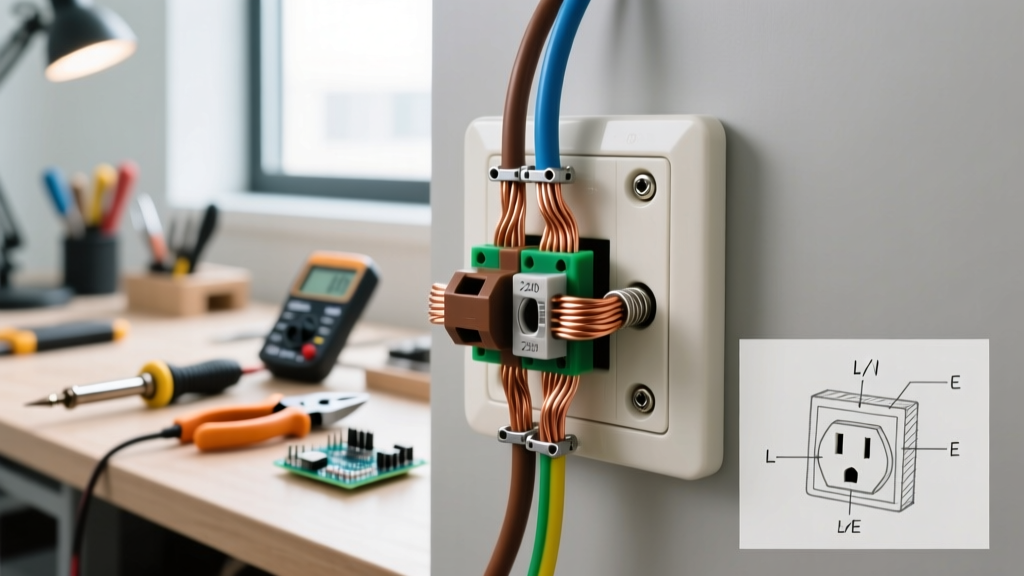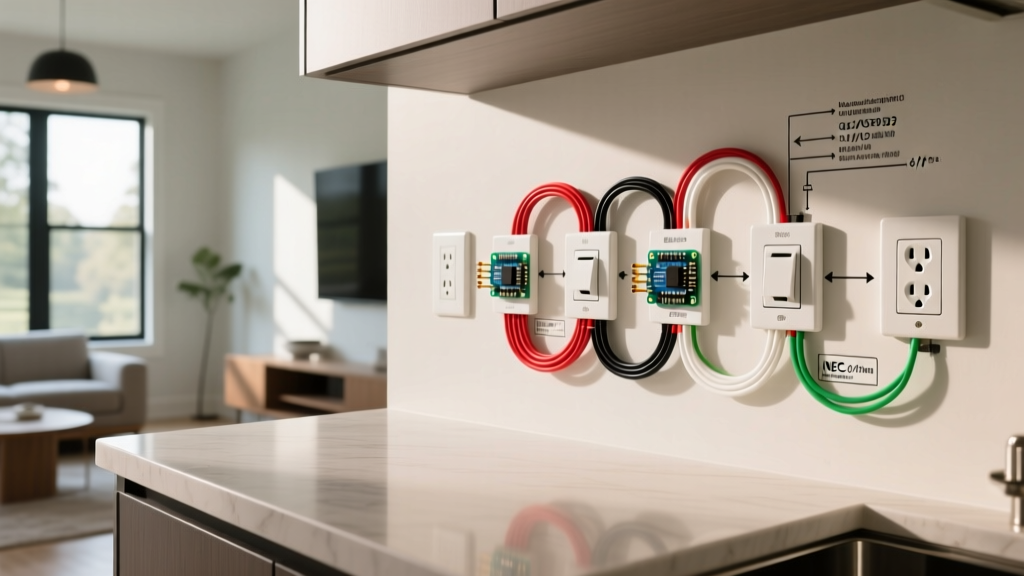

The Stakes of Code Compliance in Circuit Routing
Running a new circuit from your main service panel to a receptacle is one of the most common DIY electrical projects, but it is also where the most dangerous code violations occur. Understanding how to run electrical wire from breaker box to outlet requires more than just pulling cable through walls; it demands strict adherence to the National Electrical Code (NEC). Failing to follow NEC guidelines for wire sizing, physical protection, and box fill can result in overheated conductors, electrical fires, and failed inspections.
As of the 2026 adoption cycles, local jurisdictions are heavily enforcing the 2023 NEC mandates regarding Arc-Fault and Ground-Fault protection, as well as strict derating rules for bundled cables. This guide breaks down the exact code requirements, material specifications, and routing techniques you need to execute a safe, compliant installation.
Phase 1: Circuit Sizing and Wire Gauge Selection
Before drilling a single hole, you must match your breaker size to the correct wire gauge. The NEC (Article 240.4) strictly prohibits over-fusing a conductor. For standard residential 120V receptacle circuits, you will almost exclusively use copper Non-Metallic Sheathed Cable (NM-B), commonly known by the brand name Romex.
| Breaker Size | Min. Copper Wire Gauge | Max Continuous Load (80% Rule) | Common Application |
|---|---|---|---|
| 15 Amp | 14 AWG (14/2 NM-B) | 12 Amps (1,440 Watts) | General lighting, low-draw bedrooms |
| 20 Amp | 12 AWG (12/2 NM-B) | 16 Amps (1,920 Watts) | Kitchens, bathrooms, garages, outdoor |
| 30 Amp | 10 AWG (10/2 NM-B) | 24 Amps (2,880 Watts) | Dryers, RV outlets (Requires 10/3 for 120/240V) |
Pro Tip: While 14 AWG is legal for 15A circuits, most professional electricians in 2026 exclusively pull 12/2 NM-B (approx. $125 per 250ft roll) for all receptacle circuits. The marginal cost increase prevents future voltage drop issues and allows for future breaker upgrades without rewiring.
Phase 2: Physical Routing and Stud Penetration Rules
How you physically route the wire through the framing is governed by NEC Article 300.4, which focuses on protecting cables from physical damage, specifically from drywall screws and nails.
The 1-1/4 Inch Setback Rule
When boring holes through wood studs to run your NM-B cable, the edge of the hole must be at least 1-1/4 inches from the nearest edge of the stud. For a standard 2x4 stud (which is actually 1.5 inches wide), this means your hole must be bored almost perfectly in the dead center. Use a specialized self-feed bit, like the Klein Tools 53729 1-1/4-Inch Wood Boring Bit, to ensure a clean, centered hole that accommodates the cable without pinching.
When to Use Steel Nail Plates
If plumbing, HVAC ducts, or structural constraints force you to drill a hole closer than 1-1/4 inches to the edge of the stud, NEC 300.4(A)(1) mandates the installation of a steel nail plate. These plates must be at least 1/16 inch thick and must completely cover the width of the stud where the cable passes behind it. Gardner Bender 1-1/2 in. Steel Nail Plates (retailing around $1.50 each) are the industry standard here.
Code Warning: Never run NM-B cable directly across the face of a stud or joist where it will be covered by drywall. It must be run through bored holes or secured to a running board. Surface-mounted wiring in finished walls is a severe fire and shock hazard.
Phase 3: AFCI and GFCI Protection Mandates
Modern electrical codes have virtually eliminated the "standard" breaker for residential outlet circuits. According to NEC Article 210.12, Arc-Fault Circuit Interrupter (AFCI) protection is required for all 15A and 20A, 120V branch circuits supplying outlets in dwelling units, including living rooms, bedrooms, and hallways.
Simultaneously, NEC Article 210.8 requires Ground-Fault Circuit Interrupter (GFCI) protection for outlets in wet or damp locations: kitchens, bathrooms, garages, crawlspaces, and outdoors.
The Dual Function (DF) Breaker Solution
If you are running a circuit to a kitchen or garage outlet, you need both AFCI and GFCI protection. Instead of wiring a GFCI receptacle at the first outlet in the run and an AFCI breaker at the panel, the most efficient and code-compliant method in 2026 is installing a Dual Function (DF) Circuit Breaker.
- Square D HOM120DF: Homeline 20A Dual Function breaker (approx. $48).
- Eaton BR120DF: BR series 20A Dual Function breaker (approx. $45).
Installing a DF breaker at the panel protects the entire wire run and all downstream outlets, satisfying both NEC articles simultaneously and eliminating the need to hunt for tripped GFCI buttons behind furniture.
Phase 4: Box Fill Calculations (NEC Article 314.16)
A common failure point for DIYers is stuffing too many wires into a standard electrical box. NEC Article 314.16 dictates strict "box fill" calculations to prevent overheating and damaged insulation during termination.
For 12 AWG wire, the NEC assigns a volume allowance of 2.25 cubic inches per conductor. Here is how you calculate the fill for a standard outlet box:
- Hot and Neutral Wires: Each current-carrying conductor entering the box counts as 1 unit. (e.g., 1 incoming 12/2 cable = 2 units).
- The Device (Receptacle): The outlet itself counts as 2 units based on the largest wire connected to it.
- Ground Wires: All equipment grounding conductors combined count as exactly 1 unit, regardless of how many there are.
- Internal Clamps: If the box has built-in clamps, they count as 1 unit.
Example Calculation: You are running one 12/2 cable into a box to feed a single receptacle, and the box has internal clamps.
2 wires (hot/neutral) + 2 wires (device) + 1 wire (grounds) + 1 wire (clamps) = 6 units.
6 units x 2.25 cubic inches = 13.5 cubic inches minimum box volume.
A standard "single gang" nail-on plastic box is typically 18 to 22 cubic inches, which easily passes this requirement. However, if you are daisy-chaining three cables through one box, you must upgrade to a deep 22.5 cu. in. box or a 4x4 steel box with a mud ring.
Phase 5: Conduit Fill and Derating Factors
If your local jurisdiction requires conduit (EMT or PVC) instead of NM-B cable, or if you are running wire through unfinished basements where physical damage is likely, you must use individual THHN/THWN-2 conductors. This triggers NEC Chapter 9, Table 1 for conduit fill, and NEC 310.15(C)(1) for derating.
The Derating Trap: If you pull more than three current-carrying conductors through a single conduit (for example, running two separate 120V circuits in the same pipe to save time), you must "derate" the ampacity of the wire. Four to six conductors require you to multiply the wire's base ampacity by 80%. A 12 AWG THHN wire is rated for 30A in free air, but its standard termination limit is 20A. If derated to 80%, it drops to 16A, meaning you can no longer legally use it on a 20A breaker. Always keep separate circuits in separate conduits, or limit multi-wire runs to avoid catastrophic overheating.
Summary Checklist for Panel-to-Outlet Routing
- Verify breaker size matches wire gauge (20A breaker = 12 AWG minimum).
- Maintain 1-1/4" stud setback or install 1/16" steel nail plates.
- Install Dual Function (AFCI/GFCI) breakers for wet locations and dwelling areas.
- Calculate box fill to ensure minimum cubic inch requirements are met.
- Strip exactly 3/4 inch of insulation for terminal screws; never leave exposed copper outside the terminal.
By treating the NEC not as a suggestion, but as an engineering manual, you ensure your new outlet circuit is safe, efficient, and ready to pass any municipal inspection.