
The Non-Negotiable NEC Mandates for Outdoor Receptacles
Installing an outside electrical outlet is fundamentally different from wiring an interior living space. Outdoor environments subject electrical components to UV radiation, extreme temperature fluctuations, moisture ingress, and physical impact. As we navigate the 2026 enforcement cycles of the National Electrical Code (NEC), local Authorities Having Jurisdiction (AHJs) are strictly scrutinizing outdoor installations for shock and fire prevention.
Whether you are wiring a receptacle for a holiday lighting display, a sump pump, or an electric vehicle charger, compliance is not optional. According to the NFPA 70 National Electrical Code, failure to adhere to outdoor-specific articles can result in failed inspections, voided insurance claims, and severe electrocution hazards.
GFCI Protection (NEC Article 210.8)
Ground-Fault Circuit Interrupter (GFCI) protection is the absolute baseline for outdoor safety. NEC Article 210.8(A)(3) mandates that all 125-volt through 250-volt receptacles rated 150 volts or less to ground, 50 amperes or less, installed outdoors, must have GFCI protection. This applies to all outdoor receptacles, with very few exceptions (such as dedicated circuits for snow-melting equipment with specific ground-fault protection of equipment - GFPE).
Weather-Resistant (WR) and Tamper-Resistant (TR) Designations
A standard indoor duplex receptacle will fail outdoors within months. The brass contacts will oxidize, and the thermoplastic face will degrade under UV exposure. NEC Article 406.9(A) requires all 15A and 20A outdoor receptacles to be listed as Weather-Resistant (WR).
- Metallurgy: WR receptacles (such as the Leviton 5362-W or Hubbell WR525) utilize heavy-duty nickel-plated brass contacts and nickel-plated steel mounting straps to resist galvanic corrosion.
- Materials: The face and body are molded from UV-stabilized thermoplastic that resists cracking in freezing temperatures and warping in direct sunlight.
- Tamper-Resistant (TR): NEC 406.12 requires outdoor receptacles at dwelling units to also be TR, featuring internal shutter mechanisms that prevent foreign objects from being inserted into the slots.
AFCI Requirements for Outdoor Branch Circuits
While GFCI protects the user from shock, Arc-Fault Circuit Interrupter (AFCI) protection safeguards the structure from fire. Under NEC Article 210.12, branch circuits supplying outdoor outlets in dwelling units generally require AFCI protection. The most cost-effective and reliable method to achieve both GFCI and AFCI compliance is installing a Dual-Function (DF) circuit breaker (e.g., Square D HOM120DF or Eaton BR120DF) in the main panel, rather than relying on a dual-function receptacle outdoors.
Enclosure Selection: NEMA Ratings and In-Use Covers
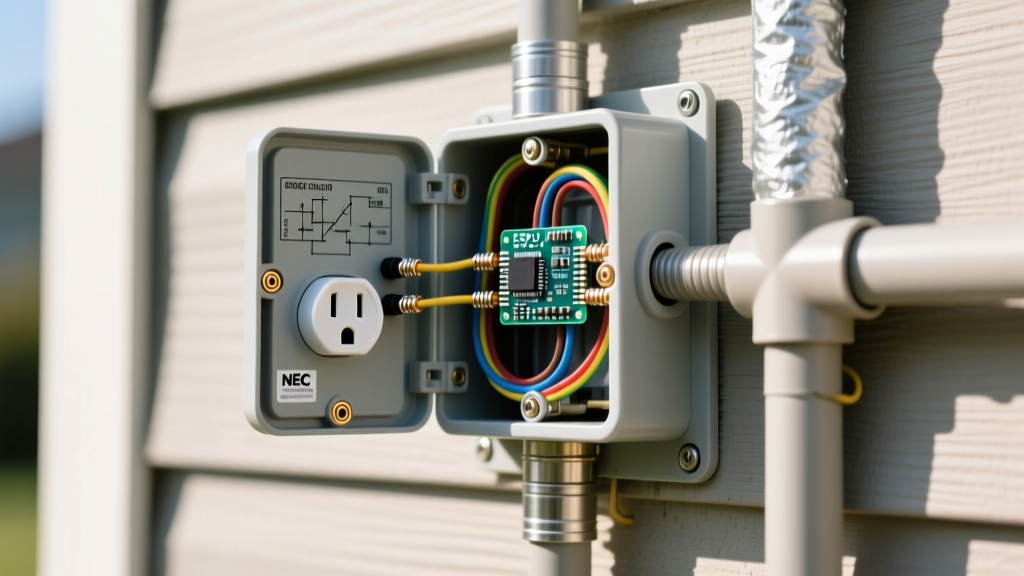
The receptacle itself is only half the battle; the enclosure housing it must withstand the elements. NEC 406.9(B)(1) requires weatherproof enclosures for outdoor receptacles.
NEMA 3R vs. NEMA 4 Enclosures
Most residential installations utilize NEMA 3R enclosures, which are rain-tight and sleet-resistant but not completely watertight. If your outside electrical outlet will be subjected to high-pressure hose downs (e.g., near a patio or driveway), you must upgrade to a NEMA 4 watertight enclosure, such as the Hubbell WP1015M series.
The 'In-Use' Cover Mandate
NEC 406.9(B)(2)(a) dictates that an outside electrical outlet in a wet location must have a cover that provides weatherproofing whether or not the attachment plug is inserted. This eliminated flat, flip-lid covers from code compliance years ago. You must install an 'Extra-Duty' bubble cover or hood that accommodates large power adapters and smart plugs. The TayMac MM410 and Hubbell WP1015 series are industry standards, offering 2.75 inches of internal depth for bulky transformer plugs.
Wiring Methods and Burial Depths (NEC Table 300.5)
Running power to an exterior wall or a detached post requires selecting the correct cable type and adhering to strict burial depths to prevent shovel or frost-heave damage. Below is a critical reference matrix based on NEC Table 300.5 for residential 120V, 20A circuits.
| Wiring Method | Minimum Burial Depth | Application Notes & Constraints |
|---|---|---|
| UF-B Cable (Direct Burial) | 24 Inches | Must be GFCI protected. No conduit required underground, but PVC sleeve needed where cable exits the ground to 8 feet above grade. |
| PVC Conduit (THWN-2) | 18 Inches | Use Schedule 40 for standard burial. Schedule 80 is required where conduit emerges from the ground and is subject to physical damage. |
| RMC or IMC Conduit | 6 Inches | Rigid Metal or Intermediate Metal Conduit. Highly durable but requires threading and specialized bending tools. |
| UF-B under 2' Concrete | 18 Inches | Cable must be encased in at least 2 inches of concrete to reduce the burial depth requirement. |
Pro Tip: Never use standard NM-B (Romex) cable outdoors, even inside exterior walls where condensation can occur. The paper wrapping inside NM-B acts as a wick, drawing moisture directly into your electrical panel.
Step-by-Step Installation and Torque Specifications
Modern code enforcement heavily emphasizes the mechanical integrity of terminations. A poorly torqued connection will expand and contract with outdoor temperature swings, eventually loosening and creating a high-resistance arc fault.
1. Box Mounting and Sealing Strategy
When mounting a weatherproof box to siding (vinyl, wood, or HardiePlank), use stainless steel or heavily galvanized lag screws. Apply a bead of 100% silicone sealant (such as DAP Silicone Max) to the top and sides of the box flange. Crucial Edge Case: Do not caulk the bottom edge. Leaving the bottom unsealed creates a weep hole, allowing any internal condensation or trapped moisture to drain out rather than pooling inside the enclosure.
2. Conduit and Fittings
Use PVC conduit with PVC solvent cement. Where the conduit enters the weatherproof box, you must use a conduit body (LB or LL) or a rain-tight hub connector. Standard indoor locknuts and bushings will allow water to wick directly into the box via capillary action.
3. Torque Specifications (NEC 110.14(D))
NEC 110.14(D) requires that terminations be torqued to the manufacturer's specifications using a calibrated torque tool. For a standard Leviton 5362-W 15A receptacle, the terminal screw torque specification is exactly 14 in-lbs. Over-tightening strips the brass threads; under-tightening causes thermal arcing. Invest in an inch-pound torque screwdriver (e.g., CDI 401SM) for all outdoor terminations.
Common Edge Cases and Troubleshooting Nuisance Tripping
Even perfectly wired outside electrical outlets can experience nuisance GFCI tripping. Understanding the physics of outdoor circuits is vital for troubleshooting.
The Capacitance and Moisture Problem
Long underground cable runs possess inherent capacitance. When combined with microscopic moisture ingress in downstream (load-side) connections, the cumulative leakage current can exceed the GFCI's 4mA to 6mA trip threshold, causing the receptacle to trip randomly, especially during heavy rain or morning dew.
The 'Line-Only' Wiring Solution
To mitigate nuisance tripping on complex outdoor circuits, avoid using the LOAD terminals on the outdoor GFCI receptacle to daisy-chain other outlets. Instead, install a GFCI circuit breaker in the main panel and wire the outdoor receptacle on the LINE side only. Alternatively, use a heavy-duty, outdoor-rated GFCI receptacle (like the Pass & Seymour 2095-W) and seal all wire nuts with liquid electrical tape or silicone-filled wire connectors (e.g., 3M DBR/Y-6) to completely eliminate moisture ingress at the splice points.
Final Safety Inspections
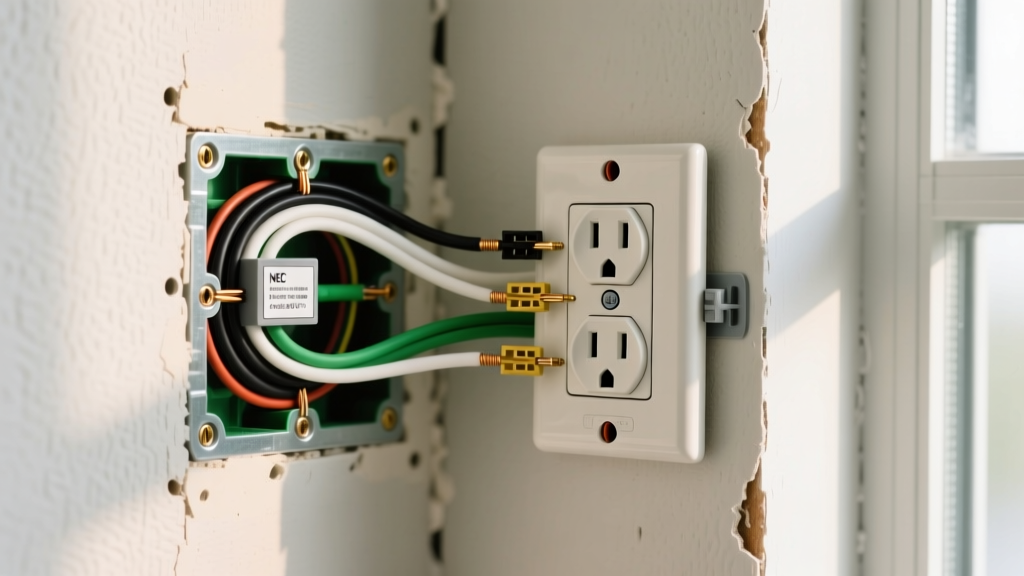
Before energizing the circuit, perform a visual inspection. Verify that the WR marking is visible on the receptacle yoke, the in-use cover closes completely over your largest intended plug, and the grounding conductor is securely bonded to the weatherproof box via a green grounding screw or clip. For comprehensive safety guidelines and consumer resources, always refer to the Electrical Safety Foundation International (ESFI). Proper installation of an outside electrical outlet ensures reliable power for years while keeping your family and property safe from electrical hazards.