A standard North American wall outlet delivers 120 volts (nominal), while standard European, UK, and Australian outlets deliver 230 volts. In North American split-phase systems, the 120V outlet voltage is derived from the 240V main service using the center-tapped transformer formula: V_outlet = V_line-to-line / 2. Substituting standard residential values: 240V / 2 = 120V. In commercial 3-phase wye systems, the formula shifts to V_outlet = V_line-to-line / √3, yielding 208V / 1.732 = 120V.
The Assumptions That Fix Your Outlet Voltage
The exact voltage at your receptacle is not a universal constant; it is fixed by two primary assumptions: system topology and regional standards. If you assume a single-phase residential topology in a region governed by the National Electrical Code (NEC), the answer is 120V. If you assume a single-phase topology in an IEC-governed region, the answer is 230V.
Furthermore, '120V' or '230V' are nominal values, not absolute guarantees. The actual voltage is fixed by the ANSI C84.1 standard, which dictates that utilization voltage (the voltage at the outlet) must remain within ±5% of the nominal value under normal load, and within ±10% under extreme conditions. Therefore, the assumption that fixes your exact measured answer is the distance from the utility transformer and the voltage drop across your branch circuit wiring.
Acceptable Voltage Ranges (±20% Tolerance Table)
When troubleshooting brownouts or overvoltage conditions, you need to know the mathematical boundaries of your system. The table below maps the nominal voltages to their neighboring values across a ±20% range. Note that while ±5% is the standard utilization target, crossing the ±10% threshold typically triggers utility intervention, and ±20% represents catastrophic brownout or surge conditions that will destroy sensitive electronics.
| Nominal System | -20% (Severe Brownout) | -10% (Utility Limit) | -5% (NEC Target) | +5% (NEC Target) | +10% (Utility Limit) | +20% (Severe Surge) |
|---|---|---|---|---|---|---|
| 120V (US Residential) | 96.0V | 108.0V | 114.0V | 126.0V | 132.0V | 144.0V |
| 230V (EU/UK/AU) | 184.0V | 207.0V | 218.5V | 241.5V | 253.0V | 276.0V |
| 208V (US 3-Phase Wye) | 166.4V | 187.2V | 197.6V | 218.4V | 228.8V | 249.6V |
| 240V (US Split-Phase L-L) | 192.0V | 216.0V | 228.0V | 252.0V | 264.0V | 288.0V |
How the Answer Shifts: 120V vs 230V vs 3-Phase
The voltage at an outlet shifts fundamentally based on the phase configuration of the supply transformer. Here is how the math and physical wiring change across the three most common global systems:
1. North American 120V/240V Split-Phase
Residential homes in the US and Canada are fed by a single-phase, center-tapped transformer. The full secondary winding provides 240V (used for dryers and ranges). The center tap is bonded to ground (neutral), splitting the waveform into two 120V legs that are 180 degrees out of phase. A standard outlet connects between one hot leg and the neutral, yielding 120V.
2. European/Australian 230V Single-Phase
Most of the world uses a 3-phase wye distribution system where the phase-to-neutral voltage is natively 230V (historically 220V or 240V, harmonized to 230V). Residential homes are typically fed just one of those phases plus the neutral. There is no center-tap splitting; the outlet simply receives the full 230V line-to-neutral potential.
3. North American 120V/208V 3-Phase Wye
Commercial buildings in the US use a 3-phase, 4-wire wye system. The voltage between any two hot phases (line-to-line) is 208V. Because the phases are 120 degrees apart (not 180 degrees like split-phase), you cannot simply divide by 2. You must use the square root of 3 (1.732). The outlet voltage (line-to-neutral) is calculated as 208V / 1.732 = 120V. This allows commercial buildings to run standard 120V office equipment on the same panel that powers 208V HVAC systems.
When Voltage Conversions Become Meaningless
A common follow-up question is, 'How many watts is a 120V outlet?' This conversion is meaningless unless you know both the breaker ampacity and the load's Power Factor (PF).
In DC circuits, Watts = Volts × Amps. But in AC circuits, the formula is Real Power (Watts) = Volts × Amps × Power Factor. If you plug a purely resistive load (like a space heater) into a 120V, 15A outlet, the PF is 1.0, and the outlet can deliver 1,800W. However, if you plug in an inductive load (like an undersized induction motor or a bank of uncorrected fluorescent ballasts), the PF might drop to 0.7. The outlet is still 120V, and the breaker still sees 15A, but the real work being done is only 1,260W. The remaining current is 'reactive power' bouncing back and forth, generating heat in the wires without doing useful work.
Decision Tree: Identifying Your Outlet and Required Parts
Use this decision path to identify your outlet's voltage based on physical plug geometry and region, terminating in the exact replacement receptacle part number you need to buy at the supply house.
| IF Region & Plug Geometry... | AND Circuit Breaker Size... | THEN Voltage Is... | BUY THIS EXACT PART |
|---|---|---|---|
| US/Canada: 2 flat parallel pins (1 wider) + round ground | 15A or 20A Single Pole | 120V | Leviton 5262-W (NEMA 5-15R, 15A) |
| US/Canada: 2 flat horizontal pins + round ground | 15A or 20A Double Pole | 240V | Leviton 5862-W (NEMA 6-15R, 15A) |
| US/Canada: 3 flat pins (1 L-shaped) + no ground pin | 30A 3-Pole | 208V/240V 3-Phase | Hubbell HBL2620 (NEMA L15-30R Twist-Lock) |
| Europe: 2 round pins with side grounding clips | 16A Single Pole MCB | 230V | Legrand 770018 (Schuko Type F, 16A) |
| UK: 3 large rectangular pins (1 vertical, 2 horizontal) | 32A Ring Main MCB | 230V | Crabtree 503860 (BS 1363, 13A fused) |
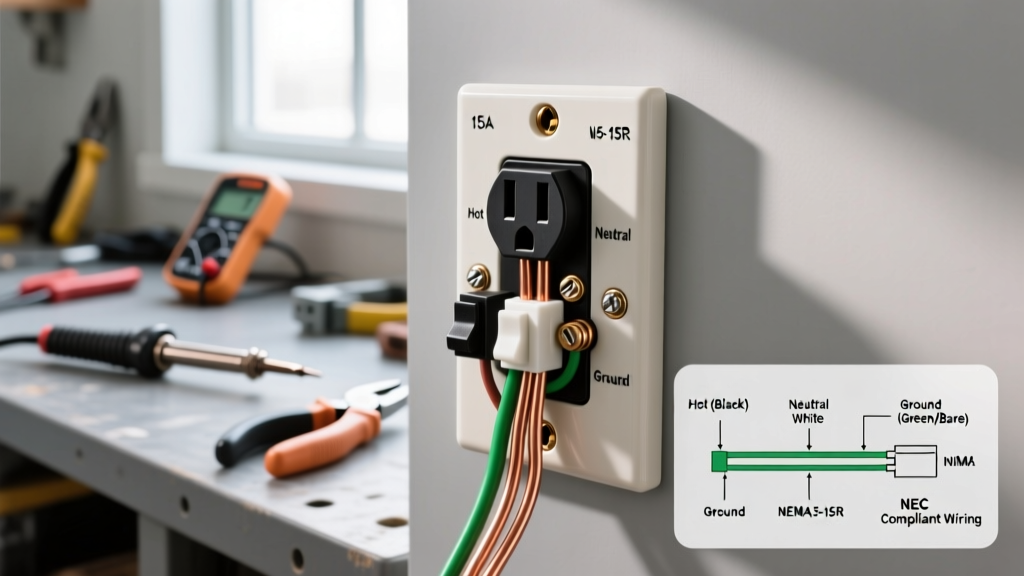
For standard US residential replacements on a 15A branch circuit wired with 14 AWG copper, the default pick is always the Leviton 5262-W (or equivalent spec-grade NEMA 5-15R). Ensure you wire the brass screw to the hot (black), the silver screw to the neutral (white), and the green screw to the ground (bare/green), torquing the terminal screws to the manufacturer's specification (typically 14 in-lbs) to prevent arc faults.
Frequently Asked Questions
Can I plug a 220V appliance into a 120V outlet?
No. While it physically won't fit without an adapter, using a step-up transformer to run a 220V appliance on a 120V, 15A US circuit will draw nearly double the amperage on the primary side, instantly tripping the breaker or causing a fire. Always install a dedicated 240V circuit for 220V-240V equipment.
Why does my multimeter read 122V at the panel but 116V at the outlet?
This is voltage drop. According to NEC informational notes, branch circuit voltage drop should ideally not exceed 3%. A 6V drop on a 120V circuit is exactly 5%, indicating your wire run is either too long for its gauge (e.g., 14 AWG run over 60 feet) or your terminal connections are loose and introducing resistance.