
Navigating the Electrical Outlet Taiwan Landscape: A Safety & Code Primer
Whether you are an expatriate renovating a Taipei apartment, a facility manager maintaining a commercial space in Kaohsiung, or a DIY enthusiast upgrading your home workshop, understanding the specific requirements for an electrical outlet Taiwan installation is critical. While Taiwan shares physical plug similarities with North America and Japan, its underlying wiring codes, safety certifications, and high-voltage appliance standards are governed by distinct local regulations. Ignoring these nuances can lead to catastrophic failures, voided insurance claims, and severe shock hazards.
In this comprehensive 2026 safety guide, we dissect the Chinese National Standards (CNS), Bureau of Standards, Metrology and Inspection (BSMI) mandates, and practical wiring protocols you must follow when installing or replacing receptacles in Taiwan.
Core Specifications of an Electrical Outlet Taiwan Uses
Before touching a wire stripper, you must understand the baseline electrical grid parameters. Taiwan operates on a 60Hz frequency, but the voltage delivery and plug configurations vary strictly by application.
| Parameter | Standard Specification (Taiwan) | Common Application |
|---|---|---|
| Nominal Voltage | 110V (Single Phase) / 220V (Split Phase) | General lighting & receptacles / Heavy HVAC |
| Frequency | 60 Hz | Grid-wide standard |
| Plug/Receptacle Type | Type A (NEMA 1-15) & Type B (NEMA 5-15) | Standard 15A household outlets |
| High-Draw Receptacles | NEMA 6-15, 6-20, or CNS-specific 20A/250V | Window ACs, water heaters, induction cooktops |
| Governing Body | BSMI (Bureau of Standards, Metrology and Inspection) | All imported and domestic electrical goods |
For a detailed global mapping of plug types, the International Electrotechnical Commission (IEC) provides the definitive reference for Type A and Type B configurations used across the region.
CNS Standards vs. US NEC: What DIYers Must Know
A common and dangerous mistake made by Western expats is applying the US National Electrical Code (NEC) blindly to Taiwanese wiring. While the NFPA 70 (NEC) is a gold standard globally, Taiwan relies on CNS 3199 (Wiring Methods and Materials) and CNS 14328 (Receptacles). Here are the critical divergences:
1. Wire Color Coding
- US NEC: Black (Hot), White (Neutral), Bare/Green (Ground).
- Taiwan CNS: Black (Hot/Live), White (Neutral), Green (Ground). However, for 220V single-phase circuits, CNS mandates Red (Hot 1), Black (Hot 2), and Green (Ground). Using white as a hot wire without proper phase tape marking is a severe code violation in Taiwan.
2. BSMI Certification Mandates
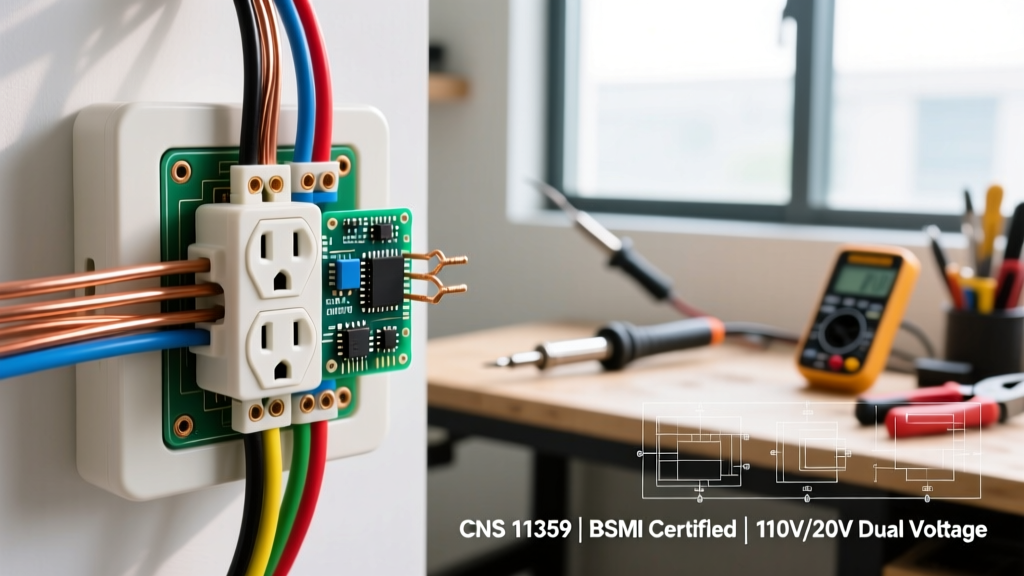
You cannot legally import or install uncertified receptacles in commercial or multi-family residential builds. Every compliant electrical outlet Taiwan product must bear the official BSMI certification mark. Leading compliant brands include Panasonic (e.g., the WN1301 series for 15A duplex), Shihlin Electric, and Tenby. A standard BSMI-certified 15A 125V duplex receptacle costs between 40 and 80 TWD ($1.25 - $2.50 USD) in 2026, while heavy-duty 20A 250V AC outlets range from 150 to 300 TWD ($5.00 - $10.00 USD).
High-Voltage (220V) Appliance Outlets & Code Compliance
Taiwanese homes frequently utilize 220V single-phase power for high-draw appliances like split-system air conditioners and instant electric water heaters. Unlike the US, where 240V is standard for dryers and ranges, Taiwan's 220V systems often do not utilize a neutral wire for these specific dedicated circuits.
Safety Warning: Never attempt to wire a 220V Taiwanese water heater using a standard US NEMA 10-30 (3-prong, ungrounded) receptacle. Modern CNS codes strictly require a dedicated equipment grounding conductor for all 220V wet-area appliances. Use a NEMA 6-20R equivalent or the specific CNS twist-lock receptacle rated for 250V/20A.
Grounding and RCD Requirements in Taiwan
One of the most pervasive hazards in older Taiwanese apartments (built before 2005) is the "fake ground." Builders often installed Type B (3-prong) receptacles but only connected the hot and neutral wires, leaving the ground terminal floating. This defeats the purpose of the third prong and creates a lethal shock risk.
The Shift Toward RCDs (Residual Current Devices)
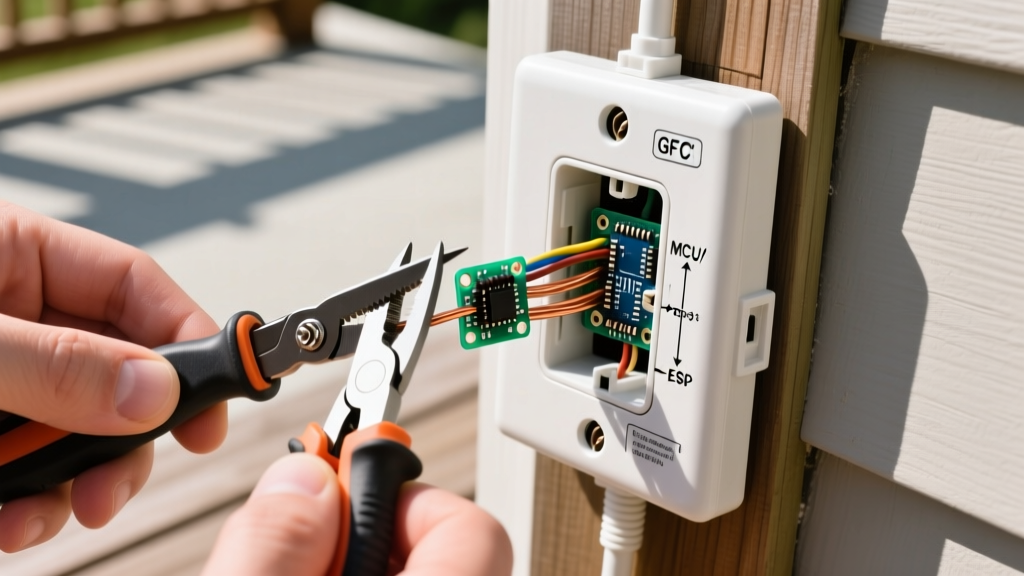
Recent updates to Taiwan's interior building codes now heavily emphasize the use of RCDs (the local equivalent to North American GFCIs) in wet locations. When upgrading an electrical outlet Taiwan setup in bathrooms, kitchens, or outdoor balconies, you must install a BSMI-approved RCD receptacle or ensure the circuit breaker in the distribution panel features integrated RCD protection (typically tripping at 30mA within 0.1 seconds). Panasonic's WN1365 series RCD receptacles are currently the industry standard for these retrofits.
Step-by-Step: Safely Replacing a Standard 110V Receptacle
Follow this precise procedure to ensure your installation meets CNS safety tolerances.
- Isolate and Verify: Turn off the miniature circuit breaker (MCB) at the main distribution board. Use a non-contact voltage tester and a dual-lead multimeter to confirm 0V between Hot-Neutral, Hot-Ground, and Neutral-Ground.
- Inspect the Junction Box: Taiwanese walls typically use 40mm or 50mm deep metal or PVC junction boxes. Ensure the box is securely anchored. If the box is damaged, replace it before proceeding.
- Prepare the Conductors: Strip the wire insulation to exactly 12mm (approx. 1/2 inch). CNS standards dictate that no bare copper should be visible outside the receptacle terminal, and insulation must not be pinched inside the terminal clamp.
- Terminate the Wires: Insert the Black (Hot) wire into the brass terminal, the White (Neutral) into the silver terminal, and the Green (Ground) into the green terminal. If using screw terminals, loop the wire clockwise around the screw. Torque the screws to 0.8 Nm to prevent cold-flow loosening over time.
- Secure and Test: Mount the receptacle flush against the box. Restore power and test with a specialized 3-prong receptacle tester to verify correct polarity and ground continuity.
Common Failure Modes & Troubleshooting
When auditing an existing electrical outlet Taiwan installation, look out for these specific localized failure modes:
- The "Cheater Plug" Epidemic: The use of 3-to-2 prong adapters to plug grounded appliances into ungrounded Type A outlets is rampant. This is a massive fire and shock hazard. The only code-compliant fix is running a new equipment grounding conductor back to the panel or installing an RCD receptacle (which provides shock protection without a physical ground wire).
- Aluminum Wiring in 1980s Builds: Some budget developments in the late 1980s used aluminum branch wiring. Connecting standard copper-rated receptacles to aluminum wire causes galvanic corrosion and high-resistance arcing. You must use CO/ALR rated receptacles or pigtail with approved AlumiConn connectors.
- Overloaded 15A Circuits: Taiwanese kitchens often daisy-chain multiple high-draw appliances (rice cookers, microwaves, kettles) onto a single 15A breaker. If a receptacle feels warm to the touch (exceeding 35°C / 95°F), the circuit is overloaded. Split the loads across two separate 20A dedicated circuits using 2.0mm² (approx 14 AWG) or 3.5mm² (approx 12 AWG) THHN wire.
Frequently Asked Questions (FAQ)
Can I use US-purchased receptacles in Taiwan?
Physically, US NEMA 5-15R receptacles will fit Taiwanese plugs and operate on the 110V/60Hz grid. However, for commercial properties or new residential builds, using non-BSMI certified US receptacles violates local fire and building codes. For private DIY in an older home, high-quality US brands like Leviton or Hubbell are electrically safe, provided the wire gauges match the terminal ratings.
What wire gauge is required for a standard 110V outlet in Taiwan?
Taiwanese wire sizing is often measured in square millimeters (mm²) rather than AWG. A standard 15A receptacle circuit requires a minimum of 2.0 mm² (equivalent to roughly 14 AWG). For 20A circuits, you must use 3.5 mm² (equivalent to roughly 12 AWG). Always verify the BSMI stamp on the wire jacket.
How do I identify the official BSMI mark on an outlet?
Look for a small emblem featuring the letters "BSMI" alongside a specific certification number (e.g., CI38xxxxxx). You can verify this number directly on the official BSMI English portal to ensure the product hasn't been counterfeited or recalled.
Final Thoughts on Code Compliance
Working with an electrical outlet Taiwan requires respecting the intersection of familiar physical form factors and distinct local safety codes. By adhering to CNS wire color standards, mandating BSMI-certified components, and eliminating floating grounds through proper RCD integration, you ensure your electrical infrastructure is safe, legal, and built to last. When in doubt, consult a locally licensed electrician certified by the Taiwan Electrical Contractors' Association to inspect your panel and grounding electrode system.