
The Canadian Electrical Landscape: What You Need to Know
When troubleshooting an electrical outlet, Canada's unique climate and strict Canadian Electrical Code (CEC) standards introduce specific variables that differ significantly from American NEC guidelines. Canadian homes operate on a 120V/60Hz alternating current system, utilizing 15A or 20A duplex receptacles. However, the internal wiring topologies, mandatory Tamper-Resistant (TR) mechanisms, and stringent Arc-Fault Circuit Interrupter (AFCI) requirements dictate a specialized approach to diagnostics.
If a receptacle in your home has suddenly lost power, exhibits intermittent behavior, or shows physical signs of thermal damage, it is critical to approach the diagnosis methodically. According to the Electrical Safety Authority (ESA), improper DIY electrical repairs are a leading cause of residential fires in Ontario and across the country. This guide provides a deep-dive, expert-level diagnostic framework for identifying and resolving dead or failing receptacles while maintaining strict adherence to the latest CEC regulations.
Step 1: The 3-Minute Non-Contact Diagnostic
Before removing any faceplates or handling bare conductors, you must verify the presence of voltage and isolate the circuit. Do not rely solely on a lamp or phone charger to test a dead outlet; these devices do not provide diagnostic data regarding wiring faults.
- Deploy a Receptacle Tester: Insert a CSA-approved tester like the Gardner Bender GFI-3501 (approx. $18 CAD) into the suspect outlet. Observe the LED sequence.
- Analyze the LED Matrix: If the 'Open Ground' or 'Hot/Neutral Reversed' lights illuminate, you have identified a hard-wired fault that requires opening the junction box.
- Test the GFCI/AFCI Trip Mechanism: Press the black 'Test' button on the tester. If the outlet is GFCI-protected (either locally or upstream), the power should cut immediately. If it does not, the GFCI mechanism has failed, or the outlet is improperly wired, violating CEC Rule 26-700.
- Verify the Breaker Panel: Locate your main distribution panel. Look for a tripped breaker (the handle will rest in the middle 'trip' position) or a tripped AFCI/GFCI breaker with an illuminated LED indicator.
Step 2: Common Failure Modes in Canadian Homes
Understanding the specific failure modes prevalent in Canadian construction eras is vital for accurate diagnosis. The table below maps common symptoms to their root causes and relevant CEC codes.
| Symptom | Multimeter Reading | Probable Root Cause | CEC Rule / Required Fix |
|---|---|---|---|
| Dead outlet, no power | 0V Line-to-Neutral | Tripped upstream GFCI or backstabbed push-in connection failure. | Rule 26-700. Reset GFCI or side-wire the receptacle using screw terminals. |
| Intermittent power loss | Fluctuating 105V-118V | Loose wire nut splice in the junction box or degraded backstab terminal. | Rule 12-3034. Re-terminate with Ideal 33-090 wire nuts or Wago 221 lever connectors. |
| Shock from appliance casing | 120V Line-to-Ground, 0V Neutral-to-Ground | Open ground or bootleg ground (neutral bonded to ground at the receptacle). | Rule 10-204. Install a dedicated grounding conductor or replace with GFCI (labeled 'No Equipment Ground'). |
| Breaker trips instantly upon plugging in | N/A (Short Circuit) | Hot wire touching ground/neutral, or internal receptacle short. | Replace receptacle with CSA-approved Leviton 001-05325-WMP (approx. $3.85 CAD). |
The 'Backstab' Push-In Terminal Failure
One of the most pervasive issues in Canadian homes built between 1980 and 2010 is the failure of push-in (backstabbed) wiring terminals. Many budget-grade receptacles feature spring-loaded internal clamps designed to accept 14 AWG solid copper wire without using the side screw terminals. While this speeds up rough-in installation, the thermal expansion and contraction cycles caused by Canadian winters and high-draw appliances (like space heaters or vacuums) cause the spring tension to degrade over time.
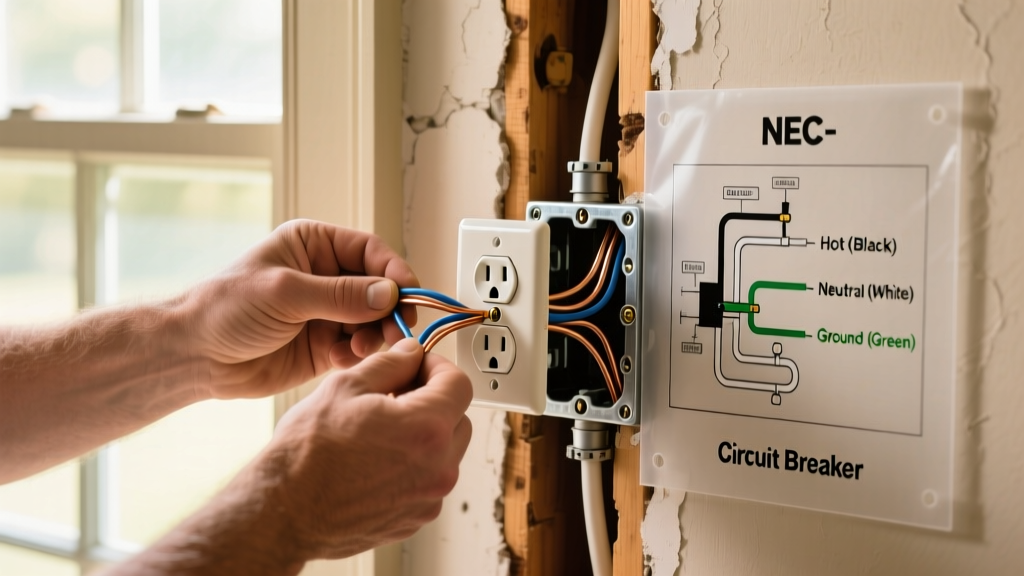
Expert Insight: The CSA Group testing standards allow push-in terminals, but master electricians universally recommend side-wiring (using the brass and silver screws) or using screw-clamp plates. If you open a dead outlet and find 14/2 NMD90 cable pushed into the back, pull the wires out, strip them to 5/8 inch, and loop them clockwise around the terminal screws.
GFCI and AFCI Tripping: CEC 2024/2026 Updates
The Canadian Electrical Code has aggressively expanded Arc-Fault Circuit Interrupter (AFCI) and Ground-Fault Circuit Interrupter (GFCI) requirements. If a bedroom, living room, or hallway outlet is dead, the issue is rarely the receptacle itself; it is almost always a tripped Combination AFCI breaker at the panel.
- AFCI Nuisance Tripping: Older combination AFCI breakers (pre-2018) are highly sensitive to the brushed motors in vacuums or the switching power supplies in modern LED drivers. If an Eaton BRCA115 (approx. $52 CAD) trips repeatedly without a genuine arc fault, the breaker's internal microprocessor may be failing, or there is a shared neutral fault downstream.
- GFCI Stacking: CEC rules prohibit 'stacking' GFCI protection. If you have a GFCI receptacle in a bathroom that is also fed from a GFCI breaker, the capacitive leakage current can cause phantom tripping. Ensure downstream receptacles are standard TR duplexes, not secondary GFCIs.
Step 3: Advanced Multimeter Voltage Drop Testing
When a receptacle shows 120V on a cheap digital tester but fails to power a high-draw appliance, you are likely experiencing severe voltage drop due to high resistance in the circuit. To diagnose this, use a True-RMS multimeter like the Fluke 117.
- Set the Dial: Switch the Fluke 117 to AC Voltage (V~).
- Measure Line-to-Neutral (L-N): Insert the red probe into the shorter (hot) slot and the black probe into the longer (neutral) slot. A healthy Canadian circuit should read between 118V and 122V.
- Measure Line-to-Ground (L-G): Move the black probe to the D-shaped ground hole. The reading should be nearly identical to L-N (within 1-2V).
- Measure Neutral-to-Ground (N-G): Insert the red probe into the neutral slot and the black into the ground hole. This is the critical diagnostic step. A reading of 0V indicates a perfect circuit. A reading above 2V under load indicates a loose neutral connection somewhere upstream, which is a severe fire hazard.
Edge Case: Troubleshooting Aluminum Wiring (Pre-1977 Homes)
If your home was built in Canada between the late 1960s and 1977, it may contain solid aluminum branch wiring (typically 15A circuits using 12 AWG aluminum). Aluminum oxidizes rapidly when exposed to air, creating a highly resistive layer that generates immense heat at the termination points.
If an outlet in an aluminum-wired home feels warm to the touch, emits a faint 'fishy' or burning plastic odor, or shows brown scorch marks on the faceplate, stop using the circuit immediately. Standard copper-rated receptacles will fail catastrophically when connected directly to aluminum wire due to galvanic corrosion and differing thermal expansion rates.
The Fix: You must install receptacles specifically marked CO/ALR (Copper/Aluminum Revised), such as the Leviton 1620-2W. Alternatively, and preferably, hire a licensed contractor to perform a COPALUM crimp or AlumiConn lug pigtailing procedure, transitioning the aluminum wire to a short copper pigtail before terminating at a standard TR receptacle. Technical Safety BC and other provincial authorities strongly mandate permits and inspections for any aluminum wiring remediation.
When to Call a Licensed Canadian Electrician
While replacing a standard 15A duplex receptacle is within the capabilities of an advanced DIYer, Canadian law and insurance policies dictate strict boundaries. You must contact a Licensed Electrical Contractor (LEC) if:
- You discover aluminum wiring that has not been previously remediated and inspected.
- The junction box is damaged, lacks a proper grounding conductor, or is overfilled (violating CEC box fill calculations).
- You need to install a new 20A circuit for kitchen countertop appliances, which requires 12/2 NMD90 cable and specific split-receptacle configurations.
- Your home's main panel is a recalled Federal Pioneer or Zinsco panel, which are notorious for failing to trip during short circuits.
Always verify that your replacement components bear a recognized Canadian certification mark, such as the cCSAus or cULus logo. Uncertified imports purchased from overseas marketplaces do not meet CSA C22.1 standards and will void your home insurance in the event of an electrical fire. By combining methodical multimeter diagnostics with a strict adherence to the Canadian Electrical Code, you can safely restore power and ensure the long-term reliability of your home's electrical infrastructure.