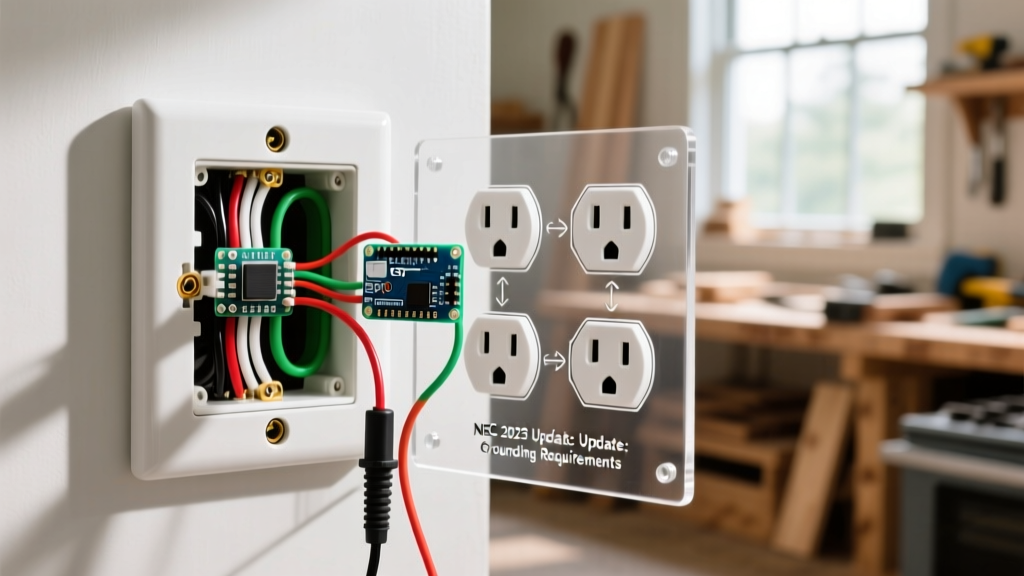
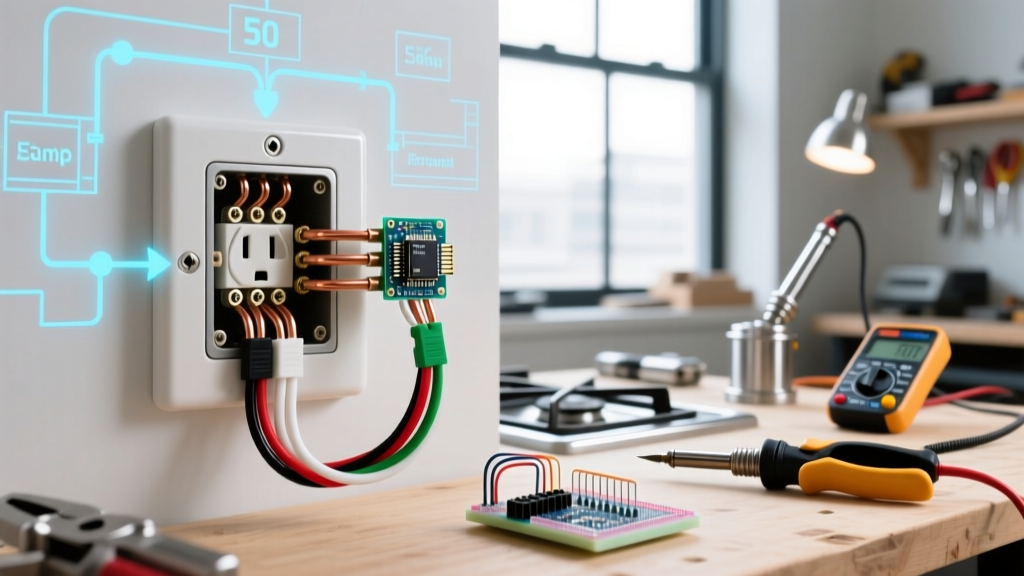
A circuit breaker is an automatically operated electrical switch designed to protect a circuit from damage caused by overcurrent, short circuits, or ground faults. In a real installation, it changes a potentially catastrophic thermal event or lethal shock into a simple mechanical trip that requires a manual reset, isolating the fault without destroying the wire insulation or harming the user.
The Core Function: What a Breaker Actually Does
Inside a standard residential breaker, two distinct mechanisms monitor the current flowing through the bimetallic strip and the solenoid coil. The thermal element responds to sustained, low-level overloads by bending as it heats up, eventually unlatching the contacts. The magnetic element responds to massive, instantaneous short circuits by creating a magnetic field strong enough to snap the latch open in < 25 milliseconds.
While standard breakers only look at total current magnitude, modern panels require breakers that also analyze the shape of the electrical wave or monitor current leakage, leading to the different type of breakers we see in modern load centers.
The Main Different Types of Breakers in Residential Panels
The National Electrical Code (NEC) has progressively mandated advanced protection over the last two decades. Here is how the primary breaker types compare in a residential setting.
| Breaker Type | Protection Mechanism | Primary Hazard Prevented | Common Part Example (120V 20A) |
|---|---|---|---|
| Standard Thermal-Magnetic | Bimetallic strip + Solenoid | Wire melting / Short circuits | Square D HOM120 |
| GFCI (Ground Fault) | Current differential sensor (Line vs. Neutral) | Lethal electric shock | Eaton BRGFT120 |
| AFCI (Arc Fault) | Microprocessor analyzing high-frequency wave signatures | Electrical fires from arcing | Square D HOM120CAFIC |
| Dual Function (DF) | Combines GFCI and AFCI logic on one board | Shock + Fire (Comprehensive) | Eaton BRD120 |
According to Eaton's circuit breaker documentation, Dual Function (DF) breakers have largely become the default choice for new construction, as they satisfy both NEC Article 210.8 (GFCI) and 210.12 (AFCI) requirements in a single slot, eliminating the need for complex pigtail wiring in crowded panels.
Where You Meet This in Practice: Sizing and Trip Curves
Where you meet this in practice is at the intersection of load calculation and wire ampacity. A breaker's amp rating is not a suggestion; it is the absolute ceiling for the wire connected to it. Furthermore, you must account for continuous loads (those expected to run for 3 hours or more).
You are wiring a dedicated outlet for a 1500W, 120V portable space heater that will run continuously in a workshop.
- Base Current: I = P / V → 1500W / 120V = 12.5 Amps.
- Continuous Load Rule (NEC 210.20): Multiply by 125% → 12.5A × 1.25 = 15.625 Amps.
- The Mistake: A standard 15A breaker will nuisance-trip on its thermal element because 15.6A exceeds its continuous rating.
- The Fix: You must step up to a 20A breaker. Consequently, you must pull 12 AWG copper wire (rated for 20A at 60°C/75°C) rather than 14 AWG, which is only rated for 15A.
If you install a 20A breaker but leave 14 AWG wire on the circuit, the breaker will allow 19 Amps to flow indefinitely. The 14 AWG wire will overheat, melt its THHN insulation, and start a fire inside the wall cavity before the breaker ever trips.
Decision Tree: Picking the Exact Breaker for Your Circuit
Use this decision path to select the correct breaker for your next rough-in or panel upgrade. This table terminates in a concrete, off-the-shelf part number assuming a standard Square D Homeline (HOM) or Eaton BR panel.
| If Your Circuit Is... | Then You Need... | Concrete Pick (Square D HOM) | Concrete Pick (Eaton BR) |
|---|---|---|---|
| Kitchen, Dining, Living Room, or Bedroom 15A/20A receptacles | Dual Function (AFCI + GFCI) | HOM120DF | BRD120 |
| Bathroom, Garage, Outdoor, or Crawl Space receptacles | GFCI (Arc fault usually not required by NEC for these specific wet/outdoor zones) | HOM120GFIC | BRGFT120 |
| 240V Electric Baseboard Heater or Water Heater | Standard 2-Pole Thermal-Magnetic (No AFCI/GFCI required for hardwired 240V resistive loads in most jurisdictions) | HOM230 (for 30A) | BR230 |
| Lighting-only circuit in a hallway or closet | AFCI (Standard thermal-magnetic is no longer code-compliant for most living space lighting) | HOM115CAFIC | BRCAF115 |
Common Confusions and Mistakes to Avoid
When discussing the different type of breakers, two major confusions consistently cause failed inspections or dangerous installations.
1. Confusing Breaker Ampacity with Wire Ampacity
Novices often believe that swapping a 15A breaker for a 20A breaker will "fix" a circuit that keeps tripping when multiple appliances are used. This is a critical error. The breaker protects the wire. If you upgrade the breaker without upgrading the wire from 14 AWG to 12 AWG, you have removed the safety net. The breaker is the weak link by design; never make the wire the weak link.
2. Confusing GFCI with AFCI
People frequently use the terms interchangeably. Remember the mnemonic: GFCI protects Goats (people/animals) from shock by detecting current leaking to ground. AFCI protects Assets (the house) from fire by detecting the high-frequency signature of an electrical arc across a loose connection or damaged wire. Modern code often requires both, which is why Dual Function breakers exist.
Frequently Asked Questions About Breaker Selection
Can I use an Eaton CL breaker in a Square D Homeline panel?
Yes, but only if the breaker is explicitly UL Classified for that specific panel. Eaton's CL line is classified for use in competing panels (like Square D HOM and GE). However, you cannot simply force a standard Eaton BR breaker into a Square D panel; the bus bar stab shapes are different, and doing so will result in poor contact, arcing, and a melted bus bar.
Why does my AFCI breaker trip when I plug in a vacuum cleaner?
Universal motors in vacuums and power drills generate natural electrical noise and minor arcing at the carbon brushes. Older generation AFCI breakers (pre-2015) often misinterpreted this as a dangerous parallel arc. Modern AFCI and Dual Function breakers feature advanced microprocessors with refined algorithms that can distinguish between normal motor brush arcing and a dangerous wire fault.
Do I need a special breaker for a smart home panel?
No. Smart panels (like the SPAN panel or Leviton Smart Load Center) use proprietary smart breakers that communicate via low-voltage data buses to the panel's main controller. You cannot use standard off-the-shelf HOM or BR breakers in these specific smart panels; you must use the manufacturer's designated smart breaker modules.
Always match the breaker brand to your panel's label, size the wire strictly to the breaker's ampacity column, and default to Dual Function breakers for any 15A or 20A residential branch circuit where local code permits.