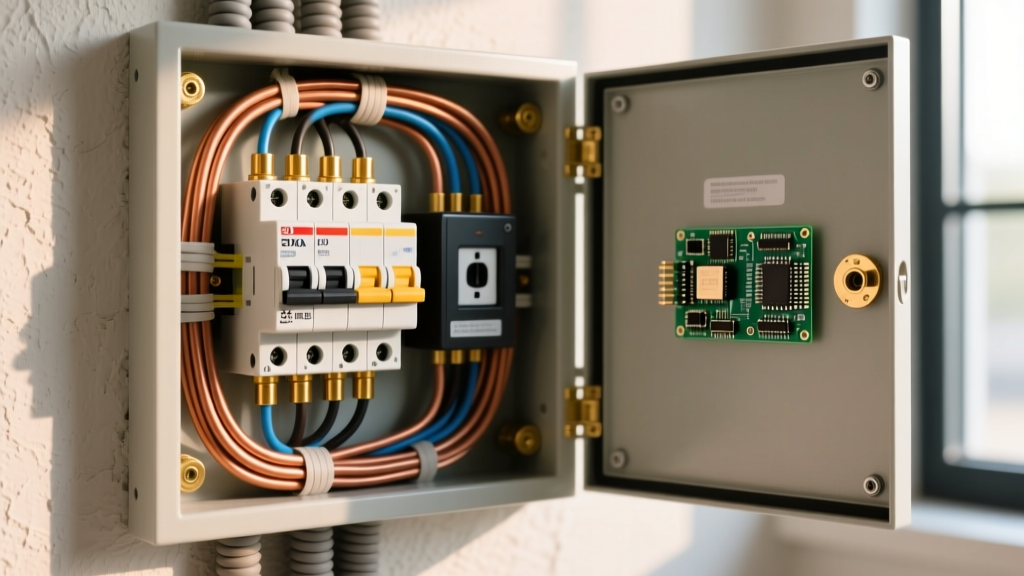
A bus bar in an electrical panel is a solid strip of copper or aluminum that serves as a central junction point to distribute incoming electrical current to multiple circuit breakers. Instead of splicing a dozen individual wires together to share a main feed—which would create massive resistance, voltage drop, and heat—the bus bar provides a single, low-impedance metal highway. In a real circuit, it changes the installation by eliminating messy wire nuts and terminal lugs for branch circuits, allowing breakers to simply clip onto metal stabs to draw power safely and cleanly.
What Bus Bars in an Electrical Panel Actually Do
Think of a bus bar as a high-capacity power strip built directly into the steel chassis of your load center. When utility power enters your main panel, it lands on the main lugs (or the main breaker). From there, the current flows into the phase bus bars. These bars run vertically down the center of the panel, featuring alternating metal protrusions called 'stabs' or 'clips'.
When you snap a Square D QO or Eaton BR breaker into place, the breaker's internal contacts grip these stabs. This mechanical connection transfers the electrical load from the bus bar into the breaker, which then protects the branch circuit wire. Because the bus bar is a solid piece of metal with a massive cross-sectional area compared to standard branch wiring, it can handle the aggregate sum of all connected loads without overheating—provided it is sized correctly for the enclosure.
The Math: Sizing and Ampacity of Copper Bus Bars
Bus bar ampacity isn't arbitrary; it is strictly dictated by the cross-sectional area of the metal and its ability to dissipate heat. A standard engineering rule of thumb for bare copper bus bars in free air is 1,000 Amps per square inch of cross-sectional area. However, inside an enclosed electrical panel, heat cannot escape as easily, requiring a derating factor (typically around 0.80 for enclosed spaces per standard thermal limits).
Let's run a worked numeric example to see how this plays out on the bench:
- Measure the Bar: You have a custom DC solar combiner box using a copper bus bar that is 1/4 inch thick and 2 inches wide.
- Calculate Cross-Sectional Area: 0.25 in × 2.0 in = 0.5 square inches.
- Calculate Raw Ampacity: 0.5 sq in × 1,000 A/sq in = 500 Amps (in free air).
- Apply Enclosure Derating: 500A × 0.80 (enclosure factor) = 400 Amps continuous safe capacity.
If you attempt to push 450A through this bar inside a sealed fiberglass enclosure, the bar will act as a resistive heater. According to the Copper Development Association, exceeding the thermal limits of a bus bar leads to annealing, where the copper softens, loses its spring tension at the bolted joints, and eventually causes a catastrophic arc fault due to loose connections.
| Thickness | Width | Cross-Section | Approx. Enclosed Ampacity |
|---|---|---|---|
| 1/8" | 1" | 0.125 sq in | 100A |
| 1/4" | 1" | 0.250 sq in | 200A |
| 1/4" | 2" | 0.500 sq in | 400A |
| 1/2" | 4" | 2.000 sq in | 1,600A |
Where You Meet This in Practice
You will encounter bus bars in three primary scenarios in residential and light commercial work:
- Main Service Panels: The main bus bars are fed directly by the service entrance conductors. In a 200A panel, these bars are heavily plated copper or high-grade aluminum, designed to handle the full 200A continuous load plus the heat generated by up to 40+ branch breakers packed tightly around them.
- Main Lug Only (MLO) Subpanels: These panels lack a main breaker. The feeder wires land directly on the main lugs, which feed the bus bars. The bus bar rating here dictates the absolute maximum feeder size you can use, regardless of the breaker protecting the wire at the upstream panel.
- DC Solar and Battery Banks: Low-voltage DC systems require massive current to deliver high wattage. A 48V battery bank pushing 5,000W requires over 100A of continuous DC current. Makers and solar installers use dedicated, insulated DC bus bars (like the heavy-duty models from Blue Sea Systems) to distribute power to inverters and charge controllers without relying on fragile terminal blocks.
Scenario Walkthrough: The 100A Subpanel Bus Bar Failure
To understand why bus bar ratings matter, let's look at a real-world failure scenario involving a detached garage subpanel.
The Numbers: The panel's front sticker reads 'Max Main Breaker 100A.' However, if you look at the tiny stamping on the steel chassis near the bus bar, it reads 'Bus Bar Rating: 70A.' This is common in cheap, compact 4-space panels where the physical metal stabs are too thin to dissipate the heat of a full 100A load continuously.
The Outcome: The DIYer plugs in the EV charger (pulling 40A) and fires up the welder (pulling 45A). The total continuous load is 85A. The upstream 100A breaker in the main house does not trip, because 85A is well below its 100A trip curve. However, inside the garage subpanel, the 70A-rated bus bars begin to overheat severely.
What Went Wrong: After three hours of welding and charging, the heat softens the plastic supports holding the bus bar stabs. A breaker shifts slightly, losing contact pressure. The resulting high-resistance connection arcs, melting the breaker housing and tripping the upstream feeder via a ground fault, leaving the garage dead and the panel destroyed. The DIYer confused the feeder breaker rating with the bus bar ampacity. The bus bar was the bottleneck, and it failed before the breaker ever had a chance to protect it.
Common Confusions: Hot Bus Bars vs. Neutral and Ground Bars
One of the most dangerous mistakes a novice can make is confusing the hot phase bus bars with the neutral and ground bars. While they are all technically 'bus bars' (metal strips that aggregate current), their physical installation and code requirements under the NFPA 70 National Electrical Code are vastly different.
- Hot Phase Bus Bars: These carry the live, ungrounded current. They are completely uninsulated and are mounted on ceramic or high-dielectric plastic standoffs to keep them from touching the grounded steel panel enclosure. You never touch these with bare hands or uninsulated tools.
- Neutral Bars: These carry the return current. They are heavily insulated from the panel chassis in subpanels, but bonded directly to the chassis in main panels. They use set-screws to clamp wires, rather than breaker stabs.
- Ground (Equipment Grounding) Bars: These carry fault current only during a short circuit. They are always bolted directly to the steel panel chassis (which acts as the ground path back to the source).
The Golden Rule: In a main panel, the neutral and ground bars are bonded together (connected). In a subpanel, they must remain strictly isolated. If you accidentally land a neutral wire on a ground bar in a subpanel, you create a parallel neutral path, which can energize the panel chassis and cause shock hazards.
Frequently Asked Questions
Can I add an extension bus bar to an existing panel to fit more breakers?
No. You cannot mechanically bolt a third-party bus bar extension onto an existing UL-listed panel. The panel's internal clearances, thermal dissipation, and short-circuit bracing are engineered for the factory-installed bars. If you need more spaces, you must install a larger panel or add a subpanel.
Why are some residential bus bars aluminum and others copper?
Copper is the standard for high-end panels (like Square D QO) because it runs cooler and resists corrosion better. Aluminum is used in many budget-friendly panels (like some Eaton and Siemens models) to keep costs down. Aluminum bus bars are perfectly safe when used within their rated ampacity, but they are more susceptible to thermal expansion and require specific anti-oxidant compounds if you are bolting aluminum feeder wires directly to them.
Do DC bus bars in a solar setup need insulation covers?
Absolutely. Unlike AC panels where the hot bars are recessed behind a deadfront, DC bus bars are often mounted directly to a board. Because DC arcs do not self-extinguish at the zero-crossing point like AC arcs do, a dropped wrench across an exposed 48V DC bus bar can sustain a continuous, high-heat plasma arc. Always use bus bars with molded polycarbonate insulating covers.