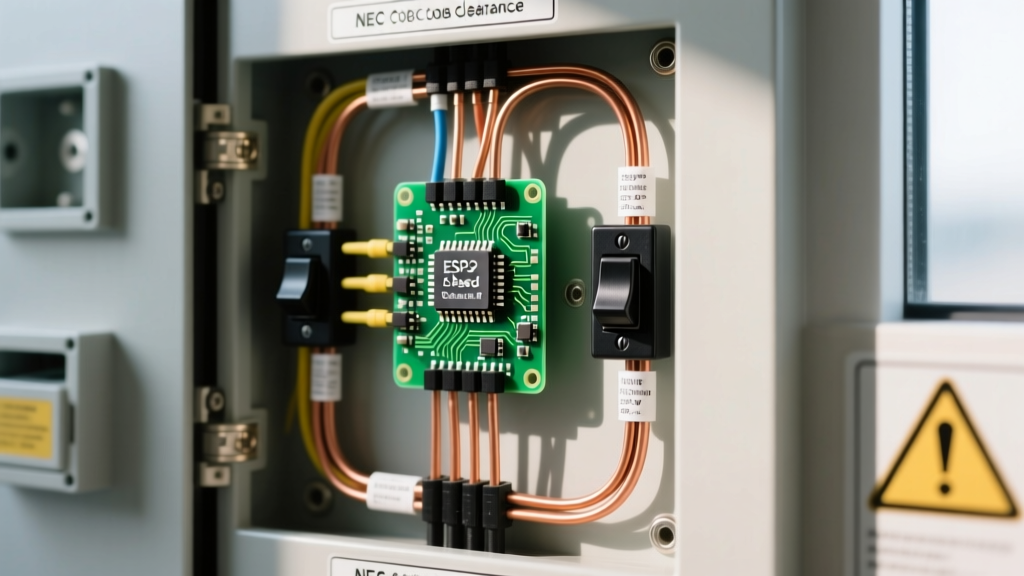
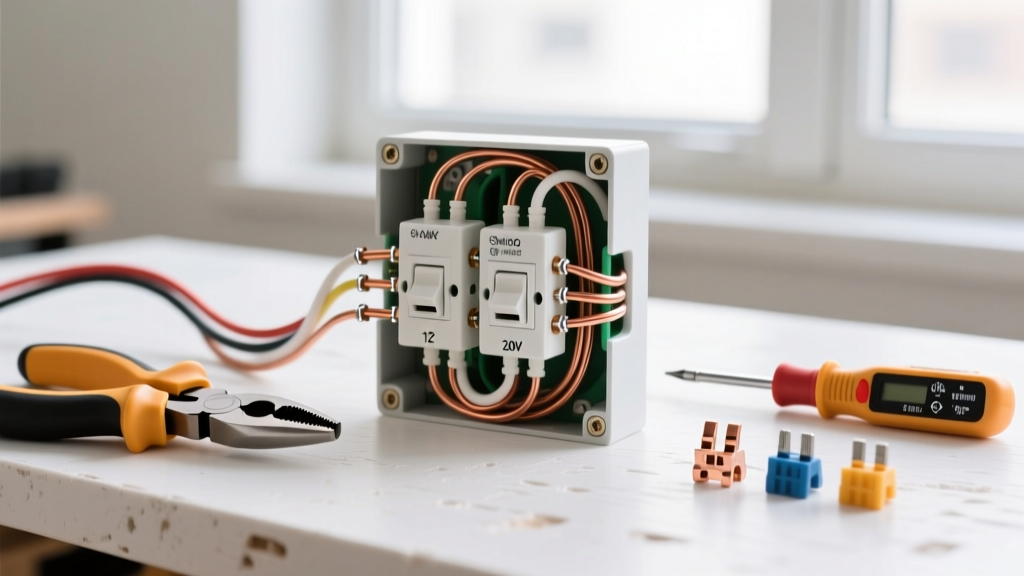
The maximum safe continuous amp capacity of wire gauges in standard 120V residential branch circuits is governed by the 80% rule: you can safely draw 12 amps on a 14 AWG wire (protected by a 15A breaker) and 16 amps on a 12 AWG wire (protected by a 20A breaker). While the physical copper can momentarily handle more, pushing a circuit to its absolute thermal limit causes terminal degradation, insulation breakdown, and severe voltage drop long before the breaker's bimetallic strip physically trips. If you are planning a workshop, kitchen remodel, or server rack, you must calculate your loads against these continuous limits, not the breaker's printed handle rating.
The 80% Rule and Real-World Ampacity
The National Fire Protection Association (NFPA) outlines the rules for circuit sizing in NEC Article 210.20(A) and 210.23. The core distinction you must understand is the difference between a continuous load and a non-continuous load.
A continuous load is defined as any load where the maximum current is expected to continue for three hours or more. This includes lighting in commercial spaces, baseboard heaters, EV chargers, and server equipment. For these loads, the branch circuit rating must be at least 125% of the continuous load. In plain English: you can only use 80% of the wire and breaker's rated capacity.
Furthermore, NEC 110.14(C) dictates that termination temperature ratings govern the wire's ampacity. Even if you pull 90°C THHN wire in conduit, standard residential receptacles and breakers are typically rated for 60°C or 75°C terminations. You must size the wire based on the 60°C/75°C column, which locks 14 AWG at 15A and 12 AWG at 20A.
| Wire Gauge (AWG) | Breaker Size | Max Continuous Load (80%) | Max Non-Continuous Load (100%) | Common Applications |
|---|---|---|---|---|
| 14 AWG | 15 Amp | 12 Amps (1,440W @ 120V) | 15 Amps (1,800W @ 120V) | General lighting, bedroom outlets |
| 12 AWG | 20 Amp | 16 Amps (1,920W @ 120V) | 20 Amps (2,400W @ 120V) | Kitchen small appliance, bathroom, garage |
| 10 AWG | 30 Amp | 24 Amps (2,880W @ 120V / 5,760W @ 240V) | 30 Amps (3,600W @ 120V / 7,200W @ 240V) | RV receptacles, heavy window ACs, dryers |
Load Tally: What Trips the Circuit Before the Breaker?
Many DIYers assume that if their total load equals 19 amps on a 20-amp breaker, they are safe. This is a dangerous misconception. Before the breaker's thermal overload mechanism physically snaps open, two silent failures occur in the wiring system: terminal heat buildup and voltage drop.
When you push 19 amps continuously through 12 AWG NM-B cable, the copper stays relatively cool, but the connection points at the receptacle screws and the breaker lug generate localized heat. Over months, this heat causes thermal expansion and contraction, loosening the mechanical connection. A loose connection increases resistance, which generates more heat—a runaway thermal cycle that melts the receptacle face before the breaker ever trips.
Additionally, voltage drop starves inductive loads. If you run a long 12 AWG circuit to a garage freezer and a space heater, the voltage at the end of the run might sag from 120V to 112V. Motors draw more current to compensate for lower voltage, accelerating winding insulation failure.
Accounting for Inrush Currents (LRA)
The amp capacity of wire gauges must also survive momentary spikes. Motors, compressors, and power supplies have an Inrush Current or Locked Rotor Amps (LRA) rating that can be 5 to 8 times their running current. A table saw drawing 12 amps while cutting will briefly pull 60+ amps for a fraction of a second when the blade hits dense hardwood. The breaker's magnetic trip handles this, but if your baseline continuous load is already near the limit, the inrush spike will push the thermal mass of the breaker over the edge, causing a nuisance trip.
| Device | Running Watts | Running Amps (@120V) | Continuous? | Inrush / Surge Factor |
|---|---|---|---|---|
| Coffee Maker | 1,000W | 8.3A | No (10 mins) | None (Resistive) |
| Toaster Oven | 1,500W | 12.5A | No (30 mins) | None (Resistive) |
| Stand Mixer | 350W | 2.9A | No | High (Motor start) |
| Refrigerator (Shared) | 250W | 2.1A | Yes (Compressor cycles) | Very High (LRA ~12A) |
| Total Simultaneous | 3,100W | 25.8A | - | Result: Immediate Trip |
Analysis: Running the coffee maker and toaster oven simultaneously draws 20.8A. This exceeds the 12 AWG wire's 16A continuous limit and the 20A absolute breaker limit. You must stagger these loads or install a second 20A small-appliance branch circuit.
Headroom, Voltage Drop, and Future-Load Planning
Wire sizing isn't just about preventing fires; it's about delivering usable power. NEC Chapter 2, Informational Note No. 4, recommends a maximum voltage drop of 3% for branch circuits. On a 120V circuit, that's a 3.6V drop. If you are running 12 AWG wire more than 50 feet from the panel to a dedicated workshop outlet, the resistance of the copper will cause a voltage drop that severely limits your effective amp capacity.
For long runs, you must upsize the wire. If you need 16 amps at the end of a 100-foot run, 12 AWG will result in a ~5% drop. You must pull 10 AWG wire to maintain the 3% threshold, even though you will still terminate it on a 20A breaker (using pigtails to step down to 12 AWG for the receptacle termination if the device doesn't accept 10 AWG).
| Scenario / Load Type | Action Required | Wire & Breaker Spec |
|---|---|---|
| Single device draws > 50% of branch rating (e.g., 1500W space heater on 15A circuit) | Install Dedicated Circuit | 12 AWG / 20A Breaker |
| Motorized equipment with high LRA (Table saw, air compressor, well pump) | Install Dedicated Circuit | 12 AWG or 10 AWG / 20A or 30A |
| General lighting and miscellaneous plug loads in a bedroom | Share Branch Circuit (Max 600W continuous) | 14 AWG / 15A Breaker |
| Garage EV Level 1 Charger (12A continuous draw) | Install Dedicated Circuit | 10 AWG / 20A Breaker (for 80% headroom) |
Always plan for future loads. If you are opening up walls to run new 12 AWG NM-B to a garage, pull a second cable for a future 240V EV charger or welder. The cost of an extra spool of wire and a double-pole breaker today is a fraction of the cost of ripping open drywall in three years.
Frequently Asked Questions
Can I put a 20-amp breaker on 14 AWG wire to get more amp capacity?
Absolutely not. This is a direct violation of NEC 240.4(D) and is a primary cause of residential electrical fires. The breaker's job is to protect the wire, not the device. 14 AWG copper is physically rated for a maximum of 15 amps in standard residential terminations. If you install a 20-amp breaker, you are allowing 20 amps to flow through a wire that will overheat, melt its PVC insulation, and arc inside the wall cavity long before the breaker's thermal strip bends enough to trip. The breaker will happily pass 19 amps indefinitely while the 14 AWG wire slowly cooks.
How does the amp capacity of wire gauges change in high-temperature attics?
When NM-B or THHN cable passes through an environment where the ambient temperature exceeds 86°F (30°C), you must apply temperature correction factors (derating) per NEC Table 310.15(B)(16). For example, if your attic reaches 120°F in the summer, the ampacity of 12 AWG THHN (rated 30A at 90°C) must be multiplied by a derating factor of 0.87, dropping its capacity to 26.1A. While this still allows it to be used on a 20A breaker, if you are bundling multiple cables together through insulation (which traps heat), the ampacity drops further. In extreme attic heat, always upsize to 10 AWG for 20A circuits to maintain a safe thermal margin.
Why does my 15-amp circuit trip when I start my table saw even if the running amps are under 12A?
This is caused by Locked Rotor Amps (LRA) and magnetic tripping. When an induction motor starts, it acts like a short circuit for the first few milliseconds until the rotor begins spinning and generating back-EMF. A table saw rated for 10 running amps can easily pull 50 to 60 amps of inrush current. Standard thermal-magnetic breakers have an instantaneous magnetic trip setting (usually 5 to 10 times the rated current). If your 15A breaker has a magnetic trip threshold of 75A, a 60A inrush spike shouldn't trip it. However, if there is already a 4A load (like a shop vac) on the same circuit, the combined magnetic spike can exceed the breaker's instantaneous threshold, or the thermal mass of the breaker is already warmed up from previous use, causing a nuisance trip. The fix is a dedicated 20A circuit using 12 AWG wire.