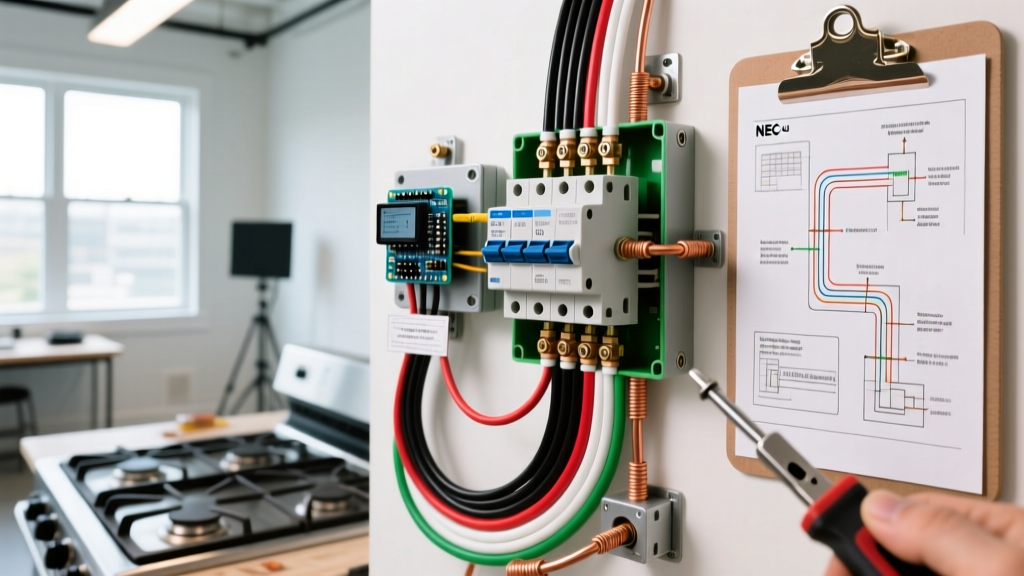

Introduction to Electric Panel Wiring Diagnostics
Troubleshooting electric panel wiring requires a methodical approach, a solid understanding of split-phase power systems, and strict adherence to safety protocols. While 2026 has seen a rise in smart load centers like the Span panel and Leviton smart breakers, over 85% of residential and light-commercial properties still rely on legacy thermal-magnetic load centers from Square D, Siemens, and Eaton. When these systems develop faults, the symptoms—ranging from flickering lights to scorched bus bars—can be deceptive.
This guide bypasses generic advice and dives deep into the exact failure modes, diagnostic measurements, and manufacturer-specific torque requirements needed to resolve complex panel wiring faults safely.
CRITICAL SAFETY WARNING: Working inside an energized panel exposes you to arc flash and shock hazards. According to OSHA Electrical Safety Standards and NFPA 70E, diagnostic work on live 120/240V panels requires Category 2 PPE, including arc-rated (AR) clothing and Class 0 insulated gloves. Never bypass main breaker safeguards.
Fault 1: The 'Floating Neutral' (Loose Service Neutral)
A loose neutral connection at the main service lug or the neutral bus bar is one of the most destructive electric panel wiring faults. Because residential split-phase systems rely on the neutral to carry the unbalanced current between the two 120V legs, a compromised neutral forces the two legs to act as a 240V series circuit.
Diagnostic Symptoms
- Voltage Fluctuations: Lights on one leg dim while lights on the other leg burn unusually bright when a high-wattage appliance (like a hair dryer or microwave) turns on.
- Appliance Damage: 120V electronics on the heavily loaded leg experience voltage drops (e.g., 85V), while electronics on the lightly loaded leg receive overvoltage (e.g., 155V), leading to blown capacitors or fried control boards.
Troubleshooting Steps
- Set your True RMS multimeter (e.g., Fluke 117) to AC Voltage.
- Measure Line 1 to Neutral (L1-N) and Line 2 to Neutral (L2-N) at the main lugs. A healthy panel reads ~120V on both.
- Turn on a heavy 120V load on L1. If L1-N drops below 110V and L2-N spikes above 130V, you have a floating neutral.
- The Fix: De-energize the panel via the utility meter disconnect. Retorque the main neutral lug. For standard Square D QO panels, the manufacturer specifies 35 in-lbs for 14-10 AWG wires and up to 50 in-lbs for larger conductors. Use a calibrated torque screwdriver like the Klein Tools 32500.
Fault 2: Thermal vs. Magnetic Breaker Trip Signatures
Homeowners often report a 'tripped breaker' without understanding the root cause. Standard thermal-magnetic breakers possess two distinct trip mechanisms. Diagnosing which mechanism activated is crucial for tracing the fault downstream.
| Trip Signature | Internal Mechanism | Timeframe | Common Root Cause |
|---|---|---|---|
| Thermal Overload | Bimetallic strip bends from sustained heat | Slow (Seconds to Minutes) | Overloaded circuit (e.g., space heater + vacuum on a 15A circuit), loose terminal causing localized heat. |
| Magnetic Short Circuit | Solenoid trips instantly from massive current spike | Instantaneous (Milliseconds) | Hot-to-ground or hot-to-neutral direct contact, failed appliance motor winding, nail through Romex. |
Pro Diagnostic Tip: If a breaker trips instantly with a loud 'pop' and the handle feels completely loose (no resistance when pushing to 'ON'), it is a magnetic trip indicating a dead short. Do not force it back on. Use a megohmmeter or a standard multimeter in continuity mode to isolate the shorted branch circuit before resetting.
Fault 3: Multi-Wire Branch Circuit (MWBC) Shared Neutral Hazards
An MWBC uses two hot wires (on opposite phases) sharing a single neutral wire. This is common for kitchen countertop receptacles. If an electrician or DIYer incorrectly troubleshoots or modifies electric panel wiring involving an MWBC, they can create a lethal 240V scenario across 120V devices.
The Simultaneous Disconnect Rule
The National Electrical Code (NEC) strictly requires that all ungrounded (hot) conductors of an MWBC be provided with a means to disconnect simultaneously. In legacy panels, this requires an identified handle tie. In modern panels, a 2-pole breaker is mandated.
Troubleshooting an MWBC Fault
If you are replacing a receptacle on an MWBC and the neutral is disconnected while the two hot legs remain energized at the panel, the two 120V circuits will series through the connected loads, sending 240V through your 120V appliances. Always verify the presence of a handle tie or 2-pole breaker at the panel before breaking the neutral splice downstream.
Fault 4: Bus Bar Corrosion and Incompatible Breakers
Not all breakers are physically interchangeable, even if they fit. Using an Eaton BR breaker in a Square D Homeline panel, or a Siemens QP in a Cutler-Hammer panel, can lead to poor bus bar contact, excessive arcing, and eventual panel fires.
Identifying Bus Bar Damage
- Visual Inspection: Look for pitting, black soot, or melted plastic on the stabs (the metal prongs the breakers clip onto).
- The 'Zinsco/Federal Pacific' Factor: If you are troubleshooting a home built before 1990 and identify a Zinsco or Federal Pacific Electric (FPE) Stab-Lok panel, stop troubleshooting and recommend full replacement. The CPSC Electrical Safety Center and independent engineers have documented that FPE breakers frequently fail to trip during short circuits due to mechanical jamming.
- UL Classified vs. UL Listed: Some aftermarket breakers (like Eaton CL) are 'UL Classified' for use in competitor panels. While legal and safe if listed on the panel's wiring diagram, they must be torqued precisely to prevent micro-arcing.
Fault 5: AFCI Nuisance Tripping in Legacy Wiring
As of the 2026 NEC adoption cycle, Arc Fault Circuit Interrupter (AFCI) protection is required on nearly all 120V, 15A and 20A branch circuits. A common troubleshooting headache is 'nuisance tripping' on older homes with degraded wiring.
Differentiating Ground Faults from Arc Faults
Modern Combination-Type AFCI breakers (like the Square D HOM120CAFI) feature diagnostic LEDs. When the breaker trips, push the 'Time Saver' or diagnostic button to read the LED blink code:
- 1 Blink: Short Circuit
- 2 Blinks: Overload
- 3 Blinks: Arc Fault (Parallel or Series)
- 5 Blinks: Ground Fault
If you get an Arc Fault code, inspect for loose wire nuts, damaged Romex insulation behind drywall, or shared neutrals with adjacent circuits, which cause current imbalance that the AFCI microprocessor interprets as an arc signature.
Essential Diagnostic Tool Matrix for 2026
| Tool | Model Recommendation | Primary Use Case | Approx. Cost (2026) |
|---|---|---|---|
| True RMS Multimeter | Fluke 117 | Measuring L1/L2 voltage drop, identifying floating neutrals. | $210 |
| Torque Screwdriver | Klein Tools 32500 | Ensuring NEC 110.14(D) compliant terminal torque (prevents thermal trips). | $145 |
| Non-Contact Voltage Tester | Milwaukee 2202-20 | Verifying de-energized state before touching bus bars. | $35 |
| Thermal Imager | FLIR C5 | Scanning loaded panels for hot spots indicating loose connections. | $550 |
When to Call a Licensed Electrical Contractor
While diagnosing a tripped breaker or a loose neutral is well within the scope of an advanced DIYer or maintenance technician, certain electric panel wiring scenarios require a licensed professional. If you discover melted main lugs, scorched bus bars, or a panel that lacks an adequate equipment grounding conductor, the panel likely needs a full service upgrade. In 2026, a professional panel 'torque-and-tune' service (retorquing all lugs, cleaning bus bars, and verifying breaker compatibility) typically costs between $250 and $450, while a full 200A panel replacement ranges from $1,800 to $3,200 depending on local utility upgrade requirements.
Always prioritize safety, rely on verified measurements over assumptions, and consult the manufacturer's wiring diagrams specific to your load center model before executing any repairs.