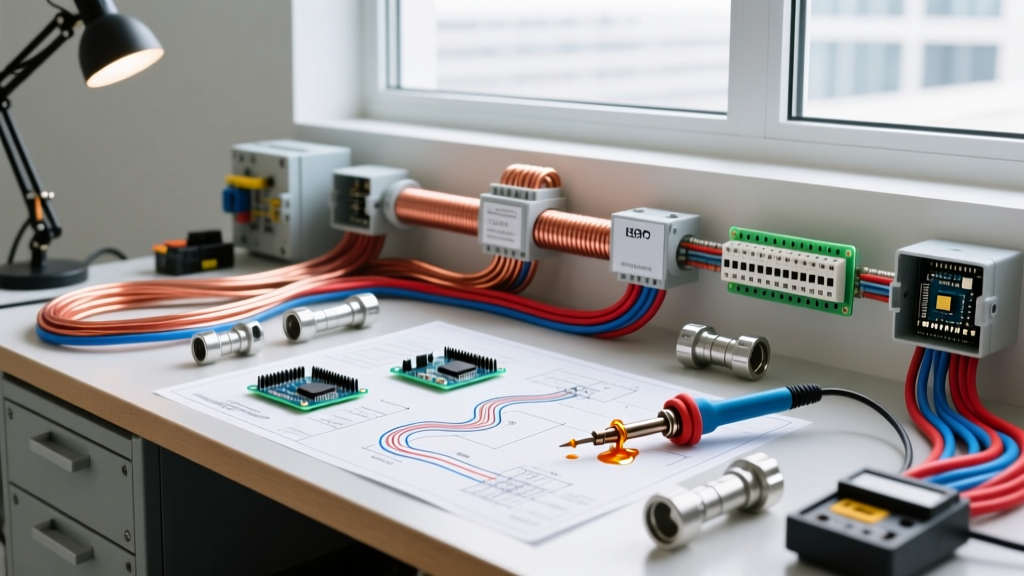

The Steel Framing Premium: Understanding the Baseline
Wiring a steel building—whether it is a commercial warehouse, an agricultural shop, or a residential barndominium—presents a unique set of challenges that directly impact your bottom line. Unlike traditional wood-framed structures where electricians can easily drill holes and staple NM-B (Romex) cable, steel building electrical wiring requires specialized materials, rigorous grounding protocols, and significantly more labor hours. In 2026, with copper prices remaining volatile and commercial labor rates climbing, accurately estimating these costs is critical for project viability.
On average, steel building electrical wiring costs 15% to 30% more than equivalent wood-framed projects. This 'steel premium' is driven by the necessity of metal-clad (MC) cables or rigid/EMT conduit, the mandatory use of protective grommets, and the complex bonding requirements dictated by the National Electrical Code (NEC). This guide provides a comprehensive, data-driven cost estimation framework for contractors and project managers planning steel structure wiring in 2026.
Conduit vs. MC Cable: The Core Material Decision
The single largest variable in your material budget is the choice between Electrical Metallic Tubing (EMT) conduit and Metal-Clad (MC) cable. Both are permitted in steel buildings, but their cost profiles differ drastically.
EMT Conduit (The Commercial Standard)
EMT is the gold standard for commercial steel buildings. It offers superior physical protection and allows for future wire upgrades without tearing into walls. However, the labor cost to measure, cut, thread, and bend EMT (using tools like Greenlee mechanical benders) is immense. Furthermore, pulling THHN/THWN-2 conductors through long conduit runs in a 60-foot steel warehouse requires multiple journeymen.
MC Cable (The High-Efficiency Alternative)
For light commercial, agricultural, and residential steel buildings, MC cable (such as Southwire or AFC Cable Systems 12/2 or 10/2 solid MC) is the preferred cost-saving measure. MC cable features a continuous corrugated aluminum or steel armor that satisfies the NEC requirement for physical protection in metal stud cavities. While the per-foot material cost of MC is higher than bare THHN wire, the labor savings are staggering. An electrician can unspool, route, and secure MC cable in a fraction of the time it takes to build an EMT raceway.
2026 Material Cost Matrix
The following table outlines average 2026 wholesale and retail pricing for the primary materials used in steel building electrical wiring. Prices reflect Q1 2026 market averages and are subject to regional copper and steel tariffs.
| Material Type | Specification | Unit | Est. 2026 Cost | Primary Use Case |
|---|---|---|---|---|
| EMT Conduit | 3/4-inch, 10ft stick | Per Stick | $9.50 - $13.00 | Commercial, exposed runs |
| MC Cable (Solid) | 12/2 AWG with Ground | 250ft Spool | $125.00 - $155.00 | Branch circuits, barndominiums |
| NM-B Cable (Romex) | 12/2 AWG | 250ft Spool | $95.00 - $115.00 | Restricted use (requires protection) |
| THHN/THWN-2 Wire | 12 AWG Stranded | Per Foot | $0.28 - $0.36 | Pulled through EMT conduit |
| Metal Stud Grommets | 3/4-inch Plastic Bushings | Pack of 100 | $18.00 - $25.00 | Mandatory NEC 300.4 compliance |
| Grounding Lugs/Bonding | Copper lay-in lugs | Per Unit | $4.50 - $8.00 | Bonding steel framing to ground |
Labor Rates and Productivity Variables
Material costs only tell half the story. According to the U.S. Bureau of Labor Statistics, the median wage for electricians continues to rise, and fully burdened commercial labor rates (including insurance, overhead, and contractor markup) in 2026 typically range from $85 to $145 per hour, depending on the region and union status.
Productivity in steel buildings is heavily influenced by the erection phase. If the steel framing is erected but the insulation and interior liner panels are not yet installed, electricians can work rapidly, routing MC cable through the open stud bays. However, if the building is already insulated with closed-cell spray foam or faced fiberglass batts, retrofitting wiring becomes a nightmare, potentially doubling the labor hours required for fishing and drywall repair.
NEC Compliance: Budgeting for Code Mandates
Ignoring the NEC is not an option, and failing to budget for its specific steel-building requirements will result in failed inspections and costly rework. The National Fire Protection Association (NFPA) outlines strict guidelines that directly impact your material and labor budget.
Article 300.4: Protection Against Physical Damage
Steel studs have sharp, unforgiving edges. NEC Article 300.4(B)(1) mandates that where cables pass through holes in metal framing members, they must be protected by listed bushings or grommets. You cannot simply pull MC cable or NM-B through a punched steel stud hole. Budget for at least 15 minutes of extra labor per circuit run just for snapping in plastic grommets and securing the cable with approved metal-stud straps (not standard wood staples).
Article 250: Grounding and Bonding the Steel Frame
In a wood building, the framing is an insulator. In a steel building, the entire structure is a massive conductor. NEC Article 250.96 requires the bonding of metal enclosures and, in many jurisdictions, the structural steel frame itself must be integrated into the equipment grounding system to prevent the building from becoming energized during a fault condition. This requires purchasing specialized grounding clamps, bare copper wire (typically #4 or #6 AWG), and exothermic welding kits (like CADWELD) or heavy-duty lay-in lugs to bond the electrical panels to the steel columns.
Real-World Scenario: 40x60 Steel Workshop Estimate
To provide actionable specificity, let us break down the estimated costs for wiring a standard 40x60-foot (2,400 sq. ft.) steel workshop in 2026. This scenario assumes a 200-amp service, basic LED high-bay lighting, and 15 standard 120V receptacle circuits using MC cable routed through open metal studs before insulation.
- Service Entrance & Panel: $2,200 - $3,500 (Includes 200A panel, meter base, and trenching if required).
- Lighting (12x LED High Bays): $1,800 - $2,800 (Includes fixtures, MC cable drops, and high-ceiling lift rental).
- Branch Circuits (15 Receptacle Drops): $3,500 - $5,200 (Includes MC cable, grommets, metal boxes, and devices).
- Heavy Equipment (Welder/CNC 240V): $1,200 - $2,500 (Dedicated 50A and 30A circuits using #6 and #10 AWG THHN in EMT).
- Grounding & Bonding Matrix: $800 - $1,400 (Copper wire, lugs, and ground rods).
- Total Estimated Range: $9,500 to $15,400 (Approx. $3.95 to $6.41 per square foot).
Hidden Costs and Edge Cases
When finalizing your budget, be prepared for the following edge cases that frequently derail steel building electrical projects:
1. Fire-Stopping Requirements
If your steel building has fire-rated partitions or passes wiring through top/bottom tracks that act as fire barriers, you must use intumescent fire-stop caulk or putty pads. Budget an additional $300 to $600 for fire-stopping materials and the documentation required for the inspector.
2. Galvanized vs. Black Steel Corrosion
If you are wiring an agricultural building or an unconditioned warehouse near a coast, the steel framing may be galvanized or subject to high humidity. Standard steel EMT conduit will rust rapidly in these environments. You must budget for PVC-coated conduit or rigid aluminum conduit, which can increase conduit material costs by 40% to 60%.
3. Lift and Scaffold Rentals
Steel buildings often feature eave heights of 14 to 20 feet. Working at this height requires scissor lifts or boom lifts. In 2026, expect to pay $250 to $450 per day for a standard electric scissor lift rental, plus delivery fees. This is a mandatory line item that does not exist in standard 9-foot residential ceiling projects.
Expert Insight: Always coordinate with the steel erection crew before they install the interior liner panels. If the electricians can run the MC cable and mount the boxes directly to the steel studs while the bays are open, you will cut your labor costs by up to 40%. Once the tin or drywall goes up, you are relegated to surface-mounted EMT conduit, which is vastly more expensive.
Final Thoughts on 2026 Budgeting
Steel building electrical wiring demands a higher upfront investment than traditional framing, primarily due to the cost of MC cable, EMT conduit, and the labor-intensive grounding requirements. However, the durability, fire resistance, and pest-proof nature of steel raceways offer superior long-term ROI for commercial and industrial applications. By utilizing the 2026 cost matrix above and strictly adhering to NEC physical protection and bonding codes, project managers can eliminate budget surprises and ensure a safe, inspection-ready installation. For further safety guidelines regarding electrical work in steel construction environments, refer to the Occupational Safety and Health Administration (OSHA) construction standards.