
The Reality of Panel Work: Arc Flash and Electrocution Hazards
Wiring an electric panel is the single most hazardous task in residential and light commercial electrical work. Unlike branch circuit wiring, where a tripped breaker isolates the hazard, the line-side lugs of a main service panel remain energized at full utility capacity—often 200A to 400A at 240V—even when the main breaker is switched off. A short circuit across these lugs does not just trip a breaker; it can trigger an arc flash event exceeding 35,000°F, vaporizing copper and causing catastrophic burns. According to the Occupational Safety and Health Administration (OSHA), electrical incidents remain a leading cause of workplace fatalities and severe residential injuries. Adhering to rigorous safety protocols is not optional; it is the baseline for survival.
CRITICAL WARNING: Never assume the utility meter socket or the service drop is de-energized. Only the local utility company can physically disconnect the grid feed by pulling the meter or disconnecting the drop. Working on the line-side of the main breaker requires utility coordination and specialized Category 4 PPE.
Pre-Work Safety and Tool Matrix
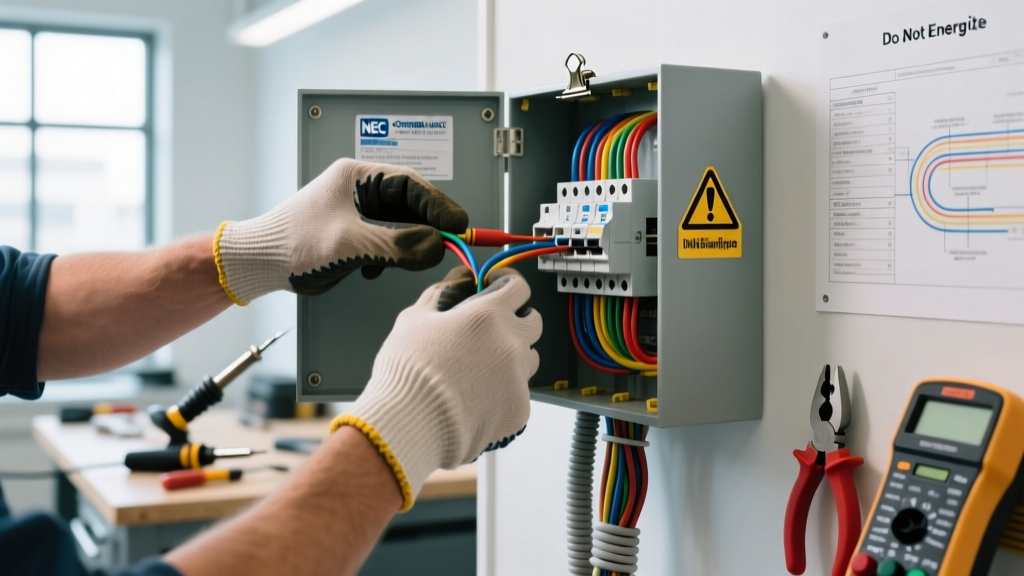
Before removing the panel dead front, you must assemble the correct diagnostic and personal protective equipment (PPE). Relying on a $20 hardware store voltage tester is a fatal error when dealing with 240V split-phase systems. Below is the mandatory equipment matrix for safe panel termination.
| Equipment Category | Specific Model / Rating | Estimated Cost (2026) | Primary Safety Function |
|---|---|---|---|
| True-RMS Multimeter | Fluke 117 or 87V (CAT IV 600V) | $220 - $480 | Accurate zero-energy verification and phantom voltage elimination |
| Non-Contact Voltage Tester | Fluke 2AC (CAT IV 1000V) | $35 - $45 | Initial proximity hazard detection before skin contact |
| Insulated Hand Tools | Klein Tools 1000V Rated Line | $150 - $250 (set) | Preventing phase-to-ground faults via tool shafts |
| Insulated Gloves | Class 00 (500V AC) + Leather Protectors | $90 - $140 | Shock protection during dead-front removal |
| Torque Screwdriver | Wiha 61000 TorqueVario-S (10-50 in-lbs) | $140 - $180 | NEC 110.14(D) compliance for lug termination |
The 'Live-Dead-Live' Zero-Energy Verification Protocol
The most common cause of electrocution during panel wiring is assuming a breaker is off without verifying the absence of voltage. The National Fire Protection Association (NFPA) mandates a strict three-point testing sequence, commonly known as the Live-Dead-Live test, before any conductor is touched.
- Live Test 1 (Verify the Meter): Test your Fluke 117 on a known live source, such as a nearby 120V receptacle. Confirm the meter reads between 118V and 122V. This proves the meter's internal battery and leads are functional.
- Dead Test (Verify the Panel): With the main breaker OFF, test phase-to-phase (L1 to L2). It should read 0V. Next, test phase-to-ground (L1 to Ground, L2 to Ground) and phase-to-neutral (L1 to Neutral, L2 to Neutral). All readings must be exactly 0V. Edge Case: If you read 2V to 5V, this is likely induced phantom voltage from parallel conductors; use the meter's low-impedance (LoZ) mode to verify it drops to zero.
- Live Test 2 (Re-Verify the Meter): Return to the known live receptacle and test again. This confirms the meter did not suffer a blown internal fuse or fail during the panel test.
Torque Specifications and Thermal Failure Prevention
Since the 2017 National Electrical Code (NEC) update, which carries forward into the 2023 and 2026 adoption cycles, Section 110.14(D) strictly requires that all mechanical connection screw terminals be tightened to the manufacturer's specified torque values using a calibrated torque tool. 'Hand-tight' is no longer a legal or safe standard.
The Physics of Loose and Over-Torqued Connections
When wiring an electric panel, both under-torquing and over-torquing lead to catastrophic thermal failure, but through different mechanisms:
- Under-Torquing: Creates a high-resistance connection. As current flows (e.g., a continuous 40A EV charger load), the resistance generates heat (I²R losses). This heat causes the aluminum bus bar or copper wire to expand and contract, further loosening the connection over hundreds of thermal cycles. Eventually, the localized temperature exceeds 105°C, melting the THHN insulation and igniting the surrounding combustible framing.
- Over-Torquing: Exceeding the manufacturer's inch-pound rating strips the threads on the aluminum lug or deforms the copper conductor. Stranded wire will 'mushroom' and shear, reducing the effective cross-sectional area of the conductor and creating the exact same high-resistance hot spot.
Real-World Torque Targets
Always check the schematic sticker inside the panel door (e.g., Square D QO or Eaton BR series). As a baseline, a #10 AWG copper branch circuit typically requires 20 to 35 inch-pounds, while #2 AWG aluminum feeder wire for a 100A subpanel may require up to 250 inch-pounds, necessitating a heavy-duty beam-style torque wrench rather than a standard screwdriver.
Working Space and Clearance Requirements (NEC 110.26)
Safety is not just about electrical shock; it is about the physical environment in which you are wiring an electric panel. The Electrical Safety Foundation International (ESFI) frequently highlights that cramped working spaces contribute to accidental contact with live parts. NEC 110.26 dictates strict clearances that cannot be compromised during remodels or new construction.
- Depth: A minimum of 36 inches of clear depth from the face of the panel to the nearest obstruction (wall, shelving, water heater).
- Width: A minimum of 30 inches wide, or the width of the equipment, whichever is greater. This space must be centered on the panel or aligned with the left/right edge.
- Height: A minimum of 6.5 feet from the floor to the ceiling, ensuring no HVAC ducts, plumbing pipes, or dropped ceilings intrude into the vertical workspace.
Remodel Edge Case: If you are finishing a basement and framing around an existing panel, do not build a recessed 'niche' that violates the 30-inch width rule. Drywallers often taper the opening to match the panel cover, which is a direct violation of the required 30-inch lateral working space.
Common Edge Cases and Code Violations to Avoid
When terminating conductors inside the enclosure, avoid these frequent failure modes that compromise safety and fail inspection:
- Double-Tapped Neutrals: NEC 408.41 strictly prohibits terminating more than one neutral conductor under a single screw terminal on the neutral bar. Unlike grounded (neutral) bars, grounding bars often allow two equipment grounding conductors of the same size under one lug, provided the manufacturer's schematic explicitly permits it. Always separate neutrals.
- Exceeding Bus Bar Stab Limits: A single bus bar stab on a residential panel is typically rated for a maximum of two conductors (e.g., one for a tandem breaker). Forcing a third wire onto a stab bends the bus bar, compromising the tension of the breaker connection and creating an arcing hazard behind the breaker itself.
- Improper Wire Bending Space: NEC 312.6 requires specific clearances between the lugs and the enclosure wall based on wire gauge. If you are wiring a 200A panel with 2/0 AWG feeders, you cannot bend the wire tightly against the back of the can; it must follow the natural sweep radius to avoid stressing the termination lug.
Final Sign-Off and Energization
Before replacing the dead front cover and energizing the newly wired panel, perform a physical tug-test on every terminated conductor. A properly torqued wire will not move. Sweep the interior of the panel with a dry, soft brush or low-PSI compressed air to remove any copper clippings, stripped insulation fragments, or drywall dust that could cause a phase-to-ground fault upon energization. Finally, turn on the main breaker, stand to the side of the panel (not directly in front), and use your True-RMS multimeter to verify 240V across the main lugs and 120V from each leg to neutral before closing the cover. By treating every connection with engineered precision, you ensure a safe, code-compliant installation that will operate reliably for decades.