
Introduction to Commercial Wiring Dynamics
Transitioning from residential to commercial electrical projects requires a fundamental shift in methodology, materials, and code compliance. While residential wiring typically relies on non-metallic (NM) sheathed cable routed through wooden studs, commercial environments demand robust, fire-resistant, and physically protected systems. Commercial buildings operate on complex 3-phase power systems (often 480V/277V or 208V/120V), requiring larger conductors, specialized raceways, and meticulous load balancing.
Whether you are a project manager overseeing a new retail build-out or an apprentice looking to understand the intricacies of large-scale electrical distribution, the foundational question remains: how do you run electrical wiring in a commercial space efficiently and safely? This guide breaks down the exact materials, National Electrical Code (NEC) requirements, and execution strategies required for commercial wiring in 2026.
Core Question: How Do You Run Electrical Wiring in Commercial Spaces?
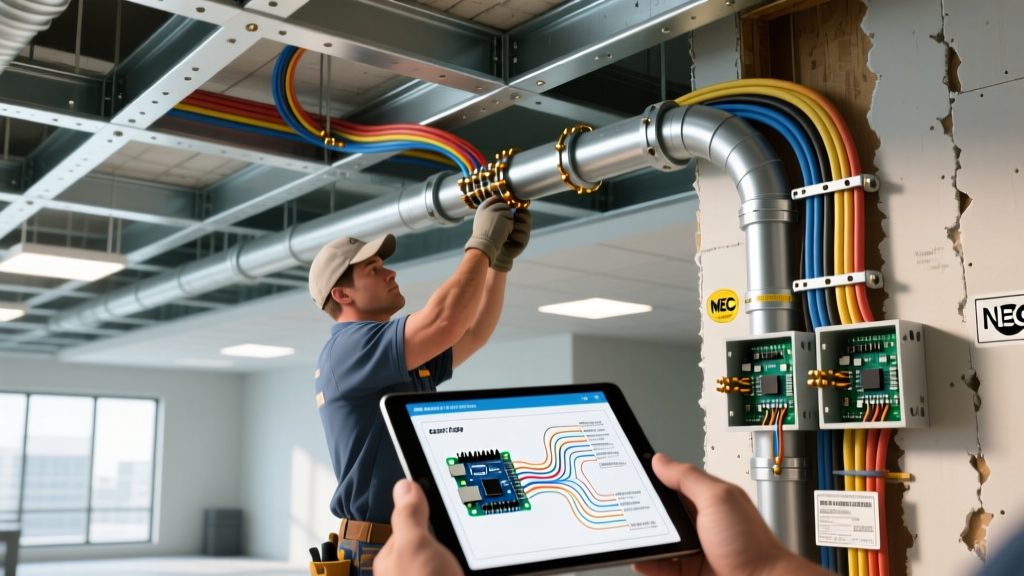
Running wire in a commercial building is rarely about simply pulling a cable through a wall cavity. It involves a systematic approach to raceway selection, structural attachment, and wire pulling mechanics. The process begins long before the first spool of wire is unspooled.
Step 1: Blueprint Analysis and Load Calculations
Before routing any wire, commercial electricians must perform detailed load calculations per NEC Article 220. This determines the feeder sizes, transformer requirements, and panelboard schedules. Commercial spaces frequently utilize non-linear loads (like variable frequency drives and commercial LED lighting), which necessitate oversized neutral conductors to handle triplen harmonics. Failing to account for this during the planning phase leads to catastrophic overheating down the line.
Step 2: Selecting the Right Raceway and Cable Types
The choice of wiring method depends on the environment (e.g., exposed ceilings, buried in concrete, or hazardous locations). Below is a comparison of the most common commercial wiring methods used in modern construction.
| Wiring Method | NEC Article | Best Use Case | 2026 Avg. Material Cost (per 100ft) |
|---|---|---|---|
| EMT (Electrical Metallic Tubing) | Article 358 | Exposed indoor ceilings, commercial walls, standard office spaces. | $110 - $160 |
| IMC (Intermediate Metal Conduit) | Article 345 | Areas requiring more physical protection than EMT but less weight than RMC. | $280 - $350 |
| RMC (Rigid Metal Conduit) | Article 344 | Heavy industrial, underground encased in concrete, hazardous locations. | $450 - $600 |
| MC (Metal-Clad Cable) | Article 330 | Quick installations in stud walls, above drop ceilings, healthcare facilities. | $180 - $260 (12/2) |
Navigating NEC Code Requirements for Commercial Routing
When determining how do you run electrical wiring in compliance with local and national laws, the NFPA 70 National Electrical Code (NEC) is your ultimate authority. Commercial routing has strict securing and supporting requirements.
- NEC 300.11 (Securing and Supporting): Raceways must be securely fastened in place. You cannot simply lay EMT conduit on top of a drop ceiling grid. It must be independently supported by the building structure.
- NEC 358.30 (Securing and Supporting EMT): EMT must be securely fastened within 3 feet of every outlet box, junction box, or cabinet, and at intervals not exceeding 10 feet.
- Support Hardware: Commercial electricians rely on heavy-duty support systems. The Unistrut P1000 metal framing channel, combined with Caddy beam clamps and threaded rods (typically 3/8-inch or 1/2-inch), is the industry standard for suspending conduit runs parallel to steel I-beams and open-web joists.
Practical Execution: Pulling Wire Through EMT Conduit
Pulling THHN/THWN-2 conductors through a long run of EMT conduit requires technique, proper lubrication, and the right tools. Here is the professional workflow for executing a large-scale commercial pull.
- Reel Setup and Tensioning: Never drag wire off a spool haphazardly. Use a heavy-duty reel stand or a Jacob's ladder setup to ensure the wire feeds smoothly without twisting. Twisted wires increase friction and can damage the insulation jacket.
- Verify Bend Limits (NEC 358.26): Before pulling, verify that your conduit run does not exceed 360 degrees (four quarter bends) between pull points. If it does, you must install a pull box or junction box. Forcing wire through excessive bends will result in a jammed conduit.
- Use the Right Fish Tape: For runs over 50 feet, standard steel tapes often fail. Use a high-tensile steel fish tape, such as the Klein Tools 56415 (150-foot, 1/8-inch steel tape), or upgrade to a fiberglass push/pull rod system for complex routing.
- Apply Conduit Lubricant: Friction is the enemy of wire pulling. Apply a UL-listed, wire-pulling lubricant like Polywater J to the conductors as they enter the conduit. This reduces pulling tension by up to 50% and prevents insulation tearing.
- Team Communication: For pulls exceeding 100 feet, use two-way radios. The person feeding the wire and the person pulling at the destination must maintain constant communication to prevent over-tensioning, which can stretch the copper and alter its resistance properties.
Commercial Wiring Cost Breakdown (2026 Estimates)
Understanding the financial scope of a commercial wiring project is critical for bidding and budgeting. Labor rates in 2026 for commercial union and non-union electricians typically range from $95 to $145 per hour, depending on the region and project complexity.
| Project Phase | Average Cost per Linear Foot (Installed) | Key Cost Drivers |
|---|---|---|
| EMT Conduit Rough-In (3/4" to 1") | $8.50 - $14.00 | Ceiling height, structural steel attachment, union labor rates. |
| MC Cable Installation (12/2 or 10/2) | $6.00 - $10.50 | Accessibility, number of bends, fire-stopping requirements. |
| Wire Pulling (THHN per conductor) | $1.50 - $3.50 | Wire gauge (AWG), distance, number of bends, lubrication needs. |
| Panelboard Termination | $250 - $600 per panel | Complexity of busbar routing, torque specifications, labeling. |
Common Commercial Wiring Failure Modes and Edge Cases
Even experienced electricians encounter edge cases that lead to system failures if not addressed during the rough-in phase.
1. Harmonics and Neutral Overheating
Modern commercial buildings are saturated with non-linear loads (computers, LED drivers, VFDs). These devices generate triplen harmonics (3rd, 9th, 15th) that do not cancel out on the neutral bus; instead, they add together. This can cause the neutral conductor to carry more current than the phase conductors. Expert Fix: Per NEC guidelines, always count the neutral as a current-carrying conductor when applying derating factors (NEC 310.15). In heavy harmonic environments, specify a 200% oversized neutral or use a K-rated transformer designed to handle harmonic heat.
2. Voltage Drop on Long Feeder Runs
Commercial facilities, such as warehouses and large retail stores, often require feeder runs exceeding 200 feet. While the NEC provides informational notes on voltage drop (recommending a maximum of 3% on feeders and 5% total for branch circuits), failing to upsize wire for long runs results in dim lighting, motor overheating, and equipment failure. Always use a voltage drop calculator based on the specific K-factor of copper (12.9 ohms-cmil/ft) and the exact one-way distance of the run.
3. Fire-Stopping Violations
When conduit or MC cable penetrates a fire-rated wall or floor assembly, the fire rating of that barrier is compromised. OSHA and local fire marshals strictly enforce fire-stopping protocols. You must use UL-listed fire-stop systems (such as 3M Fire Barrier Sealant or Hilti CFS-BL) to seal the annular space around the conduit. Documentation of these penetrations is frequently required during the final inspection phase, as outlined in OSHA electrical safety standards regarding wiring methods and components.
Pro-Tip from the Field: "Never assume a drop ceiling plenum is just a standard air space. If the plenum is used for environmental air (return air), NEC 300.22(C) mandates the use of plenum-rated wiring methods. Standard PVC conduit or non-plenum MC cable will fail inspection and pose a severe toxic smoke hazard in the event of a fire."
Frequently Asked Questions (FAQ)
Can you use Romex (NM Cable) in a commercial building?
Generally, no. NM cable is restricted in commercial construction, especially in buildings constructed of non-combustible materials or exceeding three stories. NEC 334.12 explicitly prohibits NM cable in dropped ceilings used for environmental air, embedded in concrete, and in most commercial retail or assembly occupancies. Always default to MC cable or EMT conduit.
What is the maximum number of wires allowed in a 3/4-inch EMT conduit?
According to NEC Chapter 9, Table 1, conduit fill cannot exceed 40% when pulling three or more conductors. For standard 12 AWG THHN wire, a 3/4-inch EMT conduit can legally hold up to 16 conductors. However, if you have more than three current-carrying conductors, you must apply the derating factors found in NEC Table 310.15(C)(1), which may force you to upsize the wire or use a larger conduit to manage heat dissipation.
How do you support MC cable in an open commercial ceiling?
MC cable must be secured at intervals not exceeding 6 feet (NEC 330.30). In open commercial ceilings with exposed steel joists, electricians typically use metal cable ties, Unistrut clamps, or specialized MC cable hangers (like the Caddy J-Hook) designed to support the cable without crushing the metallic armor. Avoid using standard plastic zip-ties, as they can degrade over time and are often rejected by strict commercial inspectors.