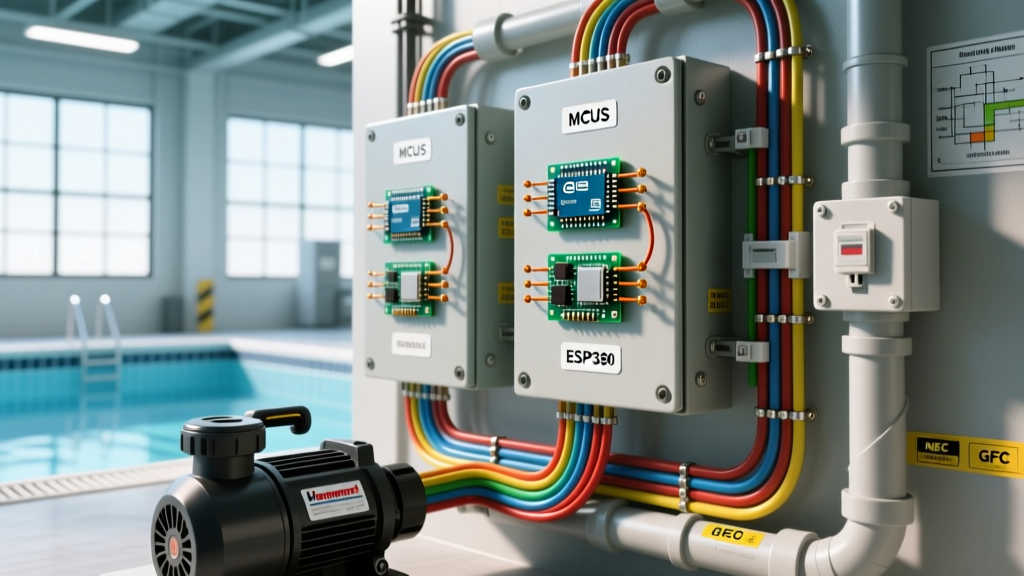

Commercial vs. Residential Hayward Pump Wiring
Wiring a commercial aquatic facility requires a fundamentally different approach than residential pool installations. When executing Hayward pool pump electrical wiring for municipal recreation centers, hotel resorts, or water parks, electrical contractors must navigate higher horsepower requirements, 3-phase power distributions, and stringent enforcement of the National Electrical Code (NEC). While a residential Hayward Super Pump might draw 12 amps on a 240V single-phase circuit, commercial workhorses like the Hayward Super II 5 HP 3-Phase or the TriStar VS950 Commercial Variable Speed Drive (VSD) demand rigorous conductor sizing, harmonic mitigation, and advanced equipotential bonding grids.
Under the latest 2026 NEC adoption cycles, Authority Having Jurisdiction (AHJ) inspectors are increasingly scrutinizing commercial mechanical rooms for improper equipment grounding conductor (EGC) sizing and inadequate VFD (Variable Frequency Drive) shielding. This guide details the exact specifications, failure modes, and installation protocols required for commercial Hayward pump systems.
NEC Article 680 Compliance for Commercial Facilities
Article 680 of the NFPA 70 (National Electrical Code) governs all swimming pool and fountain electrical installations. For commercial Hayward pumps, two sections are critical:
Equipment Grounding Conductor (EGC) Sizing
NEC 680.21(B) mandates that the EGC for commercial pool pump motors must be an insulated copper conductor. Bare copper or aluminum ground wires are strictly prohibited inside the conduit for pool pump circuits. Furthermore, the EGC must be sized according to NEC Table 250.122 based on the rating of the overcurrent protective device (OCPD), not just the motor full-load amps (FLA).
NEC 680.26 Equipotential Bonding: 'An equipotential bonding system shall be installed to eliminate voltage gradients in the pool area. All metallic parts of the pool structure, underwater lighting, metal fittings within 5 feet of the pool, and the pump motor housing must be bonded together using a minimum 8 AWG solid copper conductor.'
In commercial settings, the Association of Pool & Spa Professionals (APSP) Standards further recommend verifying the continuity of the bonding grid annually, as soil shifting and concrete settling in large commercial facilities can fracture rigid bonding connections.
Commercial Hayward Pump Wiring Matrix
The following matrix provides baseline wiring specifications for common commercial Hayward models. Always verify the specific motor nameplate data, as manufacturer updates can alter FLA ratings.
| Hayward Model | Motor HP | Voltage / Phase | Max OCPD (Breaker) | Min Conductor (THWN-2) | Min Insulated EGC |
|---|---|---|---|---|---|
| Super II 3 HP | 3.0 | 230V / 1-Phase | 30A | 10 AWG | 10 AWG |
| Super II 5 HP | 5.0 | 208V / 3-Phase | 40A | 8 AWG | 10 AWG |
| TriStar VS950 | 5.0 (Peak) | 460V / 3-Phase | 20A | 12 AWG | 12 AWG |
| EcoLogic Commercial | 10.0 | 460V / 3-Phase | 30A | 10 AWG | 10 AWG |
Step-by-Step: Wiring the Hayward TriStar VS950 Commercial VFD
The Hayward TriStar VS950 is a staple in commercial aquatic centers due to its energy efficiency. However, wiring a VFD-integrated pump requires specific mechanical and electrical precision to prevent catastrophic drive failure.
- Conduit Selection: Use Schedule 80 PVC conduit for all underground or physical damage-prone runs entering the commercial mechanical room. Schedule 80 costs approximately $4.50 per 10-foot stick, compared to $2.10 for Schedule 40, but is required by most commercial AHJs for physical protection.
- Conductor Pulling: Pull three 12 AWG THWN-2 phase conductors (Black, Red, Blue for 460V 3-phase) and one 12 AWG green insulated THWN-2 EGC. Use a non-petroleum-based pulling lubricant to prevent degradation of the THWN-2 insulation.
- VFD Terminal Torquing: This is where most commercial failures occur. The TriStar VS950 power terminals require a specific torque setting—typically 1.2 Nm (10.6 in-lbs). Use a calibrated torque screwdriver. Under-torqued VFD connections create micro-arcing, which generates harmonic noise and eventually melts the terminal block.
- Shielded Cable for Controls: If running external communication wires (e.g., RS-485 for BACnet integration into the building management system), use 18 AWG shielded twisted-pair cable. Ground the shield at the VFD end only to prevent ground loops.
The VFD Edge Case: Mitigating Bearing Fluting
Commercial variable speed Hayward pumps utilize pulse-width modulation (PWM) to control motor speed. This high-frequency switching creates common-mode voltage that capacitively couples to the motor rotor. When this voltage exceeds the dielectric breakdown of the bearing grease, it discharges through the bearings—a phenomenon known as Electrical Discharge Machining (EDM) or bearing fluting.
According to diagnostic data detailed in the Fluke Guide on VFD Motor Bearing Damage, EDM can destroy a commercial pump motor bearing in under 18 months. To prevent this, specify Hayward models equipped with insulated bearings on the non-drive end, or retrofit the motor shaft with an AEGIS SGR (Shaft Grounding Ring). An AEGIS ring costs between $120 and $180 and safely bleeds induced shaft voltages to ground, bypassing the bearings entirely.
Equipotential Bonding Grid Specifications
Commercial pool bonding is not merely connecting a wire to the pump. It requires a continuous, unbroken 8 AWG solid bare copper wire forming a grid around the pool shell and connecting all metallic elements.
- Pump Motor Housing: Attach the 8 AWG bonding wire to the external copper bonding lug on the Hayward pump motor using a listed bronze or copper grounding clamp. Do not use aluminum lugs, which will suffer from galvanic corrosion in humid mechanical rooms.
- Metallic Piping: All metal water pipes within 5 feet of the inside wall of the pool must be bonded. If the commercial facility uses CPVC or PEX plumbing, you must still bond any metal valves or fittings within that 5-foot radius.
- Pool Shell Rebar: The structural steel of the commercial pool shell must be tied together with standard steel tie-wire and bonded to the equipotential grid at a minimum of four equally spaced points.
Common Commercial Failure Modes & Troubleshooting
Voltage Drop Over Long Commercial Runs
In large resorts, the mechanical room may be located 300 feet away from the pool equipment pad. Running 10 AWG wire on a 230V 3 HP Hayward Super II pump will result in a voltage drop exceeding the NEC recommended 3% limit. Low voltage causes the motor to draw higher amps to maintain torque, leading to thermal overload trips and shortened insulation life.
Calculation: Use the formula VD = (2 * K * I * D) / CM (where K=12.9 for copper, I=FLA, D=Distance, CM=Circular Mils). If your calculated VD exceeds 3% of the nominal voltage, you must upsize the conductors. For a 300-foot run at 18 Amps, you must upgrade from 10 AWG to 6 AWG THWN-2 (approx. $1.85 per foot per conductor) to maintain optimal voltage at the pump terminals.
Harmonic Distortion in 3-Phase Systems
When multiple Hayward VFD pumps are installed on the same commercial electrical panel, the cumulative harmonic distortion (THDi) can overheat the facility's neutral conductors and trip sensitive ground-fault protection equipment (GFPE). If a facility experiences nuisance tripping on main breakers when the pool pumps ramp up to priming speed, install a 5% line reactor on the load side of each VFD. Line reactors typically cost $250 to $400 per unit and smooth the current waveform, protecting both the pump drive and the facility's power distribution network.
Final Commissioning and AHJ Inspection
Before energizing any commercial Hayward pool pump, perform a megohmmeter (megger) test on the phase conductors to ensure insulation integrity was not compromised during the pulling process. Apply 1000V DC for 1 minute; the resistance should read well above 100 Megohms. Finally, verify the equipotential bonding grid continuity using a micro-ohmmeter. Resistance between the pump motor housing and the pool deck rebar should read less than 1 ohm. Documenting these specific test results will streamline your final inspection with the local AHJ and ensure a safe, code-compliant commercial aquatic environment.