
The Split-Phase Reality: Understanding Electrical Wiring L1 and L2
In North American residential and light commercial construction, the electrical service panel is the beating heart of the building. When examining electrical wiring L1 and L2, we are looking at the two 120-volt hot legs derived from a center-tapped step-down transformer. Together, Line 1 (L1) and Line 2 (L2) provide the 240 volts required for heavy appliances, while individually providing 120 volts to standard branch circuits when referenced to the neutral bus.
As home energy demands surge in 2026—driven by Level 2 EV chargers, electric heat pumps, and induction ranges—the stress on L1 and L2 bus bars has never been higher. This guide provides a rigorous DIY versus professional analysis of managing, balancing, and upgrading these critical pathways, separating safe homeowner tasks from lethal, code-mandated professional work.
The Physics of the Bus Bars: Why L1 and L2 Matter
Before deciding who should touch your panel, you must understand the architecture. The utility transformer outside your home steps down distribution voltage (typically 7,200V) to 240V. A center tap on the transformer's secondary winding creates the neutral.
- L1 to Neutral: 120V (Powers standard receptacles, lighting)
- L2 to Neutral: 120V (Powers standard receptacles, lighting)
- L1 to L2: 240V (Powers HVAC, EV chargers, dryers, ovens)
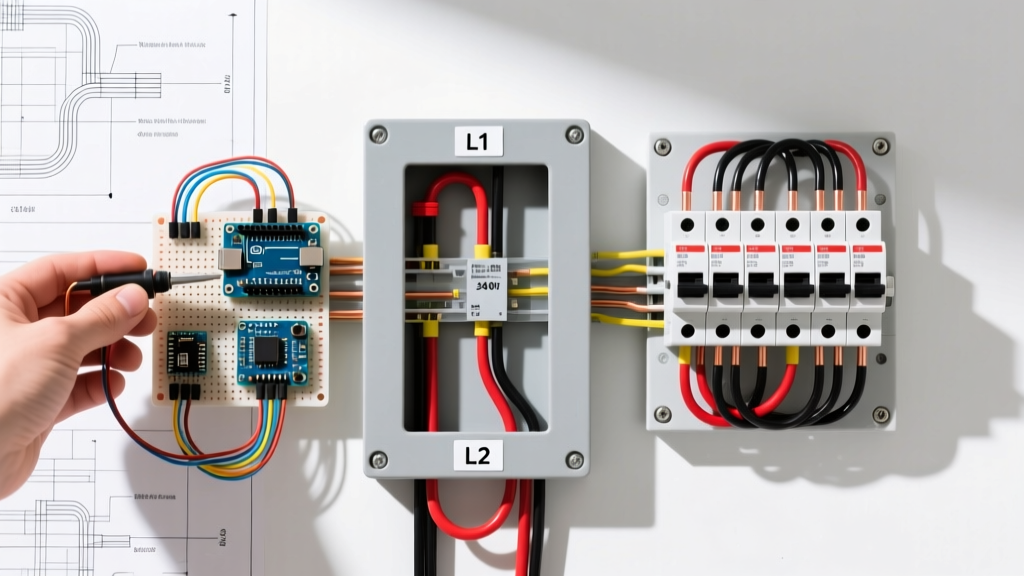
According to the National Fire Protection Association (NFPA 70 / National Electrical Code), the bus bars inside your main service panel are designed to distribute these phases to alternating breaker slots. A double-pole 240V breaker physically spans across both an L1 and an L2 stab to draw the full 240V potential.
The DIY Scope: Where Homeowners Can Safely Operate
There is a distinct boundary between legal, safe DIY electrical work and tasks that require a licensed journeyman. When it comes to electrical wiring L1 and L2, the DIY scope is strictly limited to downstream branch circuit management with the main breaker disengaged.
Acceptable DIY Tasks
- Like-for-Like Breaker Replacement: Swapping a faulty 15A single-pole breaker on L1 with an identical model (e.g., replacing a Square D HOM115 with a new HOM115). Cost: $8 to $12 per breaker.
- Basic Load Balancing (Planning): Mapping your home's circuits to identify if L1 is heavily overloaded while L2 is underutilized, and physically moving a 120V circuit breaker from an L1 slot to an L2 slot after shutting off the main breaker.
- Torquing Terminal Screws: Using a calibrated torque screwdriver to ensure branch neutral and ground wires are secured to NEC 110.14(D) specifications (typically 20-25 in-lbs for 14-10 AWG wire).
Critical Safety Warning: Even with the main breaker turned OFF, the utility feed lugs at the top of the main breaker remain live. These lugs carry the full fault current of the utility transformer (often 20,000 to 42,000 amps). An arc flash here is fatal. NIOSH electrical safety guidelines mandate strict approach boundaries that DIYers inherently violate when working inside an open, live panel.
The Professional Scope: High-Stakes L1 and L2 Interventions
Any modification to the main service entrance, the bus bars themselves, or the addition of high-amperage 240V loads strictly requires a licensed electrician. In 2026, the proliferation of smart homes and heavy electrical loads has made professional intervention more common than ever.
When to Call a Professional
- Main Breaker and Bus Bar Upgrades: Upgrading from a 100A to a 200A or 400A service. This involves pulling the utility meter, replacing the main breaker, and verifying the L1/L2 bus bars can handle the thermal load.
- EV Charger Installation: A standard Level 2 home charger (like the ChargePoint Home Flex or Tesla Wall Connector) requires a 60A double-pole breaker spanning L1 and L2, pulling 48A continuous. This requires 6 AWG copper wire and precise load calculations per NEC Article 220.
- Subpanel Feeds: Running a 100A feeder to a detached garage or workshop requires a double-pole breaker on L1 and L2, alongside properly sized neutral and ground conductors, and a separate ground rod at the destination.
Load Balancing Mathematics: The Neutral Current Factor
The most misunderstood aspect of electrical wiring L1 and L2 is neutral current. In a perfectly balanced split-phase system, the current on L1 equals the current on L2. Because the sine waves are 180 degrees out of phase, the return currents cancel each other out at the neutral bus, resulting in zero amps on the main neutral wire.
The Danger of Unbalanced Loads
If a DIYer adds a 120V workshop circuit to L1, but L2 remains largely empty, the system becomes unbalanced.
Example Scenario:
- L1 Draw: 45 Amps
- L2 Draw: 15 Amps
- Main Neutral Draw: 30 Amps (45A - 15A)
If the main neutral lug becomes loose or corroded, this 30A imbalance will cause severe voltage fluctuations. L1 voltage could drop to 90V (destroying compressor motors in refrigerators), while L2 voltage spikes to 150V (blowing out LED drivers and smart home hubs). A professional electrician uses a clamp meter on the main service conductors to verify L1/L2 balance and neutral integrity, a diagnostic step most DIYers skip.
2026 Smart Panel Technology: Monitoring L1 and L2
The traditional analog panel is being replaced by smart load centers. Systems like the Span Smart Panel or Leviton Smart Load Center utilize internal current transformers (CTs) on both the L1 and L2 bus bars to monitor energy usage at the individual breaker level.
Professional Installation Costs (2026 Estimates):
- Span Smart Panel (Full Replacement): $3,500 to $5,500 (including panel, smart breakers, and labor).
- Leviton Smart Breakers (Retrofit): $150 to $250 per smart breaker, plus $500 for the main hub module.
These systems allow homeowners to digitally balance L1 and L2 loads via a smartphone app and automatically shed non-essential loads (like the water heater) during a power outage when running on battery backup. Installing the CTs and integrating the data hub requires professional calibration to ensure the L1 and L2 phase mapping is correct.
DIY vs Professional: Task and Risk Matrix
| Task Involving L1 / L2 | DIY Feasibility | Pro Cost Range (2026) | NEC Code Reference | Risk Level |
|---|---|---|---|---|
| Replacing 15A/20A Branch Breaker | High (Main OFF) | $125 - $175 (Service Call) | Art. 240 | Moderate (Arc Flash) |
| Moving 120V Circuit for Balance | High (Main OFF) | $150 - $200 | Art. 210 | Moderate |
| Installing 60A EV Charger (240V) | Not Recommended | $600 - $1,200 | Art. 511 / 220 | High (Fire/Lethal) |
| Main Service Upgrade (200A to 400A) | Illegal / Impossible | $2,800 - $4,500 | Art. 230 | Extreme (Utility Lugs) |
| Torquing Main Neutral / L1 / L2 Lugs | Illegal / Lethal | Included in Service | 110.14(D) | Extreme |
Frequently Asked Questions
Can I install a 240V breaker myself if I turn off the main?
While turning off the main breaker de-energizes the L1 and L2 bus bars, routing 6 AWG or 4 AWG 240V cable through finished walls, making proper terminations, and ensuring the panel's fill capacity (NEC Article 312) is not exceeded requires professional expertise. Furthermore, local jurisdictions almost universally require permits and inspections for new 240V circuits, which DIYers often bypass, risking insurance claim denials in the event of a fire.
How do I know if my L1 and L2 are unbalanced?
Without a smart panel, you must use a clamp-on ammeter on the main service conductors at the top of the main breaker (a lethal task for untrained individuals). A variance of more than 15% to 20% between L1 and L2 amperage under peak load indicates a need for circuit redistribution. For the average homeowner, the Department of Energy's home energy guidelines suggest monitoring utility bills and breaker trip frequencies as indirect indicators of poor load balancing.
Does a 240V appliance use both L1 and L2?
Yes. A 240V appliance like an electric oven or heat pump connects directly across L1 and L2. It does not use the neutral wire for the 240V heating elements. However, if the appliance has 120V components (like a digital clock, control board, or interior light), it will also connect to the neutral to draw 120V from either L1-to-Neutral or L2-to-Neutral.
Final Verdict: Respecting the Bus Bars
Managing electrical wiring L1 and L2 is not a monolith; it is a spectrum of risk. Swapping a standard 120V breaker with the main disconnected is a viable DIY task for those who respect the lethal nature of the live utility lugs. However, the modern home's reliance on high-draw 240V appliances and the intricate mathematics of neutral load balancing firmly push major panel modifications into the professional domain. In 2026, with the integration of smart load management and EV infrastructure, hiring a licensed electrician is not just a code requirement—it is an investment in the thermal and operational longevity of your home's entire electrical ecosystem.