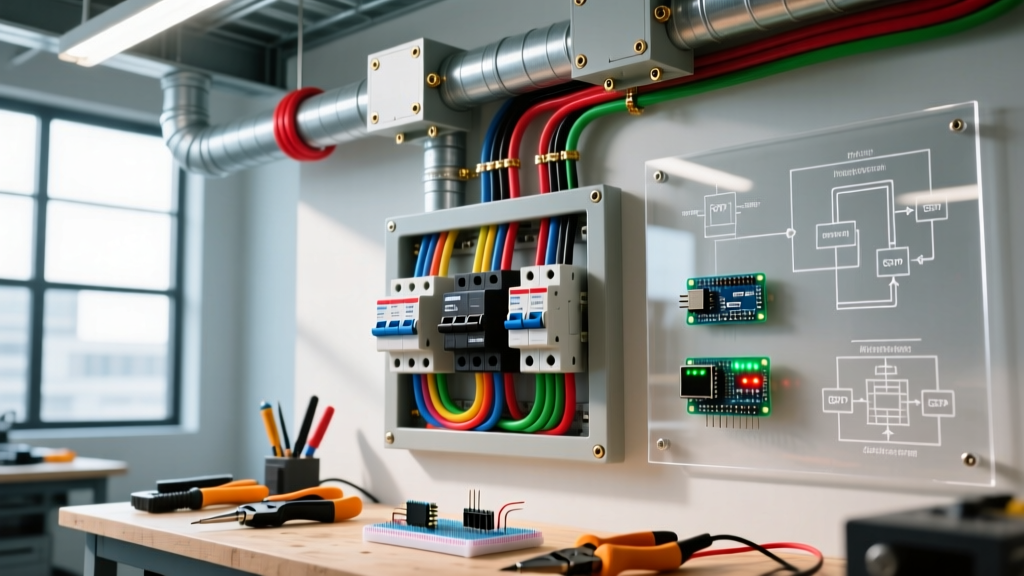

The Critical Role of Color Wiring Electrical Standards in Inspections
When an electrical inspector walks onto a commercial or residential job site, the visual assessment begins before they even open a panel. The color wiring electrical scheme is the universal language of safety, phase identification, and system voltage. A disorganized or non-compliant color scheme is an immediate red flag that often leads to deeper, more rigorous scrutiny—and frequently, a failed inspection.
As of the widespread adoption of the 2023 National Electrical Code (NEC) into 2026, inspectors are cracking down on improper wire re-identification, mixed voltage color codes in shared panels, and undocumented DC solar circuits. Understanding the exact NEC mandates for wire coloring is not just about aesthetics; it is a fundamental compliance requirement that prevents fatal shock hazards and arc flash incidents during future maintenance.
NEC Mandates: What Inspectors Look For
The National Fire Protection Association (NFPA) outlines strict rules for conductor identification in the NEC. Inspectors primarily reference three articles when evaluating your color wiring electrical setup:
- Article 200 (Use and Identification of Grounded Conductors): Dictates that neutral wires must be white, gray, or three continuous white stripes on other than green insulation.
- Article 250 (Grounding and Bonding): Mandates that equipment grounding conductors (EGC) must be bare, covered green, or covered green with yellow stripes.
- Article 110.15 (High-Leg Marking): A specific trap for commercial electricians working on 240V delta systems, requiring the high-leg (B-phase) to be distinctly marked orange.
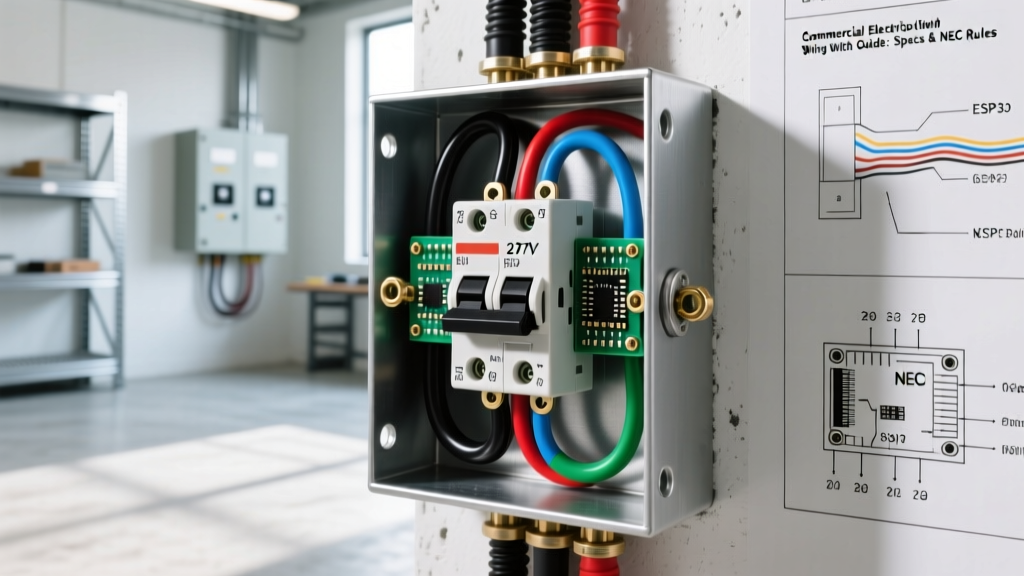
Inspector Insight: "The most common failure I write up in commercial remodels is finding 277V circuits wired with black, red, and blue THHN. If it's 277/480V, the phases must be brown, orange, and yellow. Mixing voltage color codes in the same panel is an automatic violation." — Senior Commercial Electrical Inspector, 2025 Field Report
Standard AC Power Wire Color Codes (US NEC)
To pass an inspection, your branch circuits and feeders must align with the standard color coding matrix. While the NEC explicitly mandates the colors for Neutral (White/Gray) and Ground (Green/Bare), it historically left ungrounded (hot) conductors open to interpretation. However, NEC 215.12(C) now requires that feeders and branch circuits operating at different voltages within the same building must use a standardized color coding system, which must be documented and posted at each panelboard.
AC Voltage Color Matrix
| System Voltage | Phase A | Phase B | Phase C | Neutral | Ground |
|---|---|---|---|---|---|
| 120/240V Single-Phase | Black | Red | N/A | White / Gray | Bare / Green |
| 120/208V 3-Phase (Wye) | Black | Red | Blue | White / Gray | Bare / Green |
| 277/480V 3-Phase (Wye) | Brown | Orange | Yellow | Gray | Bare / Green |
| 240V 3-Phase (High-Leg Delta) | Black | Orange (High Leg) | Blue | White / Gray | Bare / Green |
The "Taped Wire" Controversy: Re-identification Rules
One of the most heavily debated topics during electrical inspections is the re-identification of wire colors. Can you use electrical tape to change a wire's color? The answer is highly conditional and depends entirely on the wiring method.
When Re-identification is PERMITTED (NM-B / Romex)
Under NEC 200.7(C)(1), if you are using a standard 2-wire NM-B cable (which contains one black and one white wire) for a 240V circuit or a switch loop, the white wire is being used as an ungrounded (hot) conductor. You must permanently re-identify this white wire at every location where it is visible and accessible.
Actionable Specifics: Use phase-colored vinyl electrical tape (minimum 2 mils thick, such as 3M Super 33+) or heat shrink tubing. Wrap the tape completely around the wire at the panel termination, the device box, and any junction boxes. A $3 roll of high-grade vinyl tape saves you from a $250 inspection rework fee.
When Re-identification is STRICTLY PROHIBITED (Conduit / THHN)
Under NEC 200.2(A) and 210.5(C), if you are pulling individual THHN/THWN-2 conductors through a conduit, you cannot pull a white wire and tape it black to use as a hot conductor. You also cannot pull a green wire and tape it black. In conduit systems, the outer insulation must be the correct, factory-applied color for its entire length. Inspectors will fail a conduit run if they see taped THHN wires, as the tape can degrade, peel, or be removed over time inside the conduit, leaving a dangerous misidentification hazard.
DC Power and Solar PV Color Coding
With the explosion of residential and commercial solar installations, inspectors are increasingly referencing NEC Article 690 for Solar Photovoltaic (PV) Systems and OSHA 1910.304 wiring design standards for DC safety.
- Ungrounded DC Positive: Red (or any color other than white, gray, or green, but red is the industry standard).
- Ungrounded DC Negative: Black.
- Grounded DC Conductor: White or Gray (if the system is grounded).
Edge Case Warning: If your DC PV conductors share a raceway or junction box with AC conductors, they must be clearly tagged or separated by a physical barrier. Many inspectors in 2026 are requiring distinct DC wire labeling (e.g., "PV DC SOURCE") every 10 feet in exposed conduit runs to prevent maintenance workers from confusing 600V DC lines with 120V AC lines.
International vs. US Color Wiring Electrical Standards
Inspectors working in industrial facilities or data centers frequently encounter imported machinery wired to IEC (International Electrotechnical Commission) standards. This creates a massive compliance clash.
- US NEC 120V/208V: Black, Red, Blue (Phases); White (Neutral).
- IEC Standard: Brown, Black, Gray (Phases); Blue (Neutral).
If you are installing a European-manufactured CNC machine or server rack in a US facility, the internal wiring will use IEC colors. The NEC requires that at the point of connection to the US building's electrical system, the transition must be clearly documented, and the internal IEC color codes must be labeled on the inside of the machine's disconnect panel. Failing to provide a color-code translation legend inside the panel door is a frequent citation under NEC 110.22 (Identification of Disconnecting Means).
The Pre-Inspection Color Wiring Checklist
Before calling the city or county inspector to rough-in or finalize your electrical work, run through this specific color-coding compliance checklist to ensure a first-time pass:
- Verify the High-Leg: If working on a 240V Delta panel, use a multimeter to find the 208V-to-ground leg. Ensure the THHN insulation is factory orange, or that it is permanently marked with orange tape or heat shrink at both ends.
- Audit Switch Loops: Open every switch box. If a white wire in an NM-B cable is being used as a hot feed to a switch, ensure it is wrapped with black or red tape at the wire nut and at the panel.
- Check Shared Panels: If a single panelboard contains both 120/208V and 277/480V circuits, verify that the lower voltage uses Black/Red/Blue and the higher voltage uses Brown/Orange/Yellow. Ensure the color code legend is laminated and zip-tied to the panel directory.
- Inspect Grounding Conductors: Ensure no green or bare wires are being used as current-carrying neutrals. Conversely, ensure no white wires are being used as equipment grounds.
- Review Conduit Pulls: Open conduit bodies and pull boxes. Verify that no individual THHN wires have been taped to change their color. If you needed a black wire and only had white, you must pull the white wire out and replace it with a factory-black conductor.
Conclusion: Precision Prevents Penalties
Adhering to color wiring electrical standards is a hallmark of professional craftsmanship and a strict legal requirement under the NEC. Inspectors are not looking to penalize you; they are looking to ensure that the next electrician who troubleshoots the panel five years from now doesn't suffer a fatal arc flash because a neutral was misidentified as a hot. By purchasing the correct factory-colored THHN, properly re-identifying NM-B cables, and documenting mixed-voltage panels, you guarantee compliance, safety, and a smooth inspection process every time.