A subpanel is a secondary breaker box that distributes power to a specific area or outbuilding, fed by a dedicated double-pole breaker from the main service panel. In a real installation, it changes a single high-amperage feeder line into multiple localized branch circuits, giving you localized overcurrent protection and a convenient disconnect point without running individual home-runs back to the main panel. DIYers frequently confuse a subpanel with a main panel—leading to dangerous neutral-to-ground bonding errors—or they confuse the feeder breaker with a main service disconnect.
What a Subpanel Actually Is (and Isn't)
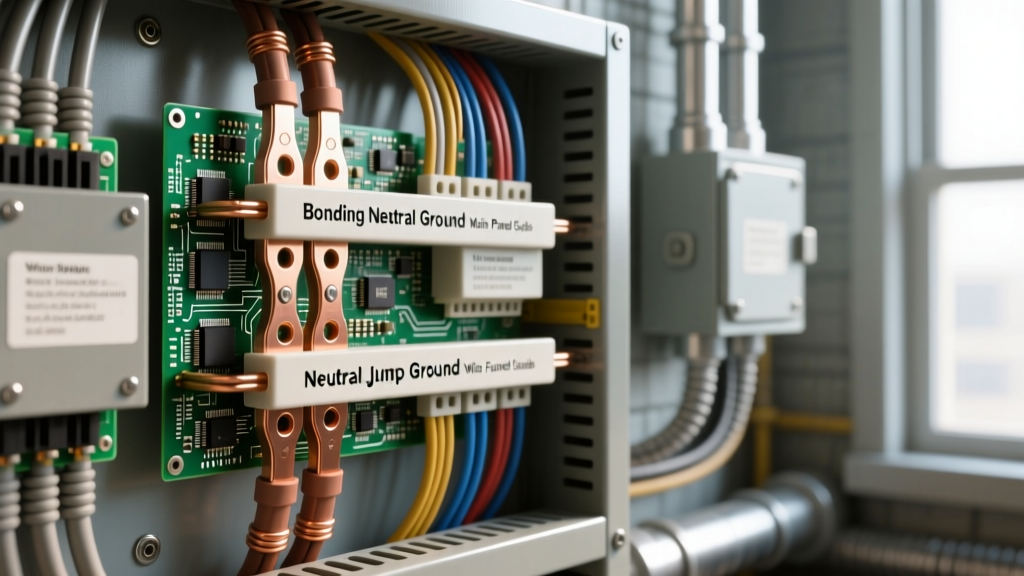
When you wire a subpanel, you are essentially creating a localized distribution node. The main service panel is the only place in your electrical system where the neutral and ground bars are bonded together. Every subpanel downstream must keep these two systems strictly isolated. If you bond them in a subpanel, normal neutral return current will split and travel back to the main panel on both the neutral wire and the bare copper ground wire. This energizes your grounding system, creating a severe shock hazard and causing GFCI breakers upstream to nuisance-trip.
Working inside a panel exposes you to lethal mains voltage. Always de-energize the main breaker, use a lockout/tagout device, and verify the bus bars are dead with a properly rated CAT III or CAT IV multimeter before touching any terminals. If you are unsure about local AHJ (Authority Having Jurisdiction) requirements for detached structures, consult a licensed electrician.
Modern NEC-style guidance (specifically NEC Article 250.32) requires a 4-wire feeder to any separate building or subpanel: two hot conductors, one grounded (neutral) conductor, and one equipment grounding conductor. Older 3-wire installations (which relied on the ground as a neutral return) are strictly prohibited in new work.
Where You Meet This in Practice
You will typically need to wire a subpanel in the following scenarios:
- Detached Garages and ADUs: Accessory Dwelling Units and large detached workshops require their own disconnecting means and localized branch circuits for 240V equipment like EV chargers or welders.
- Basement Workshops: When your main panel is on the first floor, running a 60A or 100A feeder to a basement subpanel saves hundreds of feet of branch circuit wire and keeps voltage drop manageable for heavy power tools.
- Solar and Battery Systems: Critical load subpanels are used to isolate essential circuits (refrigerator, well pump, internet) from the main panel so a solar inverter and battery backup system only has to support a fraction of the home's total wattage.
- Large Kitchen Islands: While not a 'building', a large island with multiple high-draw appliances (downdraft vents, secondary dishwashers) often requires a localized junction or subpanel to manage the conduit fill and wire routing.
The Math: Sizing a 60A Subpanel Feeder
Let's walk through a worked numeric example for a standard detached garage. We need to wire a subpanel rated for 60 amps, located 50 feet from the main panel. We will use aluminum wire to keep costs down, as copper prices remain volatile in 2026.
Step 1: Determine Ampacity and Wire Size
For a 60A double-pole breaker, we need wire rated for at least 60A in the 75°C column of NEC Table 310.16 (since most breaker terminals are rated for 75°C). 4 AWG Aluminum XHHW-2 is rated for 65A at 75°C. However, it is standard practice to upsize to 2 AWG Aluminum (rated 90A) to allow for future upgrades and to minimize voltage drop.
Step 2: Calculate Voltage Drop
The NEC recommends a maximum 3% voltage drop on feeders. Let's calculate the drop for 2 AWG Aluminum at 60A over 50 feet.
| Parameter | Value |
|---|---|
| System Voltage | 240V (Single Phase) |
| Current (I) | 60 Amps |
| One-Way Distance (D) | 50 feet |
| Wire Resistance (2 AWG Al) | 0.319 ohms per 1,000 ft |
The Calculation:
Loop resistance = 0.319 Ω/kft × (100 ft total loop / 1000) = 0.0319 Ω
Voltage Drop (VD) = I × R = 60A × 0.0319 Ω = 1.91V
Percentage Drop = (1.91V / 240V) × 100 = 0.79%
At 0.79%, this is well under the 3% recommendation. You can confidently pull four strands of 2 AWG aluminum (two hots, one neutral, one ground) through a 1-inch PVC conduit to this subpanel.
Real-World Scenario: The 200-Foot Barn Mistake
Theory is clean, but jobsites are messy. Here is a worked real-world scenario walkthrough showing what happens when you ignore the physics of long wire runs.
The Setup: A homeowner is wiring a subpanel to a detached barn located 200 feet from the main house. They plan to run a 5HP air compressor, a 240V MIG welder, and standard 120V lighting. They install a 100A subpanel and decide to use 4 AWG Copper SER (Service Entrance Round) cable buried directly in a trench, because they looked up the ampacity and saw 4 AWG copper is good for 85A.
The Numbers: They sized the feeder breaker to 80A to match the continuous load limits of the wire. The total cost for 200 feet of 4 AWG copper SER was roughly $2,400. They terminated the wires, kept the neutral and ground bars isolated in the subpanel, and energized the system.
The Outcome: When they turned on the 5HP air compressor and the dust collector simultaneously, the compressor motor hummed loudly, stalled, and tripped its internal thermal overload within ten seconds. The LED lights in the barn flickered noticeably every time a tool cycled on.
What Went Wrong: They sized the wire for ampacity (heat) but completely ignored voltage drop (resistance over distance). At 200 feet, 4 AWG copper has a loop resistance of roughly 0.123 ohms. Under an 80A combined load, the voltage drop is nearly 10V (about 4.1% on a 240V circuit).
While 4.1% sounds small, it means the 240V circuit is only delivering 230V. Worse, on the 120V legs, the voltage sags to 115V. When the 5HP compressor kicks on, it draws a massive Locked Rotor Amperage (LRA) surge—often 6 times its running current. That surge caused the voltage at the motor terminals to instantly drop below 105V. Electric motors draw more current when voltage drops, causing the windings to overheat and the thermal overload to trip.
The Fix: To keep the voltage drop under 3% at 200 feet for an 80A load, they needed to upgrade to 1/0 AWG Aluminum or 2 AWG Copper. They ended up abandoning the expensive copper SER and pulling 1/0 AWG aluminum XHHW-2 through 1.5-inch PVC conduit, which solved the voltage sag and saved them $800 in material costs.
Common Subpanel Wiring Confusions
Do I need a main breaker inside the subpanel?
Not necessarily. If the subpanel is in the same building as the main panel (like a basement workshop), the feeder breaker in the main panel acts as your disconnect. You can use a subpanel with 'main lugs' instead of a main breaker. However, if the subpanel is in a detached structure, NEC Article 225.32 requires a local disconnecting means. This can be achieved by using a subpanel with a main breaker, or by installing a standalone exterior disconnect switch before the subpanel.
Can the subpanel's main breaker be larger than the feeder breaker?
Yes, and this is highly recommended. If you are feeding a 100A-rated subpanel (meaning its bus bars and main lugs are rated for 100A) with a 60A double-pole breaker from the main panel, that is perfectly legal and safe. The 60A breaker protects the feeder wire; the subpanel's 100A rating simply means it can handle up to 100A if you ever upgrade the feeder wire and breaker in the future. The feeder breaker must never exceed the subpanel's bus bar rating.
Why do I need a separate ground rod for a detached garage subpanel?
Even though you are running a 4-wire feeder that includes an equipment grounding conductor back to the main panel, NEC 250.32(B) requires you to install a grounding electrode system (typically two 8-foot copper ground rods spaced 6 feet apart) at the detached building. This grounds the building's metallic structure to the earth to protect against lightning strikes and utility line surges. You bond the ground rod to the subpanel's ground bar, never to the neutral bar.
What size ground wire do I need for a subpanel?
The equipment grounding conductor (EGC) is sized based on the feeder breaker, not the subpanel lugs. According to NEC Table 250.122, a 60A breaker requires a minimum 10 AWG copper ground wire. A 100A breaker requires an 8 AWG copper ground wire. If you upsize your hot wires for voltage drop, you are technically required to upsize the ground wire proportionally, though many local inspectors will accept the Table 250.122 minimum if the voltage drop upsize is only one wire size.