
The Core Definition: What Is Alternating Current?
If you are diving into electrical DIY projects, panel upgrades, or microcontroller power supplies, you will inevitably encounter the question: what is alternating current? Unlike Direct Current (DC), where electrons flow continuously in a single direction from the negative to the positive terminal, Alternating Current (AC) periodically reverses its direction. In an AC circuit, electrons do not travel from the power plant to your home; instead, they oscillate back and forth in place, transferring energy through electromagnetic waves.
This oscillation occurs at a specific frequency. In North America, the standard frequency is 60 Hertz (Hz), meaning the current changes direction 120 times per second (completing 60 full sine wave cycles). In Europe and many other parts of the world, the standard is 50 Hz. This rapid reversal is the fundamental mechanism that allows AC to be easily transformed to different voltage levels, making it the undisputed king of global power distribution.
AC vs. DC: Quick Comparison Matrix
Understanding the operational differences between AC and DC is critical for selecting the right components, wire gauges, and safety protocols. Use this quick reference table to compare their fundamental characteristics.
| Feature | Alternating Current (AC) | Direct Current (DC) |
|---|---|---|
| Electron Flow | Oscillates back and forth (bidirectional) | Flows continuously in one direction (unidirectional) |
| Waveform | Sinusoidal (typically), square, or triangular | Flat, constant line (with minor ripple in rectified sources) |
| Voltage Transformation | Easily stepped up/down via transformers | Requires complex switching circuitry (buck/boost converters) |
| Long-Distance Transmission | Highly efficient at high voltages (low I²R loss) | Historically poor, though HVDC is now used for ultra-long distances |
| Typical Sources | Alternators, utility grid, portable generators | Batteries, solar cells, thermocouples, rectifiers |
| Primary Applications | Grid distribution, HVAC motors, heavy appliances | Electronics, microcontrollers, EV batteries, LED lighting |
Decoding the Sine Wave: RMS vs. Peak Voltage
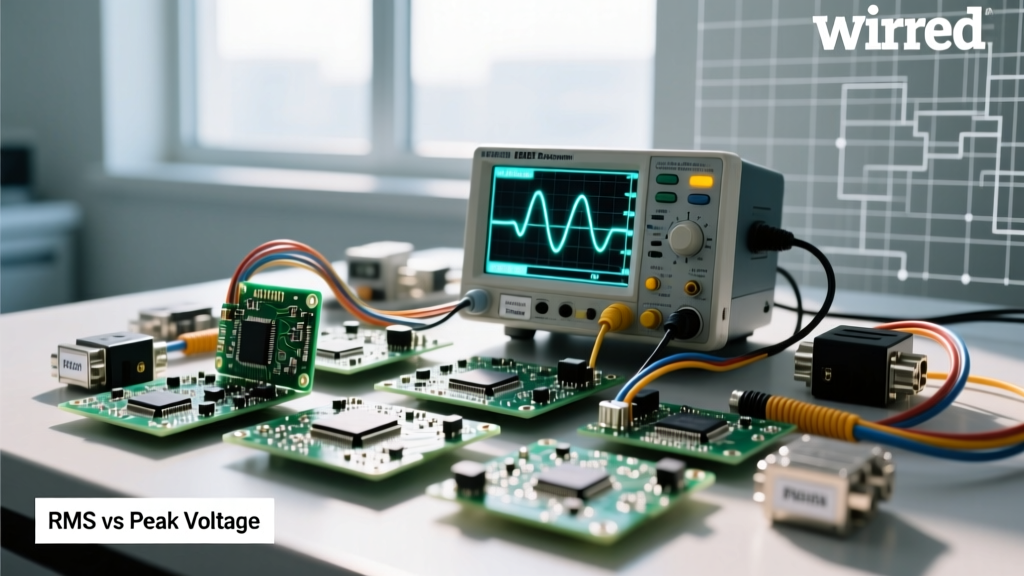
When you ask what is alternating current, you must also understand how its voltage is measured. A common point of confusion for DIYers is the difference between RMS (Root Mean Square) voltage and Peak voltage. When we say a standard US household outlet provides 120V AC, we are referring to the RMS voltage, not the peak voltage.
The RMS value is the equivalent DC voltage that would produce the same amount of heat (power dissipation) in a resistive load. Because the AC sine wave spends a significant portion of its cycle near zero volts, the actual peak voltage must be much higher to deliver the same average power.
The Math Behind the Wave
- Peak Voltage (Vp): The maximum voltage reached during a cycle. For a 120V RMS supply, the peak voltage is approximately 170V (calculated as 120V × √2, or 120 × 1.414).
- Peak-to-Peak Voltage (Vpp): The total voltage swing from the positive peak to the negative peak. For a 120V RMS supply, this is roughly 340V (170V - (-170V)).
- Average Voltage: Over a full, unrectified AC cycle, the mathematical average voltage is exactly zero, because the positive and negative halves cancel each other out.
Practical Takeaway: When selecting capacitors, diodes, or insulation for AC circuits, always rate your components for the peak voltage, not the RMS voltage, to prevent catastrophic dielectric breakdown.
The Skin Effect: How AC Changes Wire Sizing Rules
One of the most critical, yet frequently overlooked, phenomena in AC wiring is the skin effect. Because alternating current generates a constantly changing magnetic field within the conductor, it induces eddy currents that push the main electron flow toward the outer surface (the 'skin') of the wire.
According to All About Circuits, the skin effect is negligible at 60 Hz for standard residential wire gauges (like 14 AWG or 12 AWG). However, when you move into heavy industrial feeders or high-frequency applications (like inverter outputs or VFDs), the effective cross-sectional area of the conductor shrinks.
Wire Sizing Adjustments for AC
- Large Conductors: For cables larger than 250 kcmil at 60 Hz, the center of the copper carries almost no current. Engineers often use hollow tubing or bundle multiple smaller, insulated wires (like in a 500 MCM bundle) to increase surface area.
- Stranded vs. Solid: While standard stranded wire does not completely eliminate the 60 Hz skin effect (because the strands are not individually insulated), Litz wire—where hundreds of micro-strands are individually insulated and woven—forces the current to distribute evenly, entirely neutralizing the skin effect at higher frequencies.
Global Frequencies: The 50Hz vs. 60Hz Grid Split
The answer to 'what is alternating current' varies slightly depending on your geography. The global grid is split primarily between 50 Hz and 60 Hz. This historical divide stems from the late 19th-century 'War of the Currents' and subsequent regional engineering preferences.
North America, parts of South America, Japan (western regions), and Saudi Arabia utilize 60 Hz. This higher frequency allows for slightly more efficient motor operation and reduces the flicker in early incandescent lighting. Conversely, Europe, Asia, Africa, and eastern Japan standardized on 50 Hz, largely driven by early German engineering firms like AEG, which found that 50 Hz better matched the metric system and reduced mechanical wear on early generator bearings.
DIY Warning: Never plug a 50 Hz appliance (like a European table saw or heavy transformer-based audio amp) into a 60 Hz grid using only a voltage adapter. The motor will run 20% faster, draw more current, overheat, and potentially catch fire.
Safety First: AC Shock and the 'Let-Go' Threshold
Understanding the physiological impact of AC is vital for any electrical hobbyist. Alternating current is generally considered more dangerous than direct current at standard distribution voltages due to how it interacts with the human nervous system.
The Let-Go Threshold: According to safety data compiled by HyperPhysics, AC at 60 Hz is highly efficient at causing sustained muscle tetany. At currents as low as 6 to 30 milliamps (mA), AC can cause the muscles in your hand to contract involuntarily, making it impossible to 'let go' of a live conductor. DC, by contrast, typically causes a single, violent muscle spasm that often throws the victim away from the source.
Always treat AC mains with extreme caution. Use insulated tools, wear dielectric footwear, and ensure all circuits are verified dead with a non-contact voltage tester before touching any bare conductors.
How to Measure AC: True-RMS vs. Average Multimeters
When troubleshooting AC circuits, the tool you use matters immensely. If you are measuring a pure sine wave (like utility grid power), a standard, inexpensive 'average-responding' multimeter will give you an accurate RMS reading. It does this by measuring the rectified average and multiplying it by a fixed form factor (1.11).
However, modern DIY environments are full of non-linear loads. Devices like LED drivers, variable frequency drives (VFDs), and computer power supplies draw current in sharp, distorted spikes rather than smooth sine waves. If you use a cheap multimeter on these circuits, the reading will be wildly inaccurate, leading you to undersize your wiring or misdiagnose a fault.
The True-RMS Solution
For accurate diagnostics, you must use a True-RMS multimeter. As explained in Fluke's technical guides, True-RMS meters sample the waveform thousands of times per second, square the values, average them, and take the square root, providing a mathematically accurate heating-value reading regardless of waveform distortion. If your DIY projects involve smart home dimmers, solar inverters, or motor controllers, a True-RMS meter is a non-negotiable investment.
Summary Reference Card
- Definition: AC is an electrical current that periodically reverses direction, transferring energy via electromagnetic oscillation.
- Voltage Metrics: Always size insulation for Peak Voltage (RMS × 1.414), but calculate power using RMS Voltage.
- Wiring Impact: The skin effect forces high-frequency or high-amperage AC to the conductor's surface, requiring specialized cabling for heavy industrial loads.
- Safety: AC causes muscle tetany at low mA thresholds; always verify circuits are dead before handling.
- Measurement: Use True-RMS multimeters for any circuit containing solid-state electronics or non-linear loads.


