
The Exact Answer: What Correctly Describes an Electrical Shock?
If you are studying for an electrical certification, an OSHA safety exam, or a high school physics test, you have likely encountered a variation of this multiple-choice question: "Which of the following correctly describes an electrical shock?" It is a fundamental question that separates those who merely memorize safety rules from those who truly understand the physics of electricity and human biology.
To answer directly: An electrical shock is correctly described as the physiological reaction and tissue damage caused by an electric current passing through the human body, completing a circuit between two points of differing electrical potential.
Notice that the definition hinges on current flow and circuit completion, not just the presence of voltage. You can touch a 10,000-volt Van de Graaff generator and feel only a static spark, but touching a 120-volt household wire while grounded can be lethal. The distinction lies in sustained current (amperes) and the body's electrical resistance (ohms).
Common Exam Distractors vs. The Scientific Truth
When answering this question on a test, examiners will often provide plausible-sounding distractors. Here is a breakdown of why common alternative answers are incorrect:
| Proposed Statement (Distractor) | Why It Is Incorrect | The Scientific Reality |
|---|---|---|
| "A shock occurs when high voltage touches the skin." | Voltage is merely electrical pressure. Without a complete circuit and sufficient current, high voltage alone does not cause a sustained shock (e.g., static electricity). | Current (Amperes) must flow through the body to disrupt cellular and neurological functions. |
| "A shock is the body absorbing excess electrons from a wire." | The body does not act as a capacitor or battery that simply "fills up" with electrons. | The body acts as a resistor in a closed loop; electrons enter one contact point and exit another. |
| "A shock happens when a person touches a live ground wire." | A properly functioning ground wire is at zero potential relative to the earth. | Shocks occur when contacting an ungrounded (hot) conductor while providing a path to ground or neutral. |
The Physics of the Shock: Ohm’s Law Applied to Human Biology
To deeply understand the mechanics of an electrical shock, we must apply Ohm’s Law: I = V / R (Current = Voltage / Resistance). The severity of the shock is dictated by the amount of current (I) that successfully pushes through the body’s resistance (R) driven by the voltage source (V).
According to the OSHA Electrical Safety Guidelines, the human body's resistance is not a fixed number. It varies wildly based on environmental factors, skin moisture, and the contact area. Dry, calloused skin can act as a formidable insulator, while wet or broken skin reduces resistance to dangerous levels, allowing lethal current to flow even from low-voltage sources like a 24VAC irrigation controller.
The Human Body's Resistance Matrix
| Contact Condition | Approximate Resistance (Ohms) | Risk Level at 120V AC |
|---|---|---|
| Dry, intact skin (1 cm² contact) | 100,000 Ω to 600,000 Ω | Low (Current < 1.2 mA - Mild tingling) |
| Wet or sweaty skin | 1,000 Ω to 5,000 Ω | High (Current 24 mA to 120 mA - Muscular paralysis) |
| Broken skin or mucous membranes | 300 Ω to 500 Ω | Extreme (Current > 240 mA - Cardiac fibrillation) |
| Internal body resistance (hand-to-hand) | ~300 Ω | Lethal if skin barrier is bypassed |
Note: Once the initial shock breaks down the skin’s dielectric barrier, the body's resistance plummets, causing current to spike exponentially. This is why high-voltage shocks cause severe internal burns.
Physiological Thresholds: How Current Dictates Injury
It is a common saying among electricians that "it's the amps that kill you, but the volts that get the amps there." The National Fire Protection Association (NFPA) outlines specific physiological thresholds based on alternating current (AC) at 60Hz, which is the standard for North American residential and commercial power.
The mA Scale of Human Response
- 0.5 mA - 1.0 mA (Threshold of Perception): A faint tingling sensation. Most people can barely feel this.
- 5 mA - 10 mA (Pain and Minor Shock): Distinct pain, but muscle control is maintained. You can easily let go of the conductor.
- 10 mA - 20 mA (The "Let-Go" Threshold): Critical Danger Zone. Muscles contract involuntarily. If you are gripping a live wire, your forearm flexors overpower your extensors, and you physically cannot let go. You are now "frozen" to the circuit.
- 50 mA - 100 mA (Respiratory Paralysis & Fibrillation): The electrical current overrides the heart's natural sinoatrial node pacemaker, causing ventricular fibrillation. The heart quivers uselessly instead of pumping blood. Death is imminent without immediate defibrillation.
- > 1,000 mA (1 Ampere): Severe internal tissue burning, organ rupture, and immediate cardiac arrest.
Expert Insight: Direct Current (DC) behaves differently than Alternating Current (AC). DC tends to cause a single, violent muscle spasm that often throws the victim away from the source, whereas 60Hz AC causes sustained tetanic muscle contractions, making AC significantly more dangerous at standard household voltages.
Real-World Scenarios: How Shocks Happen on the DIY Workbench
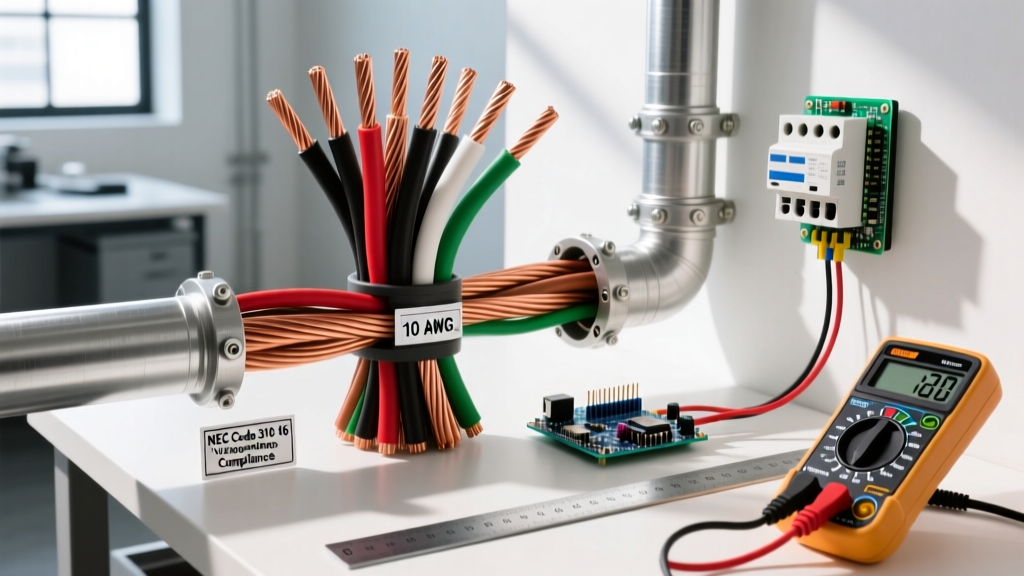
Understanding the theory is vital, but recognizing real-world hazards is what keeps DIY electronics enthusiasts and apprentice electricians alive. When working with microcontrollers, soldering stations, or wiring custom LED arrays, shocks typically occur due to three specific failures in protocol.
1. The "Neutral is Safe" Fallacy
Many beginners assume the white neutral wire in a standard US 120V circuit is safe to touch because it is bonded to ground at the main panel. However, if there is a load on the circuit and a loose neutral connection upstream, the neutral wire can rise to full line voltage (120V). Touching a disconnected neutral wire while grounded completes the circuit through your body, resulting in a severe shock.
2. Capacitor Discharge in Power Supplies
When repairing or modifying Switched-Mode Power Supplies (SMPS) for DIY projects, the large primary-side electrolytic capacitors can store lethal amounts of energy long after the device is unplugged. A 400V DC capacitor holding 50 Joules of energy can deliver a fatal shock if you bridge the terminals with a careless finger or an uninsulated screwdriver. Always use a high-wattage bleeder resistor to safely discharge capacitors before probing.
3. The Ground Path via Plumbing
A classic shock scenario occurs when a DIYer is working on a hardwired appliance (like a garbage disposal or dishwasher) while leaning against a copper water pipe or standing on a damp concrete floor. The concrete or pipe provides a near-zero resistance path to earth ground, turning the worker's body into the primary ground fault conductor.
Essential Safety Protocols for the Home Workbench
To ensure you never become a case study in an NIOSH electrical fatality report, implement these non-negotiable safety protocols on your workbench:
- Use a GFCI (Ground Fault Circuit Interrupter): A GFCI outlet monitors the current balance between the hot and neutral wires. If it detects a leakage of just 4 mA to 6 mA (indicating current is flowing somewhere it shouldn't, like through your chest to ground), it trips the circuit in under 25 milliseconds—fast enough to prevent ventricular fibrillation.
- Invest in an Isolation Transformer: When probing live AC circuits with an oscilloscope or multimeter, an isolation transformer separates your circuit from the earth ground of the mains supply. This eliminates the shock hazard caused by accidentally touching a single live point while grounded.
- Practice the "One-Hand Rule": When taking live voltage measurements, keep one hand in your pocket or behind your back. If you accidentally touch a live conductor, the current will travel down your arm and into your shoes, rather than crossing your chest cavity and passing directly through your heart.
- Verify with a CAT-Rated Meter: Never rely on a cheap, un-rated multimeter for mains voltage. Use a CAT III or CAT IV rated meter with fused probes to protect against catastrophic arc flashes and internal meter explosions that can cause secondary shock and burn injuries.
Summary for Your Exam and Your Life
When asked which of the following correctly describes an electrical shock, remember that it is the forced passage of electrical current through the body's resistance, disrupting biological electrical systems. Voltage is merely the catalyst; current is the weapon. By respecting Ohm's Law, understanding your body's physiological thresholds, and utilizing proper bench isolation techniques, you can master electrical fundamentals safely and effectively.