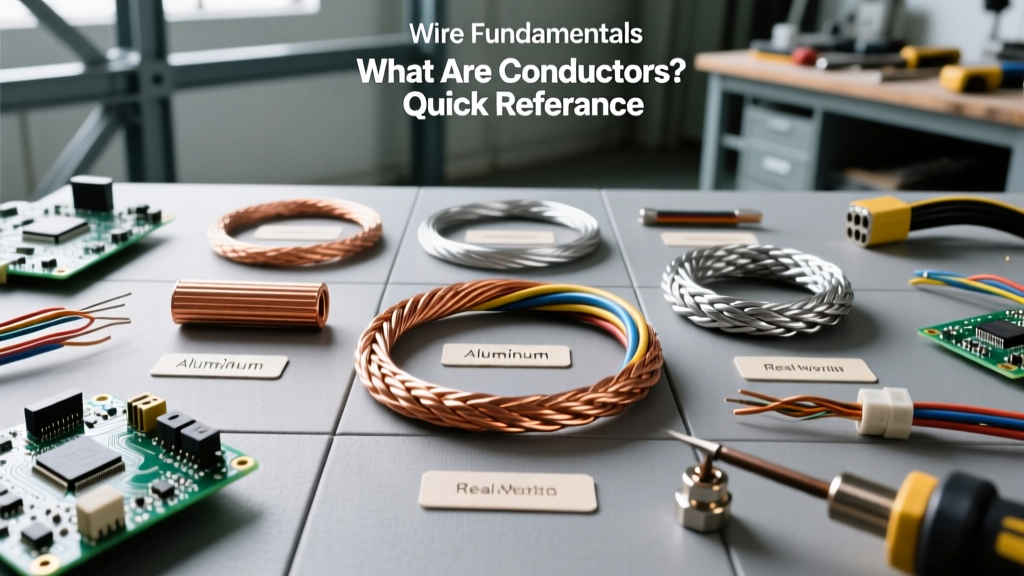

When electrical professionals, engineers, or advanced DIYers ask, 'what are the conductors,' they are seeking more than an elementary school definition. They need a practical, physics-backed breakdown of the materials that permit electron flow with minimal opposition. At the atomic level, conductors possess a 'sea of electrons'—valence electrons that are loosely bound to their parent nuclei, allowing them to drift freely when an electromotive force (voltage) is applied.
This quick reference guide bypasses the fluff and delivers the exact metallurgical data, National Electrical Code (NEC) constraints, and real-world failure modes you need to select the right wire for any circuit. Whether you are sizing a 400-amp service entrance or designing a high-frequency RF trace, understanding what are the conductors at the core of your cable is the first step in preventing voltage drop, thermal runaway, and catastrophic arc faults.
The Quick-Reference Conductor Matrix
To answer 'what are the conductors' used in modern infrastructure, we must look at the International Annealed Copper Standard (IACS). IACS defines the electrical conductivity of annealed copper at 20°C as exactly 100%. All other conductive materials are measured against this benchmark.
| Material | IACS Rating | Resistivity (nΩ·m at 20°C) | Primary Application | Key Limitation |
|---|---|---|---|---|
| Silver (Ag) | 105% | 15.9 | RF contacts, aerospace relays | Sulfide tarnish, extreme cost |
| Copper (Cu) | 100% | 16.8 | Branch circuits, transformers, PCBs | Weight, theft susceptibility |
| Gold (Au) | 70% | 24.4 | Edge connectors, low-voltage DC pins | Cost, soft metal (wears easily) |
| Aluminum (1350) | 61% | 28.2 | High-voltage transmission lines | Creep, galvanic corrosion |
| AA-8000 Alloy | 61% | 28.2 | Service entrance, feeders (NEC) | Requires larger gauge than Cu |
Copper (Cu): The IACS Benchmark and C11000
The vast majority of residential and commercial wiring utilizes Electrolytic Tough Pitch (ETP) copper, universally designated as Alloy C11000. According to the Copper Development Association (CDA), C11000 contains a minimum of 99.90% copper with a tightly controlled oxygen content (around 0.02% to 0.04%). This specific oxygen level prevents hydrogen embrittlement during high-temperature soldering or brazing.
Skin Effect and High-Frequency Derating
When dealing with alternating current (AC), particularly at frequencies above 60Hz (such as in variable frequency drives or data transmission), the 'skin effect' forces electrons to travel only along the outer perimeter of the conductor. At 1 MHz, the skin depth of copper is merely 0.066 mm. Therefore, in high-frequency applications, the effective cross-sectional area of the conductor drops drastically. To combat this, engineers use Litz wire—multiple individually insulated thin-gauge strands braided together—to maximize the surface area available for conduction.
Aluminum and the AA-8000 Alloy Revolution
Historically, pure 1350-series aluminum was used in branch circuits during the 1960s and 70s due to copper shortages. However, pure aluminum suffers from a high coefficient of thermal expansion and 'cold flow' (creep). When screwed into standard brass or steel terminals, the aluminum would expand under load heat, then contract and permanently deform as it cooled. Over time, this created loose connections, leading to high resistance, oxidation, and devastating residential fires.
To solve this, the metallurgy industry developed the AA-8000 series alloys (typically Aluminum-Iron-Copper-Magnesium blends). The addition of iron (Fe) dramatically increases the metal's creep resistance, bringing its mechanical stability under screw terminals in line with copper.
NEC Code Alert: Per National Fire Protection Association (NFPA) NEC Article 310.106(B), solid aluminum conductors smaller than 12 AWG are strictly prohibited. Furthermore, stranded aluminum branch circuit conductors must be AA-8000 series alloy, and must only be terminated on devices explicitly marked 'CO/ALR' (Copper-Aluminum Revised).
Because aluminum has only 61% of the conductivity of copper, you must increase the wire gauge by two standard AWG sizes to achieve the same ampacity. For example, a 100-amp feeder requires 3 AWG copper, but 1 AWG AA-8000 aluminum.
Noble Metals: Silver, Gold, and Contact Resistance
While copper and aluminum carry the bulk load, understanding what are the conductors in microelectronics requires looking at noble metals. Gold is highly prized in low-voltage DC applications (like USB-C pins, HDMI edge connectors, and RFID tags) not because it is the most conductive, but because gold does not oxidize. Copper oxide and aluminum oxide are highly resistive insulators that cause voltage drops across mating surfaces. Gold remains perfectly conductive even at micro-ampere signal levels where contact resistance would otherwise destroy the data packet.
Silver, while possessing the highest bulk conductivity (105% IACS), reacts with atmospheric sulfur to form silver sulfide (tarnish). Unlike gold, silver tarnish is slightly conductive, making it viable for high-current relay contacts in aerospace and industrial motor starters, but less ideal for low-voltage signal switching.
Real-World Failure Modes: Galvanic Corrosion and Creep
When selecting or troubleshooting conductors, you must anticipate environmental failure modes. The National Institute of Standards and Technology (NIST) maintains extensive galvanic series charts that dictate how dissimilar metals interact in the presence of an electrolyte (humidity/salt).
- Galvanic Corrosion: If a copper lug is bolted directly to an aluminum busbar in a humid environment, a galvanic cell is formed. The aluminum becomes the sacrificial anode and corrodes rapidly into a white, powdery aluminum oxide, which acts as an insulator and causes localized heating. Always use bi-metallic transition lugs or apply oxide-inhibiting compound (like Penetrox) to prevent this.
- Stranding vs. Solid Core: Solid conductors are rigid and ideal for pushing through conduit and terminating on standard residential receptacles. However, in high-vibration environments (automotive, marine, industrial robotics), solid conductors will work-harden and snap. Fine-strand flexible conductors must be used, paired with ferrule crimps to prevent stray strands from causing short circuits under screw terminals.
- Thermal Runaway: If a conductor is undersized for the load, its inherent resistivity causes I²R heating. As the temperature of copper rises, its resistivity increases by roughly 0.39% per degree Celsius. This creates a positive feedback loop: higher resistance causes more heat, which causes higher resistance, eventually melting the PVC/XHHW insulation and initiating an arc fault.
Summary Framework for Conductor Selection
To definitively answer 'what are the conductors' for your next project, apply this three-step decision matrix:
- Calculate the Load & Distance: Determine the continuous ampacity and run length to calculate voltage drop. (Target < 3% for branch circuits).
- Choose the Metallurgy: Select Copper (C11000) for space-constrained, high-vibration, or branch-circuit applications. Select AA-8000 Aluminum for heavy, long-distance feeder runs where weight and cost savings outweigh the need for larger conduit fill.
- Verify Termination Compatibility: Ensure all lugs, breakers, and busbars are rated for the specific metal and alloy you have chosen, applying anti-oxidant paste where dissimilar metals or aluminum are involved.
By treating conductor selection as a precise metallurgical science rather than a simple commodity choice, you ensure the longevity, safety, and efficiency of your entire electrical infrastructure.


