
The Core Question: What Are Types of Batteries in Electronics?
When building DIY electronics, designing microcontroller circuits, or wiring off-grid solar systems, your project is only as reliable as its DC power source. At the most fundamental electrical level, a battery is an electrochemical transducer. It converts stored chemical energy into direct current (DC) electrical energy through redox (reduction-oxidation) reactions. But if you are asking, 'what are types of batteries' available to makers and electricians, the answer goes far beyond simple AA cells.
Understanding battery chemistry is not just about knowing how long a device will run; it is a critical pillar of electrical fundamentals. The chemistry dictates the nominal voltage, the internal resistance, the discharge curve, and the maximum continuous current. These factors directly influence your wire sizing calculations, voltage drop considerations, and the selection of overcurrent protection devices like fuses and breakers. According to the U.S. Department of Energy, the fundamental operation of all batteries relies on the movement of ions between a cathode and an anode through an electrolyte, but the materials used drastically change the electrical output.
Primary vs. Secondary Cells: The Fundamental Divide
Before diving into specific chemistries, we must categorize batteries into two primary groups: primary (non-rechargeable) and secondary (rechargeable) cells.
Alkaline and Zinc-Carbon (The Disposable Standards)
Alkaline batteries (nominal 1.5V) are the most common primary cells. While they are cheap and accessible, they possess a relatively high internal resistance. In electrical terms, this means that under a high-current load—such as driving a servo motor or powering a high-lumen LED array—the internal resistance causes a significant voltage drop (sag) inside the battery itself. This makes alkaline cells poorly suited for high-drain microcontroller projects, though they are perfectly adequate for low-drain applications like wall clocks or basic TV remotes.
Lithium Primary (High-Energy Coin Cells)
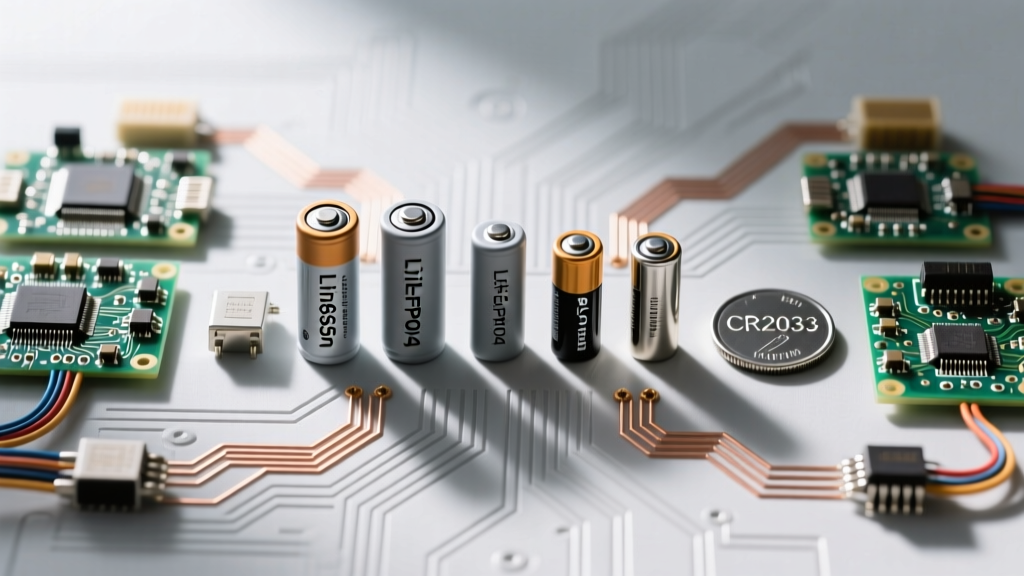
The CR2032 is a ubiquitous lithium primary coin cell with a nominal voltage of 3.0V and a capacity of roughly 225mAh. These are heavily used in DIY electronics to power Real-Time Clocks (RTC) on Arduino or ESP32 boards to maintain timekeeping when main power is lost. However, a CR2032 has an internal resistance of about 15 ohms. This limits its continuous safe discharge to roughly 15mA. Attempting to pull 100mA from a coin cell to power a Wi-Fi transmission burst will result in severe voltage sag, potentially resetting your microcontroller.
Rechargeable Chemistries for DIY & Microcontroller Projects
For sustainable, high-performance projects, secondary cells are mandatory. The Argonne National Laboratory notes that modern rechargeable chemistries have revolutionized portable electronics by offering high energy density and thousands of charge cycles.
Lithium-Ion (Li-ion): The 18650 and 21700 Workhorses
Lithium-ion cells, particularly in the 18650 (18mm x 65mm) and 21700 cylindrical form factors, are the backbone of modern portable power. They feature a nominal voltage of 3.7V, a peak charge of 4.2V, and a safe discharge cutoff around 2.5V to 3.0V. High-quality cells like the Molicel P28A (21700) boast an incredibly low internal resistance of roughly 15 milliohms, allowing them to deliver up to 35 amps of continuous current. This low internal resistance makes them ideal for high-drain applications like robotics, power tools, and high-performance drones.
Lithium Polymer (LiPo): Pouch Cells for High Discharge
LiPo batteries use a polymer electrolyte and are housed in flexible foil pouches. They are favored in RC cars and drones because they can be manufactured in custom, flat shapes and offer massive discharge rates (often rated at 50C or 100C). However, LiPos are notoriously fragile. Puncturing the pouch or overcharging them can lead to violent thermal runaway. They require specialized balance chargers and careful storage.
Nickel-Metal Hydride (NiMH): The Safe, Low-Drain Alternative
NiMH cells (nominal 1.2V) are the rechargeable successors to alkaline batteries. Modern Low Self-Discharge (LSD) NiMH batteries, like the Panasonic Eneloop, retain up to 70% of their charge after five years of sitting on a shelf. While their energy density is lower than lithium, they are exceptionally safe, tolerate over-discharge better, and are excellent for low-drain sensor nodes or portable audio amplifiers.
Lithium Iron Phosphate (LiFePO4): The Off-Grid Standard
When wiring 12V DC panels, RVs, or off-grid solar setups, LiFePO4 is the undisputed king. A standard 12V LiFePO4 battery is actually a 4S (four cells in series) pack with a nominal voltage of 12.8V and a charge voltage of 14.6V. Unlike lead-acid batteries, LiFePO4 offers a remarkably flat discharge curve, meaning your 12V appliances receive a steady voltage until the battery is nearly empty. They also boast 3,000 to 5,000 life cycles and are inherently safer than standard Li-ion, as they are highly resistant to thermal runaway.
How Battery Chemistry Dictates Wire Sizing and Circuit Design
As covered in our wire sizing fundamentals, the choice of battery directly impacts the gauge of wire you must use. The formula for voltage drop is V_drop = I * (R_wire + R_internal). If you are using a high-discharge 21700 Li-ion cell capable of pushing 25 Amps to a motor controller, using a standard 18 AWG jumper wire will result in a massive voltage drop and dangerous heat generation due to the wire's resistance.
For a 25A continuous draw, electrical codes and DIY best practices dictate using at least 14 AWG or 12 AWG copper wire for short runs to minimize resistance and ensure the full voltage reaches the load. Conversely, if you are wiring a CR2032 coin cell to an RTC module drawing only 2mA, a thin 28 AWG or 30 AWG wire-wrap wire is perfectly sufficient and saves space on your PCB.
Chemistry Comparison Chart for DIY Electronics
| Chemistry | Nominal Voltage | Internal Resistance | Max Continuous Current | Best DIY Use Case |
|---|---|---|---|---|
| Alkaline (AA) | 1.5V | High (~150mΩ) | < 500mA | Low-drain sensors, remotes |
| Lithium Primary (CR2032) | 3.0V | Very High (~15Ω) | < 15mA | RTC memory backup, CMOS |
| Li-ion (21700) | 3.7V | Very Low (~15mΩ) | 25A - 35A | Robotics, e-bikes, power banks |
| LiPo (Pouch) | 3.7V per cell | Low (~5mΩ) | 50A+ (High C-Rating) | Drones, RC vehicles |
| NiMH (Eneloop) | 1.2V | Moderate (~30mΩ) | 1A - 2A | Portable audio, safe toys |
| LiFePO4 (4S Pack) | 12.8V | Low (~2mΩ per cell) | 100A+ (BMS dependent) | Solar off-grid, RVs, marine |
Real-World Failure Modes and Safety Protocols
Understanding what are types of batteries also requires understanding how they fail. Every chemistry has specific failure modes that DIYers must design around.
- Over-Discharge (Li-ion/LiPo): Draining a lithium cell below 2.5V causes copper from the anode current collector to dissolve into the electrolyte. If recharged, this copper forms dendrites (microscopic spikes) that can pierce the separator, causing an internal short circuit and a fire.
- Thermal Runaway (LiPo): If a LiPo pouch is physically crushed or charged beyond 4.2V per cell, the electrolyte breaks down, releasing oxygen and heat, leading to a self-sustaining chemical fire that cannot be extinguished with standard water or CO2 extinguishers.
- Sulfation (Lead-Acid): While not as common in modern DIY, leaving a lead-acid battery in a discharged state causes lead sulfate crystals to harden on the plates, permanently reducing capacity.
Expert Safety Tip: Never store LiPo or Li-ion batteries at full charge (4.2V) for extended periods. The high voltage stresses the internal chemistry and accelerates degradation. For long-term storage, use your charger's 'Storage Mode' to bring the cells down to a nominal 3.80V - 3.85V, which minimizes chemical stress and prevents swelling. For comprehensive data on lithium degradation, refer to the extensive testing archives at Battery University.
Summary: Matching the Cell to the Circuit
Choosing the right battery is an exercise in balancing energy density, weight, cost, and safety. By understanding the fundamental electrical properties of different chemistries—from the high internal resistance of coin cells to the massive current delivery of 21700 Li-ions and 12V LiFePO4 packs—you can accurately size your wires, select the correct fuses, and ensure your DIY electronics operate reliably for years to come.