
The Electrochemical Divide: Primary vs. Secondary Cells
When engineers and DIYers ask, "what types of batteries are there?", the answer requires looking past consumer branding and into the fundamental electrochemistry. At its core, a battery is a galvanic cell that converts stored chemical energy into electrical energy via spontaneous redox (reduction-oxidation) reactions. Understanding these chemistries is critical not just for selecting the right power source, but for accurately sizing the DC wiring, busbars, and overcurrent protection required to safely deliver that power.
Broadly, all batteries fall into two distinct categories based on their reversibility:
- Primary Cells (Non-Rechargeable): The electrochemical reaction is irreversible. Once the anode is fully oxidized, the cell is depleted.
- Secondary Cells (Rechargeable): The reaction is reversible. Applying an external DC voltage forces electrons back to the anode, restoring the chemical potential.
Decoding Primary (Non-Rechargeable) Battery Chemistries
Primary batteries are engineered for high energy density, long shelf life, and low self-discharge rates. They are the backbone of low-draw, mission-critical, or remote IoT applications.
Zinc-Carbon and Alkaline
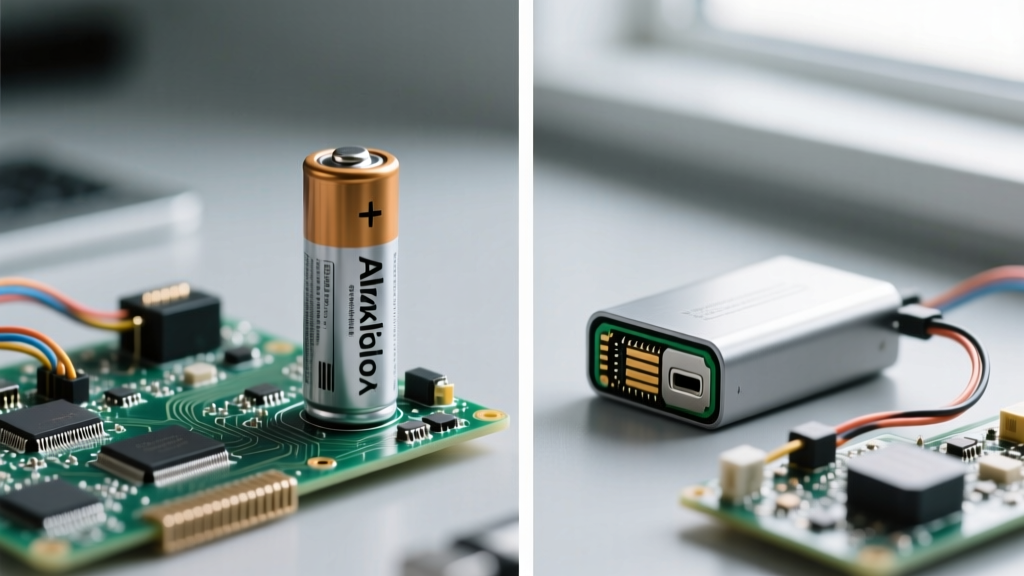
The standard alkaline cell (Zinc/Manganese Dioxide) dominates the consumer market. It provides a nominal 1.5V, but its discharge curve is steep, dropping to a cutoff of roughly 0.9V. While cheap, alkaline cells suffer from high internal resistance, making them unsuitable for high-current draws. Zinc-carbon variants are even less efficient and are largely obsolete in modern electronics, though they still appear in ultra-low-drain devices like wall clocks.
Lithium Primary Cells
When the application demands a flat discharge curve and a 10-year shelf life, lithium primary chemistries take over. The CR2032 (Lithium Manganese Dioxide) delivers a nominal 3.0V and is ubiquitous in CMOS memory backup and RF key fobs. For high-drain primary needs, Lithium Iron Disulfide (Li-FeS2) AA cells provide a constant 1.5V output and can sustain digital camera flashes far longer than alkaline equivalents.
Secondary (Rechargeable) Batteries: Powering the Modern Grid
Secondary batteries are defined by their cycle life and power density. According to the U.S. Department of Energy, advancements in secondary cell chemistry are the primary bottleneck and enabler for both consumer electronics and grid-scale renewable storage.
Lead-Acid: The Heavyweight Champion
Invented in 1859, the lead-acid battery remains the standard for automotive starting, lighting, and ignition (SLI) and off-grid solar banks. A 12V nominal lead-acid battery consists of six 2.1V cells in series.
- Flooded Lead-Acid (FLA): Requires periodic distilled water topping and equalization charges. Offers the lowest cost per watt-hour but demands strict ventilation due to hydrogen off-gassing.
- AGM (Absorbent Glass Mat) & Gel: Valve-Regulated Lead-Acid (VRLA) variants that immobilize the electrolyte. They are maintenance-free, mountable in any orientation, and exhibit lower internal resistance, making them ideal for UPS systems.
Lithium-Ion (Li-ion) and Lithium Polymer (LiPo)
Li-ion chemistries offer the highest energy density (up to 250 Wh/kg). The most common variants include:
- NMC (Nickel Manganese Cobalt): Used in EVs and power tools (like 18650 and 21700 cylindrical cells). High energy density but requires rigorous Battery Management System (BMS) thermal monitoring to prevent thermal runaway.
- LiPo (Lithium Polymer): Uses a pouch-cell format, allowing for ultra-thin profiles in drones and smartphones, though they are highly susceptible to swelling and puncture damage.
Lithium Iron Phosphate (LiFePO4)
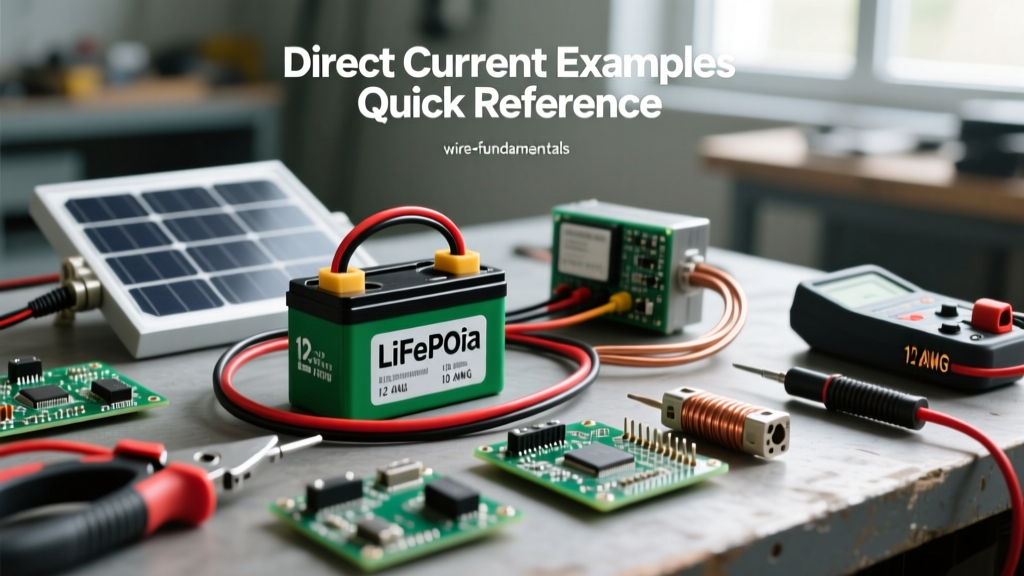
For stationary solar storage and marine applications, LiFePO4 (LFP) has become the gold standard. While its energy density is lower than NMC, LFP offers unparalleled thermal stability and a cycle life exceeding 4,000 to 6,000 cycles at 80% Depth of Discharge (DoD). As noted by Battery University, the olivine crystal structure of LFP prevents the oxygen release that causes thermal runaway in other lithium chemistries.
Nickel-Metal Hydride (NiMH)
Operating at a nominal 1.2V per cell, NiMH batteries serve as a rechargeable drop-in replacement for alkaline AA/AAA cells. They suffer from a relatively high self-discharge rate (up to 20% in the first 24 hours), though Low Self-Discharge (LSD) variants like Eneloop have largely mitigated this issue.
Comparative Matrix: Energy Density, Cycle Life, and Cost
To select the correct battery for a project, you must balance weight, lifespan, and budget. The table below outlines the core metrics of major battery types.
| Battery Chemistry | Nominal Voltage | Energy Density (Wh/kg) | Typical Cycle Life | Primary Application |
|---|---|---|---|---|
| Alkaline (Primary) | 1.5V | ~100 | 1 (Primary) | Low-drain consumer electronics |
| Lithium Manganese (Primary) | 3.0V | ~280 | 1 (Primary) | IoT sensors, medical devices, memory backup |
| Lead-Acid (AGM/Gel) | 2.1V / cell | 30 - 50 | 300 - 800 | UPS systems, automotive SLI, mobility scooters |
| NiMH | 1.2V | 60 - 120 | 500 - 1000 | Rechargeable consumer AA/AAA, hybrid vehicles |
| Li-ion (NMC/NCA) | 3.6V / 3.7V | 150 - 250 | 500 - 1500 | EVs, power tools, laptops, smartphones |
| LiFePO4 (LFP) | 3.2V | 90 - 160 | 3000 - 6000+ | Solar banks, marine house banks, server rack UPS |
Wire Sizing and Interconnect Fundamentals for Battery Banks
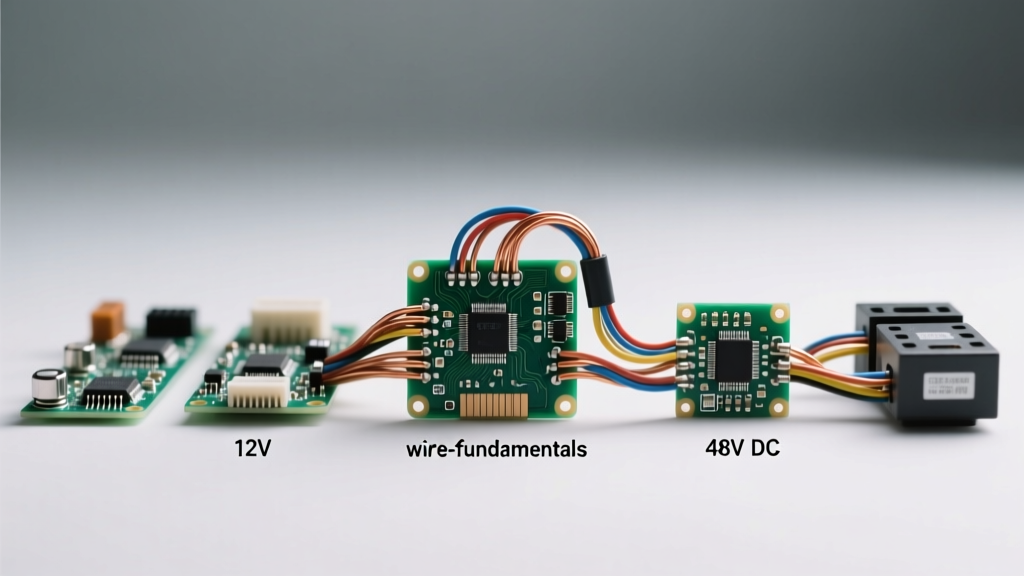
Understanding what types of batteries are there is only half the battle; safely routing the DC current they produce is where electrical fundamentals become critical. DC battery banks operate at low voltages but extremely high currents, making voltage drop and conductor heating the primary design constraints.
Calculating Ampacity and Voltage Drop
Consider a 48V LiFePO4 server-rack battery system powering a 5,000W off-grid inverter. At maximum load and the lowest cutoff voltage (e.g., 44V), the continuous current draw is calculated as: I = P / V (5000W / 44V = 113.6 Amps).
According to standard ampacity charts (and NEC Table 310.15(B)(16) guidelines for copper conductors), a 2 AWG copper wire rated at 90°C can handle roughly 115A to 130A depending on ambient temperature. However, in DC battery wiring, voltage drop is the governing factor. A 2% voltage drop on a 48V system equates to a maximum drop of 0.96V. If the cable run between the battery busbar and the inverter is 10 feet (20 feet round trip), using the circular mils formula for voltage drop reveals that 2 AWG is insufficient. You must step up to 1/0 AWG or 2/0 AWG copper welding cable to maintain system efficiency and prevent the insulation from melting under sustained high-amperage loads.
Busbars and Torque Specifications
When wiring batteries in parallel or series, never rely solely on the battery terminals to daisy-chain heavy gauge cables. Use solid copper busbars. Furthermore, LiFePO4 and Lead-Acid terminal bolts require precise torque (typically 4 to 6 Nm, depending on the manufacturer). Under-torquing creates micro-arcing and high resistance, leading to localized melting; over-torquing can strip the internal aluminum or lead threads, destroying the cell.
Safety Warning: DC arcs do not have a natural zero-crossing point like AC power, meaning a DC short circuit will sustain a continuous plasma arc until the conductor vaporizes or the battery is fully depleted. Always install Class-T or ANL fuses as close to the positive battery terminal as physically possible to protect the main feeder cables.
Environmental and Safety Protocols
End-of-life battery management is a growing concern. Primary lithium cells must never be incinerated or crushed, as they contain highly reactive metallic lithium. Secondary Li-ion and LFP batteries should be routed to specialized e-waste recyclers capable of hydrometallurgical recovery of cobalt, nickel, and lithium. Always store swollen LiPo cells in a fireproof LiPo bag and discharge them to 0V using a specialized resistor load before disposal.
By matching the exact electrochemical profile of the battery to your project's energy requirements—and sizing your DC wiring to handle the resulting current—you ensure a safe, efficient, and long-lasting electrical system.