
The Short Answer: Is Rubber an Insulator or Conductor?
When asking the fundamental question, is rubber an insulator or conductor, the definitive answer is that pure rubber is an exceptional electrical insulator. It possesses extremely high volume resistivity and tightly bound valence electrons, preventing the free flow of electrical current. However, in modern electrical engineering, the answer requires nuance. While natural and synthetic rubbers form the backbone of high-voltage cable insulation and personal protective equipment (PPE), chemical doping can intentionally transform rubber into a conductor for specialized applications like EMI shielding and antistatic flooring.
To truly understand how rubber behaves in electrical circuits, we must look past the surface and examine the molecular physics, dielectric breakdown thresholds, and the specific synthetic compounds used in modern wire manufacturing.
The Physics of Polymer Insulation
To understand why rubber blocks electron flow, we have to look at its molecular structure. Natural rubber, scientifically known as polyisoprene, is a polymer consisting of long, coiled hydrocarbon chains. In conductive metals like copper, the outermost (valence) electrons are loosely bound to their nuclei, forming a 'sea of electrons' that easily drift when a voltage is applied.
In rubber, the carbon and hydrogen atoms share electrons via strong covalent bonds. These electrons are locked into place to maintain the structural integrity of the polymer chain. Because there are virtually no free charge carriers available, an applied electric field cannot induce a current. The volume resistivity of pure natural rubber typically ranges from 1013 to 1015 ohm-meters, compared to copper's resistivity of roughly 1.68 × 10⁻⁸ ohm-meters.
Engineering Insight: Resistivity is not infinite. If the applied voltage exceeds the material's dielectric strength, the electric field will physically rip electrons from their covalent bonds, causing a catastrophic failure known as dielectric breakdown or 'tracking'.
Dielectric Breakdown & Material Comparison
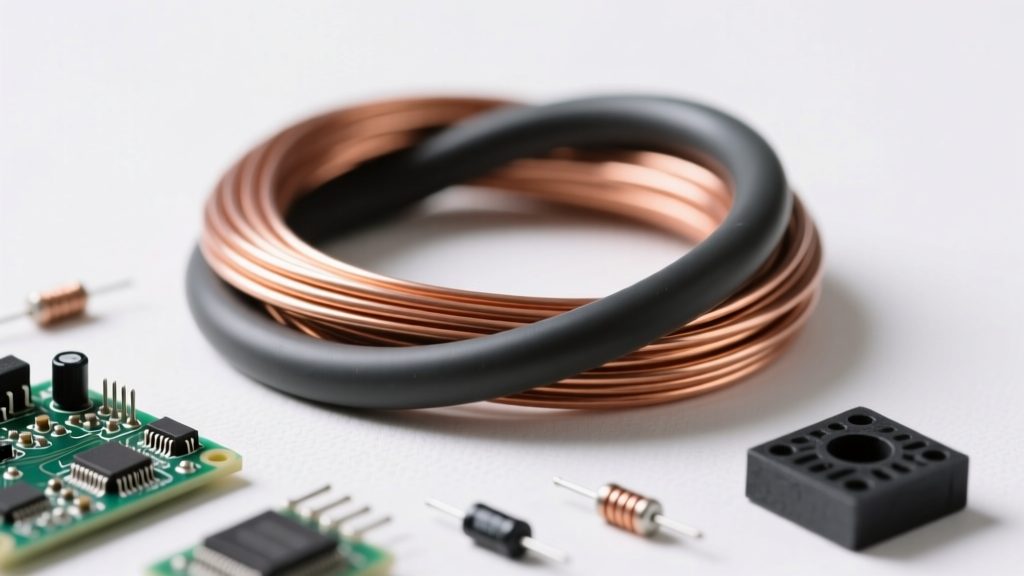
While natural rubber was the standard for early 20th-century wiring, modern electrical systems rely heavily on synthetic elastomers. Natural rubber degrades quickly when exposed to ozone, UV light, and high temperatures. Below is a comparison of the dielectric properties of common rubber compounds used in wire sizing, cable jacketing, and electrical safety gear.
| Rubber Compound | Dielectric Strength (kV/mm) | Volume Resistivity (Ω·m) | Primary Electrical Application |
|---|---|---|---|
| Natural Rubber (Polyisoprene) | 15 - 30 | 1013 - 1015 | Legacy wire insulation, low-voltage mats |
| EPDM (Ethylene Propylene) | 20 - 40 | 1015 - 1017 | Modern HV/MV cable insulation, splices |
| Silicone Rubber | 20 - 25 | 1014 - 1016 | High-temp aerospace wiring, electronics |
| Neoprene (Polychloroprene) | 15 - 20 | 1011 - 1013 | Abrasion-resistant outer cable jackets |
Why EPDM Dominates Modern High-Voltage Cables
If you are working with medium or high-voltage underground cables today, you are likely working with EPDM (Ethylene Propylene Diene Monomer) or XLPE (Cross-Linked Polyethylene). EPDM is favored because its polymer backbone is fully saturated—meaning it lacks the reactive carbon-carbon double bonds found in natural rubber. This makes EPDM virtually immune to ozone cracking and corona discharge, allowing it to maintain its insulating properties for decades in harsh environments. For deeper material specifications, the British Plastics Federation EPDM Guide provides excellent data on polymer saturation and electrical longevity.
The Carbon Black Exception: When Rubber Becomes a Conductor
Can rubber ever conduct electricity? Yes, but only if we intentionally alter its chemical composition. Pure rubber is an insulator, but manufacturers can create conductive rubber by loading the elastomer matrix with conductive fillers, most commonly carbon black, metallic powders, or carbon nanotubes.
The Percolation Threshold
When carbon black is mixed into uncured rubber, the particles are initially isolated. However, as the concentration of carbon black increases, it eventually reaches a critical point known as the percolation threshold (usually around 15% to 30% by weight). At this threshold, the carbon particles form a continuous, interconnected microscopic network throughout the rubber matrix. Electrons can now 'hop' across these carbon pathways via quantum tunneling, dropping the volume resistivity from 1015 down to 102 - 105 ohm-meters.
Practical Applications of Conductive Rubber:
- EMI/RFI Shielding Gaskets: Used in military and telecom enclosures to block electromagnetic interference while maintaining a watertight seal.
- Antistatic Flooring & Mats: Used in server rooms and explosives manufacturing. These mats are designed to have a resistance of 106 to 109 ohms—conductive enough to safely bleed off static charges from personnel, but resistive enough to prevent a lethal shock if a live wire is dropped on the mat.
- High-Voltage Stress Grading: Semi-conductive rubber layers are applied over high-voltage cable conductors to smooth out the electric field and prevent localized dielectric breakdown.
High-Voltage Safety Gear & ASTM Standards
Because of its unparalleled elasticity and dielectric strength, rubber remains the undisputed king of electrical PPE. Lineman gloves, sleeves, and blankets are manufactured from specialized synthetic rubbers (often a blend of natural and synthetic elastomers) to protect workers from arc flashes and fatal shocks. The OSHA Electrical Safety Standards mandate strict adherence to ASTM testing protocols for all rubber insulating gear.
Understanding ASTM D120 Glove Classifications
According to the ASTM D120 Standard Specification for Rubber Insulating Gloves, rubber PPE is categorized by its maximum use voltage. It is critical to select the correct class for your specific electrical environment:
- Class 00: Max Use Voltage 500V AC / 750V DC (Beige label)
- Class 0: Max Use Voltage 1,000V AC / 1,500V DC (Red label)
- Class 1: Max Use Voltage 7,500V AC / 11,250V DC (White label)
- Class 2: Max Use Voltage 17,000V AC / 25,500V DC (Yellow label)
- Class 3: Max Use Voltage 26,500V AC / 39,750V DC (Green label)
- Class 4: Max Use Voltage 36,000V AC / 54,000V DC (Orange label)
Crucial Safety Note: Rubber insulating gloves must be electrically tested every 6 months and visually inspected before every single use. Even a microscopic pinhole or a crease that has degraded the rubber matrix can result in a fatal arc channel.
Environmental Degradation & Troubleshooting Failures
While rubber is a phenomenal insulator, it is highly susceptible to environmental stress. When troubleshooting insulation failures in rubber-jacketed cables or safety mats, look for the following specific degradation mechanisms:
1. Ozone Cracking (The Criegee Mechanism)
Ozone (O3) is highly reactive and attacks the carbon-carbon double bonds in natural rubber and certain synthetics. This results in micro-fissures that appear perpendicular to the direction of mechanical stress. In high-voltage environments, corona discharge generates ambient ozone, which will rapidly destroy unprotected natural rubber insulation. Solution: Always specify EPDM or Silicone rubber for high-voltage applications where corona discharge is present.
2. Thermal Aging and Hardening
Prolonged exposure to temperatures exceeding the rubber's thermal rating causes the polymer chains to cross-link excessively or oxidize. The rubber loses its plasticizers, becoming brittle and losing its dielectric flexibility. A hardened rubber cable jacket will crack when bent, exposing the live conductor. Silicone rubber is the best choice for high-heat environments (up to 200°C continuous).
3. Surface Tracking and Carbonization
If a rubber insulator becomes contaminated with conductive dust, moisture, or salt, a leakage current can flow across the surface. This current generates localized heat, which burns the rubber surface and leaves behind a trail of carbonized rubber. Since carbon is conductive, this 'track' creates a permanent conductive path, eventually leading to a complete flashover. Silicone rubber is highly resistant to tracking compared to organic elastomers.
Summary for Electricians and Engineers
So, is rubber an insulator or conductor? In its pure and standard synthetic forms (EPDM, Silicone, Neoprene), rubber is a premier electrical insulator, vital for wire sizing, cable manufacturing, and life-saving PPE. However, material scientists can manipulate its resistivity by introducing carbon fillers, turning it into a specialized conductor for static dissipation and EMI shielding. Understanding the specific dielectric strength, thermal limits, and environmental vulnerabilities of different rubber compounds is essential for designing safe, long-lasting electrical systems.