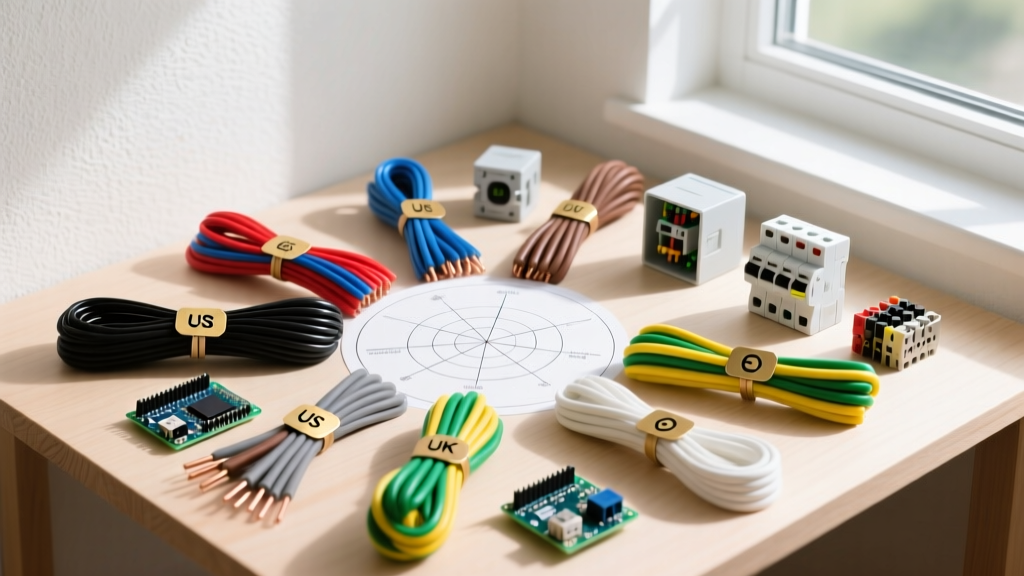

The standard US household wiring color code for 120V/240V circuits is Black (Hot), White (Neutral), and Bare Copper or Green (Ground). In the EU and UK (IEC standard), the colors are Brown (Hot), Blue (Neutral), and Green/Yellow striped (Ground). However, relying on color alone without verifying the standard, age of the installation, and local code exceptions is a leading cause of electrical shock and panel fires.
This reference provides the exact color mappings, the specific rows that cause fatal mistakes, and a concrete decision path for selecting the right wire for your next project.
The Master Household Wiring Color Code Table (NEC, IEC & Old UK)
The table below maps conductor functions across the three most common residential standards. Always verify which standard applies to your region and the specific year your property was wired.
| Conductor Function | US & Canada (NEC) | EU & UK (IEC 60446) | Old UK (Pre-2004) |
|---|---|---|---|
| Line / Hot (Phase 1) | Black | Brown | Red |
| Line / Hot (Phase 2 / 240V) | Red (or Blue) | Black | Yellow |
| Neutral (Grounded) | White (or Gray) | Blue | Black |
| Ground (Equipment) | Bare Copper or Green | Green/Yellow Stripe | Green (or Bare) |
| Switched Hot (Traveler) | Red, Black, or Blue | Brown, Black, or Gray | Red or Yellow |
Rows People Get Wrong (And the Hazards They Create)
Color codes are frequently violated in the field. Here are the most dangerous misinterpretations and how to handle them safely.
1. The White Wire Used as a Hot Conductor
In standard 12/2 or 14/2 NM-B cable, the white wire is strictly the neutral. However, in 240V baseboard heaters or switch loops, electricians use the white wire as a second hot or an always-hot feed. According to NEC Article 200.7(C)(1), when a white wire is used as an ungrounded (hot) conductor, it must be permanently re-identified with black paint, tape, or a permanent marker at every termination point. If you see a white wire connected to a brass (hot) screw on a receptacle or a breaker, treat it as lethal until proven otherwise.
2. The Old UK Black Neutral vs. US Black Hot
If you are working on a property in the UK (or a historic US property wired with imported British materials pre-1960s), a Black wire is the Neutral. In the modern US NEC standard, Black is the Hot. Bonding a US-style Black hot wire to a ground bus because you assumed it was an old UK neutral will result in an immediate, massive short circuit and severe arc flash hazard.
3. 3-Way Switch Travelers
In a 3-way switch setup using 12/3 or 14/3 cable, the Red and Black wires act as 'travelers' carrying the hot feed between switches. Neither is a neutral. Novices often cap the Red wire, assuming it is a spare, which breaks the circuit, or worse, they land it on the neutral bus bar, creating a dead short the moment the switch is toggled.
Safe Interpretation When Wire Markings Are Faded or Missing
Sun exposure, heat degradation in attics, and decades of paint overspray can destroy wire insulation colors. When visual identification fails, follow this strict verification protocol. Never guess.
- De-energize and Lock Out: Turn off the main breaker or the specific branch circuit breaker. Verify the panel is dead.
- Continuity Test for Neutral: Set your multimeter to continuity (the beep setting). Place one probe on the suspected neutral wire and the other on the known bare copper ground wire or the panel's neutral bus bar. A true neutral will read < 1.0 ohms. A hot wire will read 'OL' (Open Loop).
- Energize and Test for Hot: Restore power. Use your NCVT to scan the exposed wire ends. The hot wire will trigger the red LED and audible alarm. The neutral and ground will remain silent.
- Voltage Verification: Switch your DMM to AC Voltage (V~). Measure between the suspected Hot and Neutral. You should read 114V to 126V (US nominal 120V). Measure between Hot and Ground; it should read the same. Measure between Neutral and Ground; it should read < 2.0V. If Neutral-to-Ground reads >5V, you have a loose neutral connection back at the panel.
Decision Tree: Picking the Right Wire for Your Next Connection
Stop guessing at the hardware store. Use this decision matrix to select the exact wire type, gauge, and product for your specific household wiring project. All recommendations assume standard US residential NEC compliance for copper conductors at a 60°C/75°C ampacity rating.
| If Your Scenario Is... | Then Your Concrete Pick Is... |
|---|---|
| Wiring a standard 15A living room or bedroom receptacle (New Construction/Remodel) | Buy 14/2 NM-B (e.g., Southwire 14/2 Romex SIMpull). Black to brass, White to silver, Bare to green. |
| Wiring a 20A kitchen countertop, bathroom, or garage receptacle | Buy 12/2 NM-B (e.g., Southwire 12/2 Romex SIMpull). Do not use 14 AWG on a 20A breaker. |
| Hardwiring a 240V baseboard heater or window AC (No neutral required) | Buy 12/2 NM-B. Connect Black to L1, and re-identify the White wire with red electrical tape to connect to L2. Connect Bare to Ground. |
| Running a 30A dryer or 40A range circuit | Buy 10/3 NM-B (for 30A) or 8/3 NM-B (for 40A/50A). This provides Black (L1), Red (L2), White (Neutral), and Bare (Ground). |
| Pulling wires through 1/2' EMT metal conduit (Exposed basement/garage runs) | Buy individual 12 AWG THHN wires (Southwire SIMpull THHN). You need exactly one Black, one White, and one Green per circuit. |
For comprehensive safety standards regarding conductor identification and ampacity derating, always cross-reference your local building codes and the OSHA electrical safety guidelines before energizing any newly installed circuit.


