
The Core Definition: Unidirectional Electron Flow
When searching for a reliable example of a direct current (DC), it is essential to first understand the fundamental physics that separate it from alternating current (AC). In a DC circuit, electrical charge flows strictly in one continuous direction. While electron flow physically moves from the negative terminal to the positive terminal, conventional current is modeled as flowing from positive to negative. Unlike AC, which periodically reverses direction and crosses zero volts (typically 120 times per second in a 60Hz system), DC maintains a constant polarity and a steady voltage magnitude over time. According to the foundational texts at All About Circuits, this unidirectional flow is the absolute bedrock of all modern digital electronics, electrochemistry, and portable power systems.
The Primary Example of a Direct Current: Electrochemical Cells
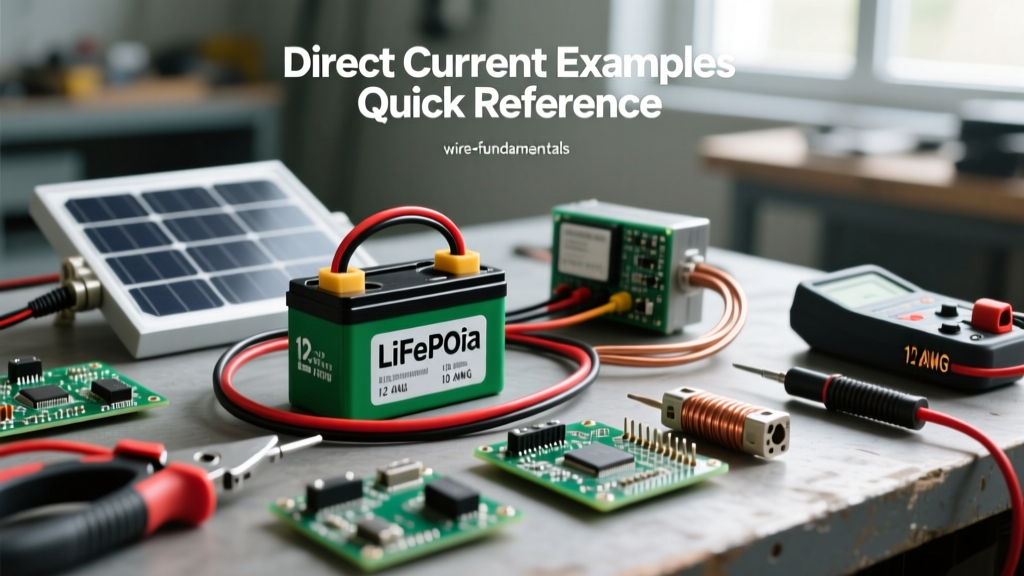
The most ubiquitous and accessible example of a direct current source is the electrochemical battery. Batteries generate DC through spontaneous redox (reduction-oxidation) reactions. Because the chemical reaction only proceeds in one direction until the reactants are depleted, the resulting electron flow is inherently unidirectional.
Lithium Iron Phosphate (LiFePO4) vs. Lead-Acid
Not all DC sources behave identically under load. The voltage profile—the way the DC voltage sags as current is drawn—varies wildly based on the internal chemistry and internal resistance of the cell.
- Lead-Acid (FLA/AGM): A standard 12V lead-acid battery consists of six cells in series (2.1V nominal each). Under a heavy DC load, the voltage can sag significantly due to higher internal resistance, dropping from 12.6V (resting) to below 11.5V during high-current cranking.
- Lithium Iron Phosphate (LiFePO4): A 12.8V LiFePO4 battery (four 3.2V cells in series) provides a remarkably flat DC voltage curve. It will hold steady at roughly 13.2V for 90% of its discharge cycle before rapidly dropping off, making it a vastly superior example of a stable direct current for sensitive RV and marine electronics.
Quick Reference Table: Common DC Sources and Profiles
| DC Source Type | Nominal Voltage | Internal Resistance | Typical Application |
|---|---|---|---|
| Alkaline Cell (AA) | 1.5V | High (150-300 mΩ) | Low-drain remotes, clocks |
| 18650 Li-Ion (NMC) | 3.7V | Very Low (15-30 mΩ) | Power tools, EV batteries |
| 12V AGM Lead-Acid | 12.6V | Low (3-5 mΩ) | Automotive starting, UPS |
| USB-C PD (PPS) | 3.3V - 21V | N/A (Regulated) | Laptops, modern DIY logic |
Solid-State and Electromechanical DC Examples
Beyond chemical batteries, the modern grid and DIY ecosystems rely heavily on solid-state and electromechanical DC generation.
Photovoltaic (Solar) Arrays
A solar panel is a classic example of a direct current generator. When photons strike the silicon P-N junction, they excite electrons, creating a unidirectional flow. The National Renewable Energy Laboratory (NREL) notes that while solar irradiance fluctuates (causing the DC current amplitude to vary with cloud cover), the polarity and direction of the current never reverse. A typical residential 400W panel produces roughly 40V DC at 10 Amps under Standard Test Conditions (STC).
Rectifiers and Switch-Mode Power Supplies (SMPS)
Wall adapters and computer power supplies do not generate DC natively; they convert AC mains power into DC. A bridge rectifier uses four diodes to force the alternating AC sine wave into a pulsating unidirectional flow. Capacitors then smooth this pulsation into a flat DC line. Modern USB-C Power Delivery (PD) chargers use high-frequency SMPS topology to step down and rectify AC into highly regulated, programmable DC voltages up to 48V.
Wire Sizing for DC: The Voltage Drop Factor
When wiring any example of a direct current, you must account for voltage drop. Because DC systems often operate at lower nominal voltages (12V, 24V, or 48V) compared to AC mains (120V/240V), the same amount of wire resistance causes a much more severe percentage loss of usable power. Furthermore, DC current utilizes the entire cross-sectional area of the wire evenly, whereas AC suffers from the 'skin effect' (though skin effect is mostly negligible at standard 60Hz frequencies).
Real-World 12V DC Sizing Scenario
Imagine you are wiring a 12V DC water pump that draws 15 Amps, located 20 feet away from your LiFePO4 battery bank. The total circuit length (positive and negative) is 40 feet. Using the standard copper voltage drop formula: VD = (2 × K × I × L) / CM, where K is the resistivity of copper (approx. 12.9 ohms per mil-foot).
- Using 10 AWG Wire (10,380 Circular Mils): VD = (2 × 12.9 × 15 × 20) / 10,380 = 0.74V drop. On a 12V system, a 0.74V drop is a 6.1% loss. This exceeds the strict 3% maximum recommended for sensitive DC electronics and motors.
- Using 6 AWG Wire (26,240 Circular Mils): VD = (2 × 12.9 × 15 × 20) / 26,240 = 0.29V drop. This represents a 2.4% loss, safely within the 3% threshold, ensuring the pump motor receives adequate voltage to start without overheating.
Always use a dedicated DC voltage drop calculator and size your wire based on the total round-trip distance, not just the one-way run.
Troubleshooting DC Ripple and Arc Hazards
Working with high-amperage DC requires specific troubleshooting techniques and safety awareness that differ vastly from AC systems. According to testing guidelines published by Fluke, verifying the purity of a DC signal is critical for microcontroller and logic circuit survival.
Measuring AC Ripple on a DC Line
If a DIY project's microcontroller keeps resetting, the DC power supply might be failing. A degraded smoothing capacitor in a rectifier circuit will allow 'AC ripple' to bleed into the DC line. To test this, set your digital multimeter (DMM) to AC Volts (V~) and probe the DC output. A healthy DC supply should read less than 50mV AC. If you read 1V or 2V AC on a 12V DC line, your filter capacitors have dried out and the DC is heavily distorted.
CRITICAL DC SAFETY WARNING: Direct current arcs are significantly more dangerous than AC arcs. Because AC voltage crosses zero 120 times a second, an electrical arc will naturally attempt to extinguish at every zero-crossing. DC has no zero-crossing; once an arc is struck (such as pulling a DC disconnect under load), it will sustain itself indefinitely, melting terminals and causing fires. Always use DC-rated breakers with magnetic blow-out chambers, and never disconnect high-current DC circuits while under load.
Polarity Reversal Protection
Unlike AC plugs, which are often polarized but can sometimes be flipped, DC barrel jacks and Anderson Powerpole connectors rely entirely on correct manual orientation. Reversing DC polarity can instantly destroy MOSFETs and logic gates. When designing DC circuits, always integrate a reverse-polarity protection mechanism, such as a series Schottky diode (which introduces a slight 0.3V drop) or an ideal P-channel MOSFET circuit, which provides protection with virtually zero voltage drop.